
Shakur Stevenson is insisting on respect rather than merely requesting it.
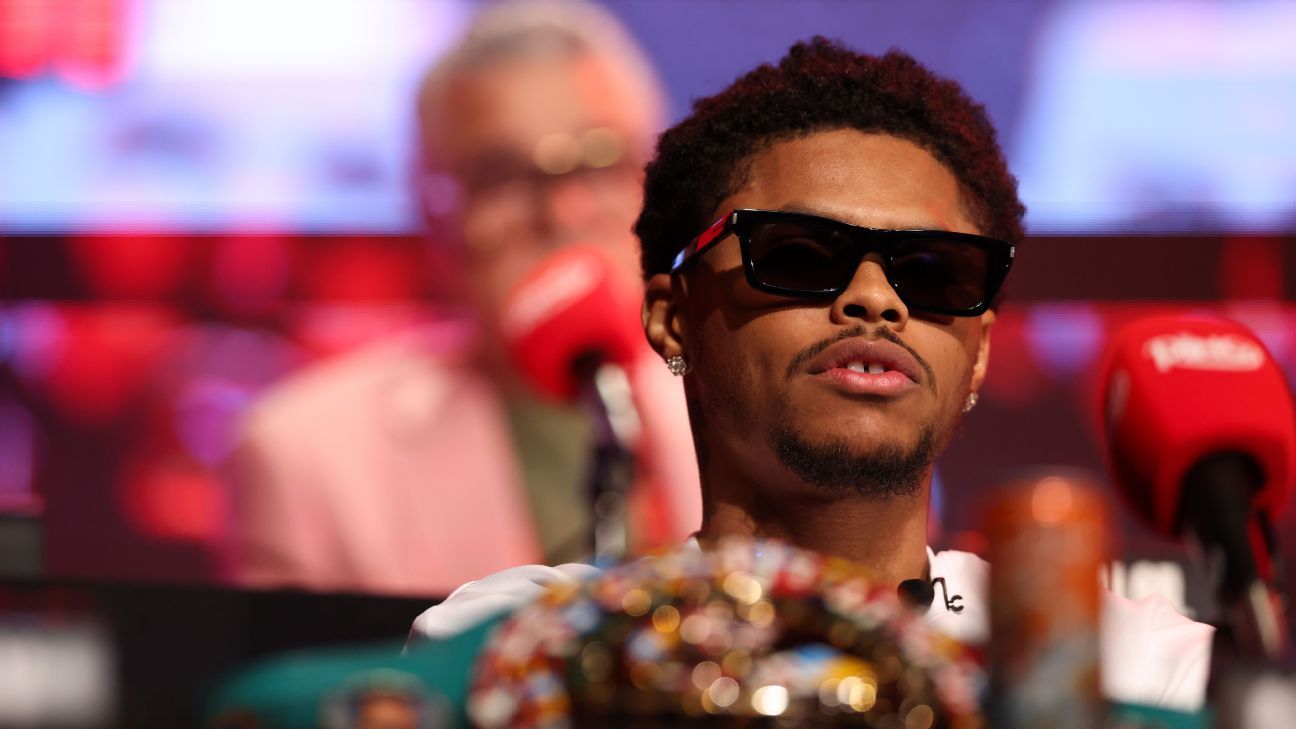
SHAKUR STEVENSON HAS been pursuing one goal for as long as he can remember. From his childhood days navigating the urban landscape of Newark, New Jersey, as the oldest of nine siblings, Stevenson has sought respect. Respect from his family, the fans, and most crucially, his fellow boxers.
Approximately five years ago, the boxing community designated Devin Haney, Ryan Garcia, Gervonta “Tank” Davis, and Teofimo Lopez Jr. as this generation’s “Four Kings,” a modern equivalent to the iconic group from the 1980s that included Sugar Ray Leonard, Marvin Hagler, Roberto Duran, and Thomas Hearns. These four fighters played a significant role in restoring boxing’s mainstream appeal following Muhammad Ali’s retirement in 1981.
Despite Stevenson’s superior amateur achievements, highlighted by a silver medal at the 2016 Olympic Games, and his exceptional skills as a ring strategist with immense potential, he was not included in this new elite group.
It might be fitting to view Stevenson (24-0, 11 KOs) as the contemporary equivalent of Wilfred Benitez, the unrecognized fifth king of the 70s and 80s, known for his remarkable defense and victories over Duran, as well as bouts against Leonard and Hearns. However, Stevenson dismisses such comparisons. He feels he should not be relegated to the sidelines of boxing royalty; he is boxing royalty. His mission is to dethrone those who have been placed ahead of him and assert his claim as the king of this boxing era.
“I felt disrespected during that time,” Stevenson shared with ESPN as he readies to face Lopez, the WBO junior welterweight champion, on Saturday at Madison Square Garden in New York. “Even though I wasn’t in the same weight class as them at that moment, we were close enough to compete against each other. I was achieving remarkable things, and I believed I was better than all of those fighters. I still hold that belief. But I used it as motivation.”
While this situation weighed on him, Stevenson continued to excel, securing world titles across three weight classes and achieving a level of success in his professional career that rivals, if not surpasses, that of his contemporaries. He has not lost a round, let alone a fight. Nevertheless, despite his accolades and his ranking as ESPN’s No. 7 pound-for-pound boxer, he has grown tired of being overlooked and dismissed as one of the top fighters of the new generation.
Even with all his achievements, the 28-year-old Stevenson is still striving for respect. Whether it comes from fans who label his style as “boring” or from peers who avoid facing him for various reasons, Stevenson is weary of asking and is prepared to start making his case, even if it means putting himself at a disadvantage.
“I don’t let that s— bother me anymore,” Stevenson stated. “I just keep moving forward and training hard. They have no choice but to acknowledge me. And after I win this fight, they won’t have any choice but to accept me and respect me.”
TRAINED BY HIS grandfather, Wali Moses, Stevenson’s boxing journey began when he was just a toddler. “He had already learned how to box in terms of preparing with me, so he didn’t start learning at age five; that’s when his boxing career began,” Moses told ESPN.
With elite defensive skills, adaptability, and exceptional boxing intelligence, Stevenson’s impressive amateur career peaked in 2016, making him the highest-medaling U.S. male boxer since Andre Ward won gold in the 2004 Olympic Games. His transition to the professional ranks has been flawless, maintaining an unblemished record as a three-division champion who is widely regarded as the most skilled boxer today.
The only drawback of being so advanced in the sport is that his superior abilities often diminish the excitement in his bouts. Lacking significant knockout power, many of Stevenson’s fights have seen him comfortably win by decision, leading to widespread criticism on social media regarding his reluctance to take risks for added excitement.
“He hears everyone say that he’s boring, too small, too defensive-minded, and lacks power,” Moses remarked. “He hears everything, and I think in the [William] Zepeda fight, he demonstrated what he is capable of. He is now out to make a statement. He had a fantastic start to his career, but these are the legacy fights. Everyone will discover who he truly is.”
While Stevenson may resonate with boxing purists who value his technical prowess, it has not been sufficient to satisfy casual fans who crave action in the ring.
His opponent on Saturday is celebrated as an exceptional entertainer, both inside and outside the ring.
“Success is all about entertainment,” Lopez told ESPN. Lopez, who refers to himself as “The Takeover,” has gained viral fame through his highlight-reel knockouts and post-fight celebrations. Coupled with his unique personality, Lopez is widely seen as one of the most thrilling fighters in boxing.
“We’ve seen it in the past when Shakur fought at Prudential Center in front of his hometown fans, and those people left his fights early due to his skill set. I think he feels a lot of pressure to entertain, so perhaps we’ll see something different from him [against me]. But from what I’ve observed, he’s not that exciting.”
This has all contributed to a label that no fighter wishes to have associated with them:
Boring.
Stevenson has acknowledged the criticisms and made adjustments. Following a dominant victory over Jeremiah Nakathila in June 2021 to secure an interim junior lightweight title, Stevenson faced backlash for not taking risks—only throwing 304 punches throughout the fight, according to CompuBox. In his subsequent fight six months later, he showcased an offensive display against Jamel Herring, whom Stevenson defeated in 10 rounds.
“I wanted an entertaining fight: to display my skills, my boxing, my power. I aimed to show everything tonight,” Stevenson stated after his victory over Herring. “I want to be a superstar in the sport; I’m here to stay.”
STEVENSON HAS ALSO altered his approach to securing fights.
After beginning his professional career with Top Rank, Stevenson became a free agent. Less than two months later, he entered into a promotional agreement with Eddie Hearn’s Matchroom Boxing.
“I think the main thing now, as I get older and understand the business, is that I need to brand myself effectively,” Stevenson explained. “And that’s something I’m going to focus on so I can be a superstar without worrying about how they want to arrange these fights. At the negotiation table, I want to have a certain level of leverage to secure the fights I truly want, and no one can say anything to prevent that.”
Stevenson recognized that the only way to secure the most significant fights would be by placing himself at a disadvantage to some extent. Whether it meant accepting lower pay (Oscar Valdez), agreeing to be a co-main event (Zepeda), or conceding size (Lopez), Stevenson understood that a level playing field would not provide the opportunities he sought. Instead, he would need to introduce an element of risk to his fights that had previously been absent.
In his latest bout in July, Stevenson engaged in an all-action contest with Zepeda as the unexpected co-main event to Hamzah Sheeraz’s fifth-round stoppage of Edgar Berlanga. The reasoning was that the event’s promoter, Turki Alalshikh, aimed to convey that he would not reward “Tom and Jerry-type boxing matches where one fighter is evading while the other is pursuing.” The typically outspoken Stevenson set aside his pride and accepted the fight.
“If you call me Jerry, then I’m whooping Tom’s ass,” Stevenson told DAZN days before his fight against Zepeda. “That’s what I’m here for, so Tom and Jerry, Jerry is whooping Tom’s ass for sure.”
Stevenson’s performance was praised even by his most ardent critics. More importantly, it demonstrated that Stevenson should never again be a co-main event. While that was intentional for Stevenson, it was not the fight strategy outlined by his team.
“I came in here to make a statement,” Stevenson said after winning a decision against Zepeda. “It wasn’t the performance I aimed for because I came in here trying to prove a point; I was trying to fight. So, I took more punishment than usual. But at the end of the day, I told you all whatever it takes to get the job done.”
WHEN MENTOR AND longtime sparring partner Terence Crawford moved up two weight classes to defeat Canelo Alvarez for the undisputed super middleweight championship last September, Stevenson realized that his ambitions could be even greater than he had previously thought. Crawford’s ability to transition from undisputed at 147 pounds to undisputed at 168 with just one fight at 154 pounds in between illustrated to Stevenson that skill can outweigh size. And if Crawford could achieve this, why couldn’t he?
“[Crawford beating Canelo] taught me a lot and confirmed what I already believed,” Stevenson remarked. “People tell you that size wins fights, but you come to understand that skills truly win fights. It wasn’t Bud’s size that defeated Canelo. It was his mastery of the craft—knowing when to box and when to accelerate. It showed me that I can do it too because I recognize how great I am.”
For the bout with Lopez, Stevenson will compete at 140 pounds, marking a career high. While some may think he is taking on more than he can handle, the idea that he cannot accomplish something serves as ample motivation to demonstrate that he can.
“My issue is if you tell me I can’t do something, I can’t help myself and can be persuaded into doing some foolish things sometimes,” Stevenson admitted. “I’ll move up to weight classes I shouldn’t be fighting in at all because of my competitive nature and someone talking trash to me. I have to show them that regardless of any advantages they possess, they will not defeat me.”
If he triumphs over Lopez, moving up another weight class to welterweight, where two other “Kings” reside, could be next for Stevenson. Garcia is set to challenge WBC welterweight champion Mario Barrios on Feb. 21, while Haney recently secured a one-sided victory over Brian Norman Jr. to claim the WBO title last November. As for Davis, his legal troubles may hinder him from entering the ring for an extended period.
Stevenson stated he has spent years calling out the biggest names in the sport. He is now prepared to place himself at a disadvantage to prove that he is superior to all of them.
“I still want those guys,” Stevenson affirmed. “I’m clearly not a 147-pounder, but I know there are fighters at 154 pounds that I believe I can defeat. I don’t plan on moving to 147 pounds or 154 pounds, but I intend to do what I need to do at whatever weight class I find myself in.
Stevenson is no longer requesting respect—he is demanding it. And if it is not granted to him, he will find a way to extract it from his opponents because the boxing ring is his sanctuary, and every fight serves as another testament to his greatness.
“The boxing ring is my comfortable place where I do extraordinary things.”

