
Muhammad Ali’s signed gloves to be showcased at the Obama Presidential Center
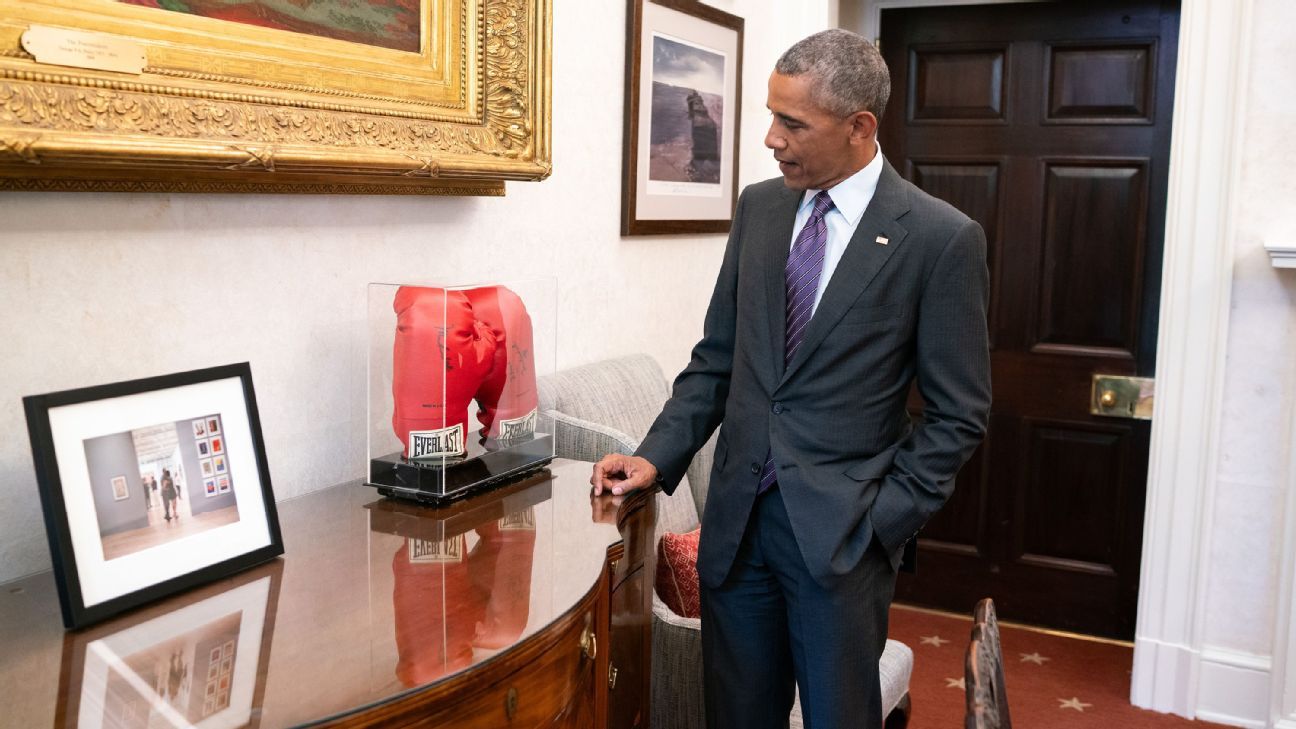
For many years, a set of red Everlast boxing gloves signed by Muhammad Ali remained quietly displayed in a private study adjacent to the Oval Office.
Inscribed simply with “To Barack,” these gloves represented more than just memorabilia for then-President Barack Obama; they served as a symbol of perseverance.
Shortly, the public will have the opportunity to view them up close.
Obama is lending the gloves to the Obama Presidential Center in Chicago, where they will be showcased starting in June.
This announcement coincides with the anniversary of one of the most legendary evenings in sports: February 25, 1964. At that time known as Cassius Clay, Ali triumphed over Sonny Liston to claim the heavyweight championship at the age of 22. This unexpected victory signified the emergence of a fighter who would transform not only boxing but also the broader cultural and political landscape.
More than sixty years later, Ali’s gloves serve as a concrete reminder of his influence.
For Michael Strautmanis, the chief corporate affairs officer at the Obama Foundation, the gloves hold both personal and historical significance.
“Muhammad Ali resonates personally with everyone,” Strautmanis stated to ESPN. “And I understood that the relationship it represented was particularly meaningful to President Obama. Thus, it was something he kept close to him.”
Ali’s 1964 win was merely the beginning. He would earn the title of “The Greatest,” not only for his speed and accuracy but also for risking his title and facing public criticism for his beliefs.
“Muhammad Ali’s activism and his abilities in the ring complement each other,” Strautmanis remarked. “He was prepared to endure hardship both inside and outside the ring for his principles.”
In a 2010 essay and again in a statement following Ali’s passing in 2016, Obama contemplated that legacy.
“Muhammad Ali was The Greatest. Period,” Obama expressed. “… He wasn’t flawless, of course. Despite his brilliance in the ring, he could be reckless with his words and full of contradictions as his faith evolved. However, his remarkable, infectious, even innocent spirit ultimately garnered him more admirers than adversaries — perhaps because in him, we hoped to see reflections of ourselves.”
Although the gloves are not linked to a particular match, Strautmanis describes them as profoundly symbolic. For Obama, that example held significance during times when, as he once humorously noted, he had to “slug it out here in Washington.”
“There were moments when I faced some tough challenges,” Obama joked while showcasing the gloves in a video shared on Facebook on June 9, 2016, shortly after Ali’s death.
During his presidency, the gloves were displayed in a private area near the Oval Office beneath the iconic photograph of Ali standing over Liston — an image captured during their rematch on May 25, 1965, in Lewiston, Maine. Since leaving the White House, they have remained in his Washington office, where Strautmanis has observed them more frequently in recent years.
“It never lost its significance for me,” he remarked. “I would always stop and reflect, thinking to myself, wow. I’m pleased that the world will have the opportunity to share that same experience.”
Their new location at the Obama Presidential Center reflects the role sports will play on the museum campus. The Center will include a full-size NBA regulation basketball court, along with various sports-related exhibits and artifacts.
“If even one person visits that museum, sees those gloves, and decides they want to be part of something greater than themselves,” Strautmanis stated, “then we will have accomplished more than our goal.”

