
Off the Field: Three U.S. Referees Discuss Their Experiences in Milan
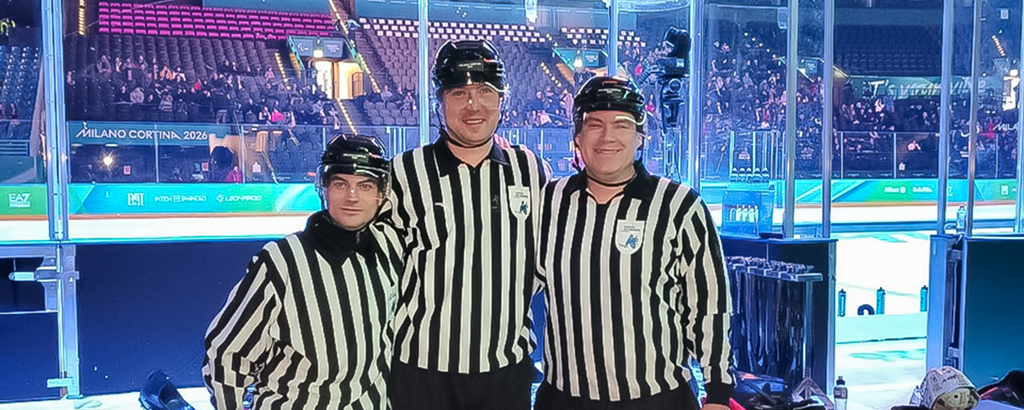
Earlier this year, the International Ice Hockey Federation revealed that 10 American officials were chosen to officiate the women’s and men’s hockey tournaments at the 2026 Olympic Winter Games. Melissa Doyle (White Bear Lake, Minn.) was appointed as a referee for the women’s tournament, while Jake Davis (Wyandotte, Mich.) was designated as a linesman for the men’s tournament. In February, the World Para Ice Hockey selected 2 American officials, including linesman Brendan Lewis (Hudson, Ohio), to officiate at the 2026 Paralympic Winter Games.
We spoke with Melissa, Jake, and Brendan to gain insights into their officiating journeys and experiences in Milan.
USAH: Describe what a game day looked like for you.
Doyle: Many of us gathered for breakfast at the hotel, where we coordinated our plans for the day. My game assignments varied significantly between the two rinks and game times, so ‘game days’ felt different each time. Sometimes, I would find someone to take a walk with or plan how to obtain food for the day. On certain days, I would try to fit in some stretching, work a few hours at my full-time job, or even watch other hockey games. Regardless, when it was time to hit the ice, I would walk to the rink with my officiating crew about two hours before puck drop. This allowed us ample time to warm up, get dressed, have our pre-game discussion, and be ready to take the ice!
Davis: A typical game day for me includes several elements. First, I aim to have a good breakfast and lunch. If I am already in town with our game crew, sharing meals is a great opportunity to discuss the upcoming game and its expectations. I usually prefer to take a nap before heading to the rink for the game. I like to arrive at the venue 90 minutes prior to puck drop with a coffee in hand. This provides me with sufficient time for pre-game discussions with my partners and to warm up physically to prepare for the game. After the game concludes, I spend some time reflecting on my performance to continue improving my skills. Once that reflection period is complete, I take time to decompress and then focus on the next assignment.
Lewis: My usual game day routine involves waking up, doing a brief stretch or workout to get the blood flowing. After that, I have breakfast or lunch depending on the game time and then prepare to head to the arena. I ensure I have everything I need to be at the arena for about 6-8 hours. We arrive at the arena 2 hours before game time, and I like to stay afterward to watch the next game or two. It’s not every day you get to be part of an event of this scale, so I wanted to absorb as much of it as possible. My pre-game routine starts about 90 minutes before we take the ice, which includes jogging, stretching, hydrating, and fueling. After confirming I am ready for the game, the officiating crew discusses potential issues to monitor. Working with officials from around the world, I ensure to communicate thoroughly about any possible challenges that may arise on the ice. After the pre-game, we proceed to work on the ice. Post-game, we receive supervision and discuss calls we made that were good, very close, or needed improvement. After that, we typically relax and watch the next game or, if we were officiating the last game of the day, head back to the village.
USAH: What is something about the Olympics that fans don’t see from the outside?
Doyle: One aspect that surprised me, which may not be apparent from the outside, was the logistics involved in getting from one location to another. We were fortunate that the main rink was only a 20-30 minute walk, while the other arena required a bus ride across a major city. For fans attending the games, this often meant taking a subway, train, and shuttle bus to reach a game.
Davis: One thing I was unaware of regarding the Olympics until I participated was the extensive preparation athletes undergo to compete. As a spectator, you witness thrilling performances from the athletes, but you do not experience the pressure they face during these events. As an Olympic official, I felt that same pressure, and without the significant amount of physical and mental preparation I undertook, I might have struggled in my duties. This preparation is essential for building confidence and skills for the Olympic games, and it occurs before, during, and after the competition.
Lewis: The dedication the athletes exhibit to achieve their goals. These athletes deserve recognition and should be in the spotlight just as much as able-bodied athletes. What they have overcome is truly deserving of attention. Each of them has a unique story, and being able to converse with some of them about their experiences was one of the highlights for me. On days when I was backing up a game and not officiating, it was incredible to be part of the atmosphere present in the arena. The fans genuinely celebrated the sport and created an unforgettable arena experience.
USAH: Did you get the opportunity to attend any other events, sightsee or explore?
Doyle: We were fortunate to attend the Opening Ceremonies. Our credentials only permitted access to hockey games. However, I did trade pins to gain entry to speed skating one day! On my off days, I took some day trips around Northern Italy. The lakes surrounded by snow-capped mountains were a delightful experience for me coming from Minnesota. I also enjoyed a day trip to Verona (the city hosting the Closing Ceremonies) and Venice.
Davis: I had the chance to explore Milan during my free time. I visited landmarks such as the historic Duomo de Milano Cathedral and the Arch of Peace, where the Olympic Flame was displayed. I also went to Lake Como on an off day, which is a beautiful small town at the foot of the Alps.
Lewis: We did some sightseeing on our days off and had a fantastic time visiting the Olympic cauldron and the Duomo di Milano. Both locations were impressive to see in person, especially after having watched them on TV during the Olympics’ opening ceremony.
USAH: How did the USA Hockey Officiating Program prepare you for the Olympics/Paralympics?
Doyle: My officiating journey began and will continue with the USA Hockey Officiating Program. I am a strong proponent of the summer officiating development camps. There, I connected with the female officiating community and received coaching from top-level officials after each game. The USAH Officiating Program provided me with opportunities such as officiating at USAH Nationals, the Rivalry Series, and the early women’s professional leagues. The USAH Officiating Program has also excelled in partnering with other leagues to further develop their officials and ensure we have access to high-level games before the Olympics.
Davis: My involvement in the USA Hockey Officiating Program over the past twenty years has significantly prepared me for success at the Olympics. Without their instruction and support, I would not have had this opportunity, nor would I have been equipped to officiate at this level of hockey. I am thankful for all the USAH officiating seminars and camps I have attended over the years. Learning from the best officials in professional, collegiate, and international hockey has provided me with a foundation to serve the game to the best of my abilities. I appreciate the hours of instruction, mentoring, and coaching I received from the USAH Officiating program staff. These skills are essential for success in officiating, and I feel a responsibility to pass this knowledge on to the next generation of officials.
Lewis: The USA Hockey Officiating Program has always been advantageous for me. Starting about 15 years ago when I first began officiating junior hockey and progressing to the USHL, I learn something new every time I step on the ice. The USA Hockey Officiating Sled Hockey Camp was crucial in preparing me to officiate sled hockey at the Paralympics. Without that introduction to high-level sled hockey players from USAH, I am uncertain if I could have reached my current position, having just completed officiating a Paralympic Games.
USAH: How do you plan to share your knowledge and experience with other officials?
Doyle: I have served as a USAH seminar instructor, mentor, and have been involved in the USAH national female officiating development program for several years. In my local chapter, I also act as a female officiating development coordinator. These are ways I have already been sharing my experiences. I hope to continue these efforts and find additional ways to give back.
Davis: After reflecting on this Olympic experience and how USAH has contributed to my development as an official, I feel compelled to give back to this sport I cherish. As a teacher by profession, I am enthusiastic about sharing knowledge with others so they can learn and grow. I would like to continue my service to USAH as a role model, mentor, and instructor at the grassroots level to inspire aspiring officials to pursue their goals. My hope is to play a part in their success, thereby enhancing the game for future generations.
Lewis: Since returning home, I have already begun sharing my experiences with other officials. Simply discussing it with fellow officials who inquire is the best way to convey the knowledge I have gained over the years and at the Paralympic Games. Assisting new referees in staying engaged with the sport and continuing to officiate games is something I am passionate about, and I enjoy helping to develop the next generation of officials.
