
Drop the Puck: Faceoff Advice From Jennifer Cameron-Ward
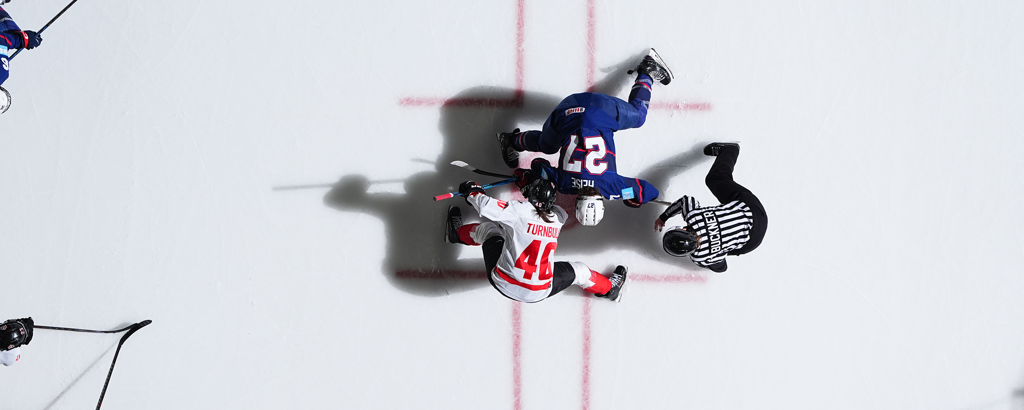
Few plays in hockey are as important the faceoff. While they can occur dozens of times in any particular game, each one could be the one that changes the outcome.
Most of the attention during faceoffs is on the players taking the draw — strategically getting into position, sizing up their opponent and springing into action at the exact right moment to make first contact with the puck and help secure possession for their team. But we can’t forget about the officials, who are responsible for executing the perfect drop, time after time, regardless of the situation. They feel the tension too.
“For all officials, I think every moment matters, and as a linesperson, the faceoff is kind of our moment,” said Jennifer Cameron-Ward, a Hollywood, Fla., native who was one of 10 American officials selected by the International Ice Hockey Federation to officiate at the 2026 Olympic Winter Games in Italy. “It’s a moment in the game where everything is actually frozen, yet it can be one of the most stressful.”
Managing the Moment
Cameron-Ward, who has been an official since the early 1990s, and has worked PWHL and Frozen Four contests as well as games at various collegiate and youth levels, says it’s important for referees and linespeople to stay calm, poised and as consistent as possible on the ice, regardless of the stakes or situations.

According to Cameron-Ward, linespeople should aim to set a tone early in every game to help hold players’ accountable. She says it’s helpful to find times before or during a game to remind players and/or coaches what’s expected in the faceoff circle, to avoid frustration or controversies later.
“It’s important to communicate, and do so with clarity, so it’s easy for everyone to understand,” said Cameron-Ward. “Small things like reminding centers to keep their feet square or wingers to stay behind the circle. Explaining to them that they’re being warned because they’re doing x and all you have to do is y and we’ll be good. Sometimes there’s also an opportunity to use a little humor. But every person and every situation will be different.”
“You can calm a players’ nerves by letting them know, ‘I’m not a bad person, I’m just here to drop some pucks, we’re going to make it fair, but I need you to do your part,” she added. “Sometimes just hearing that calms the situation and gets everyone on the same page.”
Nobody’s Perfect
The ideal puck drop, according to Cameron-Ward, is one that’s “flat, in the middle and doesn’t bounce or slide around.”
“You also want to make sure the players are in the right positions, the wingers aren’t encroaching and the centers are square to each other with their sticks on the ice,” she said.
But Cameron-Ward is also quick to point out that there really isn’t a perfect faceoff.
“You’re never going to get that,” she said. “The goal is to make it fair, so that way every drop you know the best person won it. They knew exactly what to expect from you, you knew what to expect from them and the better team will take advantage.”
Cameron-Ward believes it’s important that officials keep these situations in perspective, and don’t expect perfection.
“You’re putting way too much pressure on yourself to expect every faceoff to go exactly as you want,” she said. “Especially when you’re trying to develop and wanting to do a good job or working a higher-level game, you already put pressure on yourself. It’s when we strive for perfection where things can build and lead to frustration, and then the players can feel that and it becomes an avalanche effect. If you focus on making every faceoff fair, rather than perfect, the game will go well and you’ll do just fine.”
Advice for Newer Officials
Mistakes in a game will happen – by players, coaches and of course, by officials. Cameron-Ward says it’s important for officials to be accountable themselves, and “own” their mistakes.
“It’s important to be able to say, ‘hey that was my bad, I didn’t like that drop, that’s on me,’” she said. “And then tell the players that we’ll fix that moving forward. Obviously, then it needs to be fixed, you can’t keep making the same mistake over and over or you’ll lose credibility. But I think owning it and having that conversation can go a long way.”
Cameron-Ward, who also teaches high school special education in her current home state of Massachusetts, relishes the opportunity to play a teaching role with younger or newer officials, as others did for her early in her career.
One thing she advises younger officials to do more often is simply ask for help when they need it.
“There are a lot of supervisors and mentors out there who are willing to provide advice or come watch you work a game, they just need to be asked,” she said. “You want to be able to pay it forward. If someone asks me for help or guidance, and I’m able to do it, I will. Or if there’s a conflict, I have a network of officiating colleagues I can reach out to who would also be willing. I’m always telling my students to advocate for themselves and ask questions. I do wish a lot more officials who are trying to improve and enhance their skills would do that too.”
Cameron-Ward suggests officials who are still developing their game try to focus on being consistent and communicate with players and officiating partners to ensure alignment. This can be particularly important in a three-person system, where there are multiple officials dropping pucks over the course of a game.
“We’re trying to drop pucks with the same rhythm, use the same routine and the same language with players,” said Cameron-Ward. “We want to give them the same expectations, because that’s where consistency will build. When players have that I think they adapt well. Most people like to have rules and routines and guidelines to follow. It’s when you take that away that you lose your rhythm and things start to go sideways.”
