
Trinity Rodman’s historic NWSL contract: Implications for her and the league
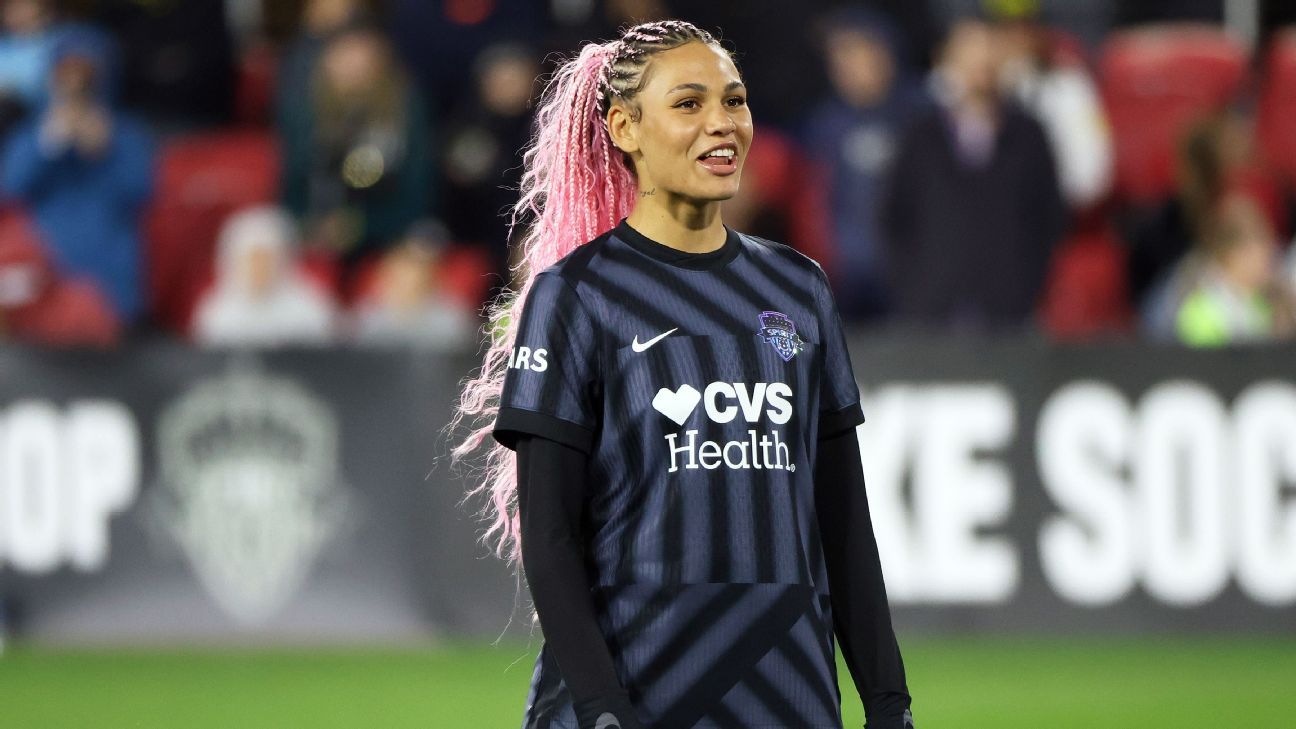
The intricate transfer saga in the history of the NWSL reached its conclusion on Thursday: U.S. women’s national team forward Trinity Rodman and the Washington Spirit announced the signing of a new contract that will see Rodman return to the team.
Rodman and the Spirit have finalized a three-year agreement with an annual salary exceeding $1 million, positioning Rodman as the highest-paid player in NWSL history and the highest-paid player globally.
Rodman’s return is a significant achievement not only for the Spirit but also for the NWSL, which nearly mishandled the situation to the extent that the league’s prominent figure could have departed despite her evident desire to remain. In recent months, the NWSL adhered to its salary cap principles while hastening the introduction of a new rule to compensate star players—only for that solution to face opposition from the NWSL Players Association. The union has lodged two separate grievances against the league, and a lengthy arbitration process seems to be on the horizon for all parties involved.
At least Rodman’s future is now resolved, bringing closure to a narrative that captivated audiences worldwide as they awaited a superstar’s next steps and a league’s pivotal decision.
What implications does Rodman’s return to the Spirit, her sole professional team thus far, hold for her, for Washington, and for the NWSL? Let’s explore.
Rodman establishes herself as the face of the NWSL
The NWSL may attempt to deny it, but the establishment of the High Impact Player (HIP) rule was primarily driven by the urgent need to retain Rodman. This new regulation will permit NWSL teams to exceed the salary cap by up to $1 million for elite players who fulfill specific criteria, such as Rodman. Just as MLS’s Designated Player rule is informally referred to as the “Beckham Rule” after the league devised a new method to sign David Beckham, the High Impact Player rule will similarly be recognized as the “Rodman Rule.”
As the NWSL scrambled to devise a strategy to keep Rodman amid a league-generated crisis, it became increasingly apparent that Rodman wanted to remain with the Spirit, which rendered the NWSL’s failure to navigate the situation all the more perplexing.
Rodman has made Washington, D.C. her home and has emerged as the face of the NWSL, leading the next generation of USWNT stars who engage audiences beyond the core NWSL fanbase. In recent years, the NWSL has witnessed the retirement or departure of several of its biggest stars to international clubs, yet Rodman continues to resonate with casual fans in the broader sports community.
Rodman will now continue as the NWSL’s premier star, a notion some may dismiss as irrelevant to her on-field contributions, but one that is undeniably integral to the sports marketing landscape. At just 23 years old, she steps into a role that carries on the legacy of the previous generation in advocating for fair compensation and equitable pay, compelling the NWSL to reassess its salary limitations.
On the field, the NWSL is also a fitting environment for Rodman. While playing soccer abroad can enhance a player’s skills and expose them to diverse playing styles essential for their development, particularly in preparation for a World Cup, Rodman can still pursue that opportunity in the future. She previously indicated to ESPN in early 2025 that a move overseas is a matter of timing rather than possibility.
Rodman’s dynamic one-on-one play and exceptional goal-scoring ability in critical moments align well with the NWSL’s fast-paced, transitional style. She is a versatile forward capable of outmaneuvering opponents in open spaces and tight situations on the wings, and she has proven herself as a goal-scorer with a diverse array of finishing techniques. A fit Rodman should be a contender for both the MVP and Golden Boot awards—a player deserving of a new roster rule named in her honor.
Moreover, there is a legacy aspect to this development. Rodman’s new contract establishes her as the highest-paid player in the league and, more significantly, reshapes the framework for the NWSL’s future.
This outcome would not have been possible without Rodman’s talent and determination, nor without the resolve of her agent Mike Senkowski, Spirit owner Michele Kang, and a Spirit front office that brought in president of soccer operations Haley Carter during the process. Their ability to compel the league to alter its operational methods will be regarded as a pivotal moment in the NWSL, reminiscent of Olivia Moultrie’s legal battle in 2021 that forced the NWSL to permit teenagers to play professionally.
In the years to come, the struggles of Rodman and Moultrie will serve as case studies in sports law and crisis management courses, illustrating the triumph of players against the suppression of their wages and rights.
The right outcome to the wrong struggle for the NWSL
Rodman’s decision to remain in the NWSL is a victory for the entire league, not just Washington. While opponents may not cheer for her success, Rodman’s return elevates the profile of the league, particularly as Berman and team owners express their aspirations for a substantial new media rights agreement. Stars enhance media value.
This league has long proclaimed itself the best in the world, but as one general manager questioned in our anonymous survey last year: what actions is the league taking to substantiate that claim? (That GM voted for England’s Women’s Super League as the best in the world.)
Allowing Rodman, a star who wanted to stay, to leave after the recent exits of Naomi Girma and Alyssa Thompson to Chelsea, and Sam Coffey to Manchester City, would have plunged the NWSL into a state of panic. The league has been losing stars to international teams and appeared uncertain about how to respond—until the introduction of the Rodman Rule, as it will henceforth be referred to.
In the long run, Rodman’s choice to stay and her advocacy for fair compensation represent a turning point for the league. The Rodman Rule could herald a new era of star players and, at the very least, could normalize million-dollar salaries. (Consider the contrast to the NWSL’s inception in 2013, which featured a $6,000 annual minimum salary.)
 play0:54Has injury cost Trinity Rodman her top 10 Women’s Rank spot?
Futbol W’s Cristina Alexander and Ali Krieger, along with Natalia Astrain, discuss Trinity Rodman’s drop from 8th to 37th in ESPN FC Women’s Rank.
If MLS serves as a reference point—and this new rule appears to be inspired by MLS’s earlier strategies with Beckham—this is merely the beginning of more comprehensive roster mechanisms to come. The NWSL has opted for a path of controlled spending and ongoing adjustments rather than completely eliminating the salary cap.
According to our anonymous GM survey, most sports executives believe it is preferable to raise the cap rather than abolish it. However, several sources within the league have labeled the High Impact Player rule as “a Band-Aid.” They argue that while the additional $1 million per team each year will be beneficial, it will need to increase within a year or two to maintain competitiveness.
Top clubs in England, some sources indicated, do not need to significantly increase their salary expenditures to remain competitive for top salaries, and those English clubs are not bound by a salary cap like the NWSL. Additionally, the markets for player salaries and transfers continue to expand at unpredictable rates. Just observe how frequently the world transfer record has been broken in the past year alone. Some sources view this more optimistically, suggesting that the HIP rule can be adjusted as the market evolves.
The NWSL also confronted one of its longstanding weaknesses during this situation. The league has been overly reactive since its inception over a decade ago: decisions regarding salary caps, schedules, or fundamental roster rules take too long, and discussions often extend until they must be resolved under pressure. A truly world-leading league should be far more proactive than it has historically been or was in this instance.
Rodman signed her previous contract four years ago. She indicated nearly a year ago that she was contemplating a move to Europe at some point, and even the most naive observer could interpret that as a strong leverage point for her upcoming negotiations. The NWSL assumed that Rodman would remain based on what Berman has described as a broader “value proposition” of competition and media exposure, but financial incentives are compelling.
Berman stated before the NWSL Championship that the league would “fight” for Rodman. From an external perspective, the NWSL appeared to be a fighter in the corner of the ring attempting to avoid contact until the final moments before the bell, hoping for a favorable split decision. The Spirit, Rodman—and even the NWSLPA—persistently pressured the league.
The league’s most unfavorable moment occurred in early December when the NWSLPA filed its first grievance after Berman vetoed an agreed-upon contract between Washington and Rodman due to its violation of the “spirit” of the rules. The union has also submitted a grievance opposing the HIP rule, arguing that the cap should simply be raised by $1 million without restrictions.
Many executives have informed the NWSL that the salary cap established in the CBA is too low, and it was anticipated to be inadequate when the CBA was signed. Most general managers expressed similar sentiments in our recent anonymous survey, as did NWSLPA executive director Meghann Burke in recent interviews. The salary cap was intended as a baseline that would rise through media rights and at the discretion of the owners.
The Spirit can now strategize for the future
Washington finished second in the league and as runners-up in the NWSL Championship for the past two years—both times with Rodman managing injuries during the final stretch of the season. She played limited minutes in the 2025 playoffs, yet the Spirit showcased their depth and tactical prowess, nearly securing the title before losing to Gotham 1-0 in November’s final.
Now, envision Washington with a healthy and newly invigorated Rodman. The “healthy” aspect is crucial here, which may lead some to view the scale of the Spirit’s investment as a risk. However, injuries are part of the game, and the sprained MCL she sustained in October is merely an unfortunate occupational hazard that all players encounter.
Rodman returned from the summer break feeling that her chronic back issues were under control, and her strong performance (from her very first minutes on the field in August) supported that assertion. She is back with the USWNT in training camp this week for the first time since April.
Now, Rodman is positioned for the long term to help deliver another championship to the Spirit after winning a title as a rookie in 2021, making Washington even more formidable in attack. Gift Monday and Rosemonde Kouassi were outstanding for Washington in the playoffs. Now, consider the addition of a fully fit Rodman back into the mix along with a complete season from Croix Bethune and Sofia Cantore. Furthermore, there is the long-term potential of new signing Claudia Martínez, an 18-year-old Paraguayan forward.
The vision is clear. This is a team pursuing championships and sustainability. Rodman is a foundational element of that pursuit.
Importantly, retaining Rodman through this rule change means that the Spirit do not have to compromise the rest of their talented roster to compensate one star. The HIP rule allows for as little as 12% of Rodman’s salary to impact the salary cap. With that financial flexibility and Rodman secured, Carter can continue to plan for the long term, as she successfully did in Orlando previously.
Sources have previously informed ESPN that, regardless of the outcome of the HIP rule in potential arbitration, the league must honor existing contracts. One way or another, a larger pool of funds is forthcoming for NWSL players.
Beyond the field, and looking beyond just Rodman, the retention of the 23-year-old represents a significant immediate success for Carter and her staff, who officially began their roles on December 1. It also reinforces the influence and ambitions of Kang, who is one of four members on the NWSL board’s executive committee. Both are innovators who find themselves on the winning side of change. This achievement is likely just one of many. Furthermore, to eliminate any doubt, the Spirit have made it clear that their aspirations will not be entirely limited by the NWSL’s current framework.
