
Teofimo and Shakur transitioned from sparring partners to contenders vying for dominance in boxing.
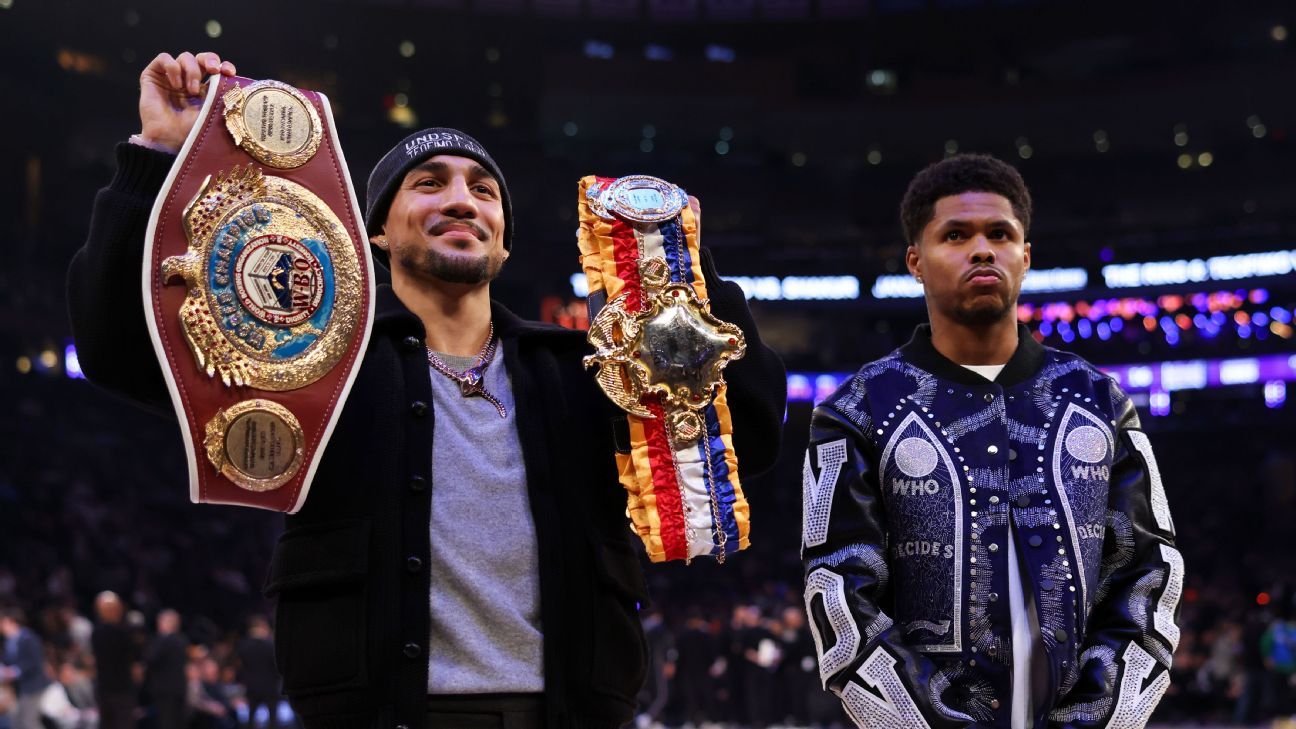
In the early spring of 2016, Herman Caicedo’s gym in Miami was bustling with activity. Champions, contenders, and hopeful Olympians from various regions, including Asia and the Americas, filled the space. However, the standout of that day was an amateur bantamweight from Newark, New Jersey: an 18-year-old with a youthful appearance — I use the term literally, as he might have shaved once, but only in hopes of stimulating some growth. That was Shakur Stevenson.
“He completed at least 40 rounds of sparring — nonstop, never leaving the ring,” recalls Caicedo, the seasoned trainer. “He did eight or ten rounds with my champion, Juan Carlos Payano.”
He then faced Claudio Marrero — who had a record of 19-1 as a junior lightweight — for another eight rounds. Chucky Flores? — Moises Flores, from Guadalajara, Mexico, who was 24-0 at that time — and Yenifel Vicente, a super bantamweight veteran with 27 wins, also faced him for at least eight rounds each.
“Weren’t there also a couple of fighters from Kazakhstan?” I inquire.
“Yes,” Caicedo confirms. “He provided them with good work as well. And he didn’t even appear fatigued.”
Despite being just a kid among seasoned fighters, Stevenson consistently matched or exceeded their efforts. The final opponent he faced that day was another youthful fighter, Teofimo Lopez Jr., from Florida but originally from Brooklyn, New York, who was also competing for a place on the Olympic team. Lopez, a lightweight, was just 32 days younger. Accounts of how the sparring session unfolded vary depending on who you ask (not unlike boxing judges, in fact). A friend who informed me about this remarkable session — consisting of four-minute rounds with 30 seconds of rest in between — recalls Stevenson having the upper hand against Lopez. However, Caicedo, who is on record, has a different recollection: “Look, it was good work, not some kind of drag-out fight. Shakur had just completed 40 rounds, while Teo was fresh. But it was likely Teo who had the better performance. Shakur was very well-rounded, well-trained, with no mistakes. But Teo appeared a bit quicker, more athletic, more explosive, more Roy Jones-like, you know what I mean? I left impressed with both of them.”
One must be cautious when drawing conclusions from sparring sessions. I understand that. The most courageous fighters I’ve witnessed — Muhammad Ali and Evander Holyfield — were both notoriously underwhelming in the gym. Still. A decade later, that day in Miami speaks volumes about each fighter, regarding their development and how they will fare in their 140-pound title fight Saturday night at Madison Square Garden. If they were princes back then, they are now battling to become kings, aiming to be recognized as the successors (at least in this hemisphere) to Terence Crawford and the ever-present legacy of Floyd Mayweather Jr.
“We signed both fighters believing they could achieve greatness,” states Carl Moretti, the Top Rank vice president who signed them both after the 2016 Olympics. “However, the reality is, they are even better than we anticipated.”
That they are no longer regarded as Top Rank fighters is a different narrative, a disappointing one at that. Nevertheless, the broader point remains. All the discussions earlier this decade about a new Four Kings era (or was it five?) turned out to be a typical boxing illusion. Yet Stevenson and Lopez, both now 28, embody the finest of their generation, the most accomplished fighters with the most extensive résumés. “Two fighters in their prime willing to face each other,” Lopez tells me. “It benefits the sport. It sets a standard.”
I must acknowledge that such standards are supported and made feasible by the Saudi financier, Turki Alalshikh. However, the compelling aspect here is the fighters themselves — not just their skill, but the significant differences in their temperaments and career trajectories that appear to be opposites.
Stevenson is reminiscent of the young fighter from 2016. If there is something almost heroic about his sparring, it stems from his unwavering passion for the sport. “His life revolves around boxing,” says Antonio Leonard, Stevenson’s co-promoter from the outset. “He’ll go anywhere, never declines an opportunity. I’ve seen him spar [Gervonta] ‘Tank’ Davis — twice — in Baltimore. Tank couldn’t handle Shakur. I recall when he first started sparring with Terence.”
Crawford, he refers to. “I asked, ‘Terence, you’re taking it easy on him, right?'”
“Hell, no,” Crawford replied. “I’m trying to take him out.” Stevenson, unlike Crawford, is not particularly aggressive. He won’t finish you with a single blow. And if you still wish to critique his unimpressive victory over Edwin De Los Santos, recognize that he still won comfortably despite injuries to his power hand, the left, and shoulder. Also, understand that he perceives distance as Albert Einstein understood physics. He is the best defensive fighter of his generation, and as a result, the most evaded. Fighters do not fear being beaten; they fear humiliation, appearing foolish and powerless. That is what makes Stevenson an exceptional fighter.
Currently, a photograph is circulating online: Mayweather, Andre Ward, Crawford, and Stevenson. It has solidified the belief that he is next in line, a potential all-time great, a pound-for-pound No. 1. That may indeed be the case, but only if he performs as the oddsmakers anticipate and defeats Lopez. And that in itself — predicting Teofimo — is the most perplexing of challenges.
Lopez is approximately a 2-1 underdog against Stevenson, according to DraftKings Sportsbook. In other words, Stevenson is a larger favorite against Lopez than Lopez was in his previous fight against Arnold Barboza Jr. Now consider this: Lopez was a 4-1 underdog in his signature victory over Vasiliy Lomachenko.
“He kept requesting Loma when nobody believed he had a chance — so what does anyone truly know?” questions Lopez’s manager, Keith Connolly. “The reality is, we’ve defeated the unbeatable southpaw twice.”
In 2020, it was Lomachenko. In 2023, it was the best (or so it was believed) 140-pounder in the world, the highly tested former Olympic gold medalist, Josh Taylor. I will always recall the lead-up to that fight, Teofimo sharing his low-key fantasy of dying in the ring. Then he had a confrontation with his father/trainer, Teofimo Lopez Sr., on camera. I thought he was unraveling and destined to lose. Then he easily defeated Taylor.
This highlights the contrast between Lopez and Stevenson. While Stevenson is rational, always calculating, and focused on boxing, Lopez is performative, charismatic, and often surrounded by family drama. Stevenson desires nothing more than to be a great fighter. Lopez shares that ambition, but even more so, he seeks love and admiration.
Some years ago, Stevenson lost his titles on the scales. He had been urinating blood for hours and reached a point where merely attempting to make weight was jeopardizing everything he cherished. In contrast, Lopez underwent a grueling weight cut that could have easily been fatal, and lost his title (albeit narrowly) in the ring against George Kambosos Jr. He then boasted about it.
“The best thing that could’ve happened to me,” he told me.
Considering Lopez’s undeniable knack for complicating matters for himself, it’s noteworthy that he declined what was widely viewed as an easier and more marketable fight against Devin Haney. Since Haney is also trained by a vocal father, it could have been seen as the Super Bowl of boxing dads. However, that would have positioned Lopez as the favorite.
“It was just timing,” Lopez explained to me Wednesday afternoon. “I was dealing with personal matters, as you know happens in my career: marriage, family issues. It worked out as it did.”
It worked out — not coincidentally, I believe — with Lopez as the underdog.
Now I remind him of that day in Miami a decade ago. “I remember,” he replies. “We were both very intelligent, high-IQ fighters and very selective with our punches. But you can’t win in sparring. It was just three rounds.”
This fight is for eternity.

