
In December 2020, NBA commissioner Adam Silver indicated that the league was revisiting the concept of expansion after nearly two decades. Over the past five years since he initially proposed the idea, a whole industry has emerged around it, generating significant anticipation.
Following various delays, the league is now moving swiftly towards the inclusion of two new teams, as ESPN’s Shams Charania reported on Monday that the upcoming board of governors meeting will feature a vote to consider adding franchises in Seattle and Las Vegas starting with the 2028-29 season.
Here’s the latest information gathered from discussions with sources connected to the NBA regarding how this intricate, league-transforming process may unfold.

Why expand now?
Expansion presents an economic consideration for the league’s current 30 owners. At what point does the financial equation become favorable enough to transition from owning 1/30 of the league to 1/32?
Currently, NBA teams hold 3.33% of the league. If the league expands to 32 teams, that percentage would decrease to 3.13%. While this may appear to be a minor adjustment, those fractional percentages can accumulate significantly over time, especially when considering the league’s media rights agreement, which is an 11-year, $76 billion deal divided among Disney, Amazon, and Comcast.
So, why would the owners pursue this? Because, eventually, the financial incentives may outweigh the drawbacks if the expansion fees— which are not shared with players and go directly to the owners—become substantial enough. With team valuations soaring in recent years, including the Los Angeles Lakers being sold for $10 billion last year, the potential figures the NBA could anticipate from expansion have also increased. Charania reported that proposals could range from $7 to $10 billion.
For instance, if both teams were to sell for a combined total of $15 billion, each of the 30 current NBA owners would receive an immediate $500 million payout, providing a strong motivation to proceed with expansion at this time.
Will expansion definitely happen?
It would be surprising if expansion does not occur.
Within league circles, it has been regarded as a likely outcome for several years, although it was not guaranteed due to some resistance from various owners regarding the financial implications for the reasons mentioned earlier. However, when Silver announced in December that a decision would be made in 2026, the consensus within the league was that expansion to Seattle and Las Vegas was nearly unavoidable.
While next week’s vote is not a binding decision, a more definitive resolution is expected to arise at the July board of governors meeting during the Las Vegas Summer League, sources informed ESPN.
Do the players have any say?
The authority to decide on expansion lies exclusively with the board of governors and will require the approval of 23 out of the 30 current owners to proceed. Although the National Basketball Players Association has input on various issues—such as potentially shortening the schedule—adding teams is not among them.
Nonetheless, the prospect of creating an additional 30 roster spots (36 including two-way contracts) is one that the union would strongly support, sources indicated.
Why Seattle?
To rectify a historical oversight.
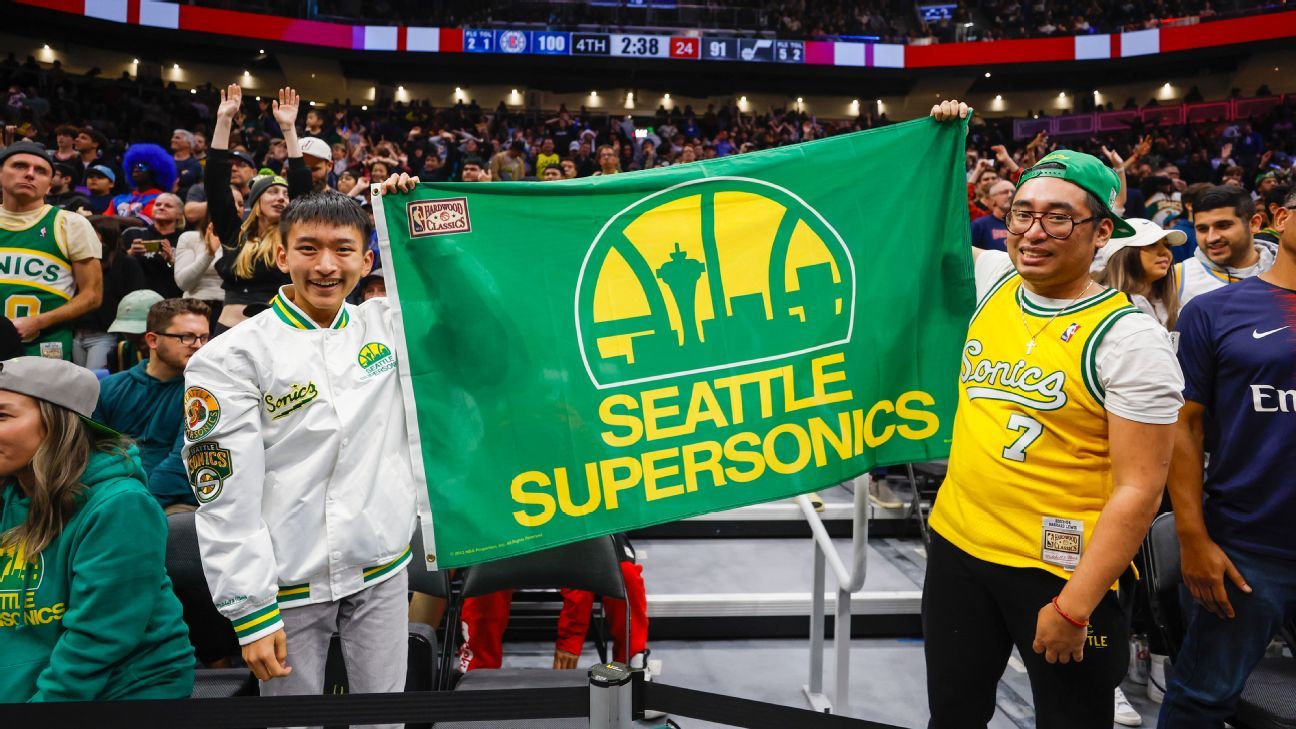
Seattle has been the largest city in the nation without an NBA team for nearly 20 years, following the relocation of the SuperSonics to Oklahoma City. Reintroducing a team to Seattle in 2028-29, two decades after the Thunder began playing in OKC in 2008, would mark a significant milestone in Silver’s tenure as commissioner.
For years, the challenge regarding the NBA’s return to Seattle was the absence of a suitable replacement for KeyArena, which the league deemed inadequate during the Sonics’ relocation. This changed in 2021 with the opening of the renovated Climate Pledge Arena, now home to the WNBA’s Storm and the NHL’s Kraken.
Why Las Vegas?
Las Vegas has emerged as the league’s unofficial 31st city, with its annual Summer League evolving over the past decade into the NBA’s equivalent of Comic-Con, a major event that attracts hundreds of thousands of fans each July. Additionally, for the first three years of its existence, Las Vegas hosted the championship round of the Emirates NBA Cup.
Las Vegas has surged in popularity from a sports perspective in recent years, with the Raiders relocating from Oakland in 2020, the Aces moving from San Antonio in 2018, the Golden Knights entering the NHL as an expansion team in 2017, and MLB’s Athletics expected to move from Oakland (via Sacramento).
Could other cities try to get a team?
Several cities have garnered attention as potential candidates, including international locations like Mexico City, Vancouver, and Montreal, as well as U.S. cities such as Kansas City, Louisville, and Nashville. A European division might be feasible in the future, but not until significant advancements in air travel occur. However, none of these cities are likely to surpass Vegas or Seattle in the expansion process.
Would Seattle be the SuperSonics? Would it retain that franchise’s pre-2008 history?
In brief: yes.
The agreement between Thunder ownership and the city of Seattle that resolved a lawsuit regarding the team’s arena lease and permitted its move to Oklahoma City stipulated that the SuperSonics name, along with all associated logos, colors, and trademarks, would be transferred to the owner of a new NBA team authorized to play at a renovated KeyArena at no cost.
This agreement established the terms for shared ownership of Sonics history, including the team’s 1979 championship trophy and retired jerseys. Officially, the NBA combines the histories of both teams. For instance, the league recognizes Hall of Famer Gary Payton as Oklahoma City’s all-time leader in games played.
However, the Thunder do not display any banners for the SuperSonics in Oklahoma City, and their media guide does not emphasize any Seattle statistics—listing, for example, Russell Westbrook as the team’s all-time assists leader instead of Payton.
Sources indicated that if a team were to return to Seattle, the Thunder would relinquish the Seattle history back to the SuperSonics—similar to how the NBA’s Charlotte Hornets reclaimed their Charlotte-era history from the New Orleans Pelicans when Charlotte regained the Hornets name in 2014.
If two teams are added in the West, what will happen to the conferences?
Both Seattle and Las Vegas would be placed in the Western Conference, necessitating one franchise to shift from the West to the East to balance the 17-15 split.
The decision would likely involve three teams: the Minnesota Timberwolves, New Orleans Pelicans, and Memphis Grizzlies. Geographically, New Orleans and Memphis are the easternmost teams in the Western Conference but are short flights from several Western opponents (including each other, all three Texas teams, and the Thunder).
While Minnesota is farther west, it is also more geographically isolated. The Timberwolves’ nearest Western opponent, the Denver Nuggets, is 680 miles away, whereas six Eastern cities (Milwaukee, Chicago, Indianapolis, Detroit, Cleveland, and Toronto) fall within that distance.
Determining which team would move East could be a lengthy process, but these factors suggest Minnesota is the most logical option.
What impact could expansion have on NBA playoffs and NBA Cup formats?
Regarding the playoffs, increasing to 32 teams should not alter anything significantly. Ten teams would qualify for the postseason, with six securing direct entry and four entering the play-in tournament. Six teams, as opposed to the current five, would go directly to the draft lottery.
However, expanding to 32 teams could lead to beneficial changes for the NBA Cup. Presently, the league divides the tournament’s group stage into six groups of five—meaning it cannot have every team play on the final day of group play due to the odd number of teams in each group.
A 32-team format would enable the NBA to adopt the 32-team FIFA World Cup structure: eight groups of four teams, each playing against one another once. Subsequently, the NBA could either allow 16 teams to advance to the knockout stage by taking the top two teams from each group (similar to the World Cup) or have each group winner advance while maintaining the current knockout stage format.
Will there be rule changes from previous expansions?
The NBA is anticipated to thoroughly examine the entire expansion process—such as how an expansion draft would function, the restrictions teams would face on spending during their initial years, and the regulations governing their draft picks—before a formal vote on expansion occurs.
The league will need to balance not making it so challenging for the incoming teams that they cannot compete for years, while also avoiding giving them an unfair advantage by starting with a clean slate. Extensive discussions will take place over the coming months regarding how this will be structured.
How could the expansion draft work?
During the 2004 expansion that introduced the Charlotte Bobcats (now Hornets), existing NBA teams were permitted to protect up to eight players under contract for the following season from being selected.
Previous expansion draft rules mandated that a team must leave at least one player unprotected, even if the team had fewer than eight players under contract heading into the offseason. Players with options to become free agents count toward that total, and if selected, the player’s former team would receive a trade exception equivalent to that player’s 2028-29 salary.
Teams could also protect players who might become restricted free agents, but past expansion draft rules did not transfer RFA status to the expansion team. The drafting team would risk losing a player without compensation. (However, the player would not be allowed to re-sign with their original team.)
In previous expansion drafts, teams were limited to selecting one player from each existing NBA franchise.
Since there were no two-way players in 2004, the league will need to determine if they can be protected in a future expansion draft. Every two-way player whose contract expires typically becomes a restricted free agent.
It is important to note that the NBA and Players Association would be operating under the current Collective Bargaining Agreement, which is in effect until the 2029-30 season. However, there is a provision that allows either side to terminate the CBA on June 30, 2029, provided notice is given on or before October 15, 2028.
What can be learned from previous expansion drafts?
In 1995, the Toronto Raptors and Vancouver Grizzlies alternated selections until they each picked one player from each of the other 27 existing NBA franchises.
The two teams conducted a coin toss to determine which would select first. The Grizzlies won the toss but chose to defer, allowing them to have the second pick in the expansion draft. Consequently, the Grizzlies were able to select higher than the Raptors in the 1995 NBA draft.
The Raptors concluded the expansion draft with 14 players, while the Grizzlies selected 13.
In 2004, Charlotte had the opportunity to select 29 players (one from each team) in the expansion draft but opted for 19. The Charlotte front office in 2004 focused on selecting players who were restricted free agents. Out of the 19 players Charlotte chose (with a minimum of 14 required), nine were restricted free agents. The only one of those nine who re-signed with Charlotte was Tamar Slay.
The standard roster regulations during the regular season and offseason will likely apply: A team can have up to 21 players in the offseason and 18 (including three on two-way contracts) once the regular season commences.
How do expansion teams factor into the leaguewide draft?
The NBA has positioned each expansion team in the first round, with Vancouver selecting sixth and Toronto seventh in 1995, and Charlotte picking fourth in 2004. In that draft, the Bobcats traded up with the Los Angeles Clippers to secure the second overall pick (Emeka Okafor).
None of the recent expansion teams have been eligible for the No. 1 pick in their inaugural year. When the Raptors and Grizzlies joined the league, they were also ineligible for the No. 1 pick in their second season. The Raptors won the draft lottery in 1996 but were unable to select first, resulting in the No. 1 pick going to the Philadelphia 76ers (who drafted Allen Iverson).
How could the salary cap work for expansion teams?
Each expansion team must operate within a reduced salary cap for its first two seasons. In July 2004, the Bobcats had $17.6 million in player salaries and were $11.8 million below the $29.4 million salary cap at the start of free agency.
If an expansion team were to join the league for the 2028-29 season, using that 66.6% figure, the team would have a salary cap of $121.9 million, compared to a projected $183 million cap for the league’s 30 existing franchises. The team would have 80% of the salary cap available in the following season, and the full cap available in Year 3.
An expansion team would be required to spend 90% of its lower $121.9 million salary cap by the first day of the regular season to meet the league-mandated salary floor. Teams can select a player in the expansion draft and then waive him without that salary counting against the cap, with that amount still applying to the salary floor.
