
Inside the Clippers’ Arena: The Impact of 4,500 Fans on the Atmosphere at the Intuit Dome
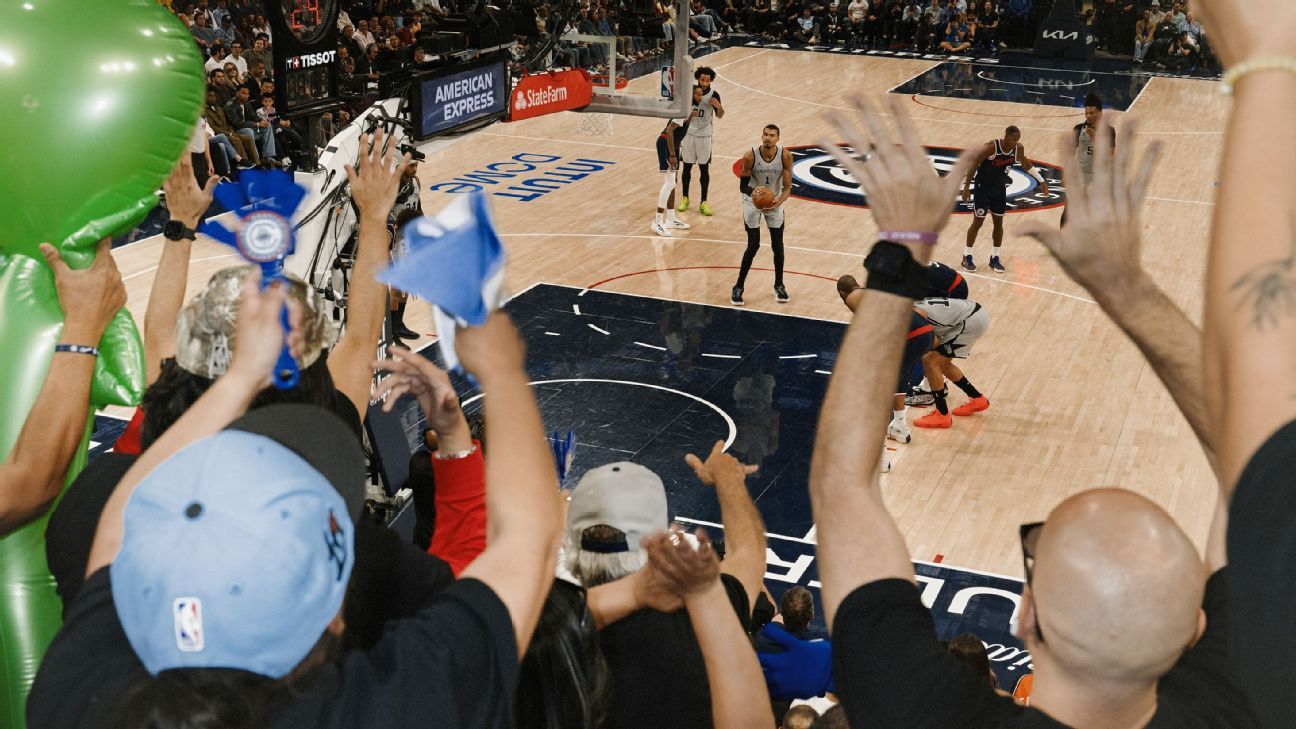
INGLEWOOD — San Antonio Spurs guard Stephon Castle stepped up to the free throw line at Intuit Dome. He received the basketball, took a deep breath, dribbled three times, and then bent his knees to take the shot.
In front of Castle was a standard 10-foot NBA basket. It seemed like a straightforward situation for the second-year player — who had a free throw shooting percentage of 73.6% — to make the shot. However, that statistic did not account for the challenge he faced behind the basket.
The LA Clippers’ Swell: A towering 44-foot section filled with 300 Clippers fans chanting “MISS,” waving their hands from side to side, and brandishing lime-green alien inflatables, a reference to Castle’s teammate, Victor Wembanyama.
In the design of the Intuit Dome, Clippers owner Steve Ballmer aimed to create a venue that would provide a significant home-court advantage, expressing a desire for the “best home in all of sports.” He sought to utilize technology and architecture to foster an environment conducive to the Clippers’ success.
The Clippers explored numerous venues with engaging atmospheres to draw inspiration for the arena. Gradually, “The Wall” took shape: 4,500 seats and 51 continuous rows, with the first 13 designated as “The Swell.”
This area is allocated for 300 of the “loudest, most energetic fans,” with seating available on a first-come, first-served basis. Some fans arrive as early as three hours prior to tipoff. Cheering for the opposing team can lead to a warning card and relocation for repeat offenses.
Opponents recorded a shooting percentage of 73.4% when facing The Wall last season. If that statistic belonged to a team, it would rank 30th in the league, reinforcing the notion that The Wall is arguably the most distinctive feature of any NBA arena.
“We like to say that when you come to Intuit Dome, you’re not a spectator. You’re a participant,” Gillian Zucker, CEO of Halo Sports & Entertainment, told ESPN. “But when you’re in the Swell, you truly are a participant, and you have a significant role to play.”
As Castle lifted his arms and flicked his right wrist to shoot on March 16, the ball ricocheted off the left side of the rim to the right and missed. The Swell made its presence known — and on the opposite side of the court, Ballmer enthusiastically pumped his fist.
The Clippers shared Crypto.com Arena with the Los Angeles Lakers for 25 years. During that time, the Lakers — now the sole NBA tenant of the venue — secured five championships, making the arena feel more like their own, with banners and retired numbers displayed in the rafters even during Clippers games.
As “Lob City” fostered a winning culture, then-head coach Doc Rivers took action before the 2013-14 season. He opted to cover the Lakers’ banners with those representing the Clippers, inciting outrage among Lakers fans.
“It’s no disrespect. I have immense respect for the Lakers,” Rivers stated. “That said, I work for the Clippers, and when we play, it should be the Clippers’ arena.”
The Intuit Dome presented an opportunity for the Clippers to craft their own narrative. Thus, they set to work fulfilling Ballmer’s vision.
Zucker noted that Ballmer frequently referenced “The Show” at San Diego State, the spirited student section at the Aztecs’ basketball arena that Ballmer claimed creates an intense atmosphere. During the design phase, the team received a visit from Borussia Dortmund, the German soccer club. Dortmund’s stadium, Signal Iduna Park, features the formidable “Yellow Wall” in the south stand, the largest standing terrace in world soccer, accommodating up to 25,000 fans.
These two sections inspired the Clippers to consider how to incorporate a similar concept into an NBA arena. They requested their basketball scouting teams to send videos of fan sections and ultimately selected one college environment that exhibited a comparable level of excitement.
Scouts chose Grand Canyon University, home to the Havocs, who aim to be the “most spirited, energetic, and disruptive student section in the country.”
“We combined all of those concepts along with the energy that some other NBA cities bring, like Utah and Oklahoma City, and said, ‘OK, how do we create a similarly passionate fan base in Los Angeles?'” Zucker explained. “Eventually, we developed the idea of the Wall and the Swell.”
Zucker mentioned that the Clippers visited hundreds of venues, with her personally exploring locations such as theaters, zoos, parks, and museums.
There were various iterations of The Wall. At one point, the Clippers considered placing the section on both sides of the arena before finalizing the current horseshoe design. Just over two years after the announcement of the new arena, the initial renderings of the Intuit Dome released in September 2021 included The Wall.
“We wanted this to be a place that you have to experience live,” Zucker stated. “You need to be here to truly feel the energy and the vibe.”
So, I decided to experience it firsthand.
On March 16, a Clippers representative escorted me from Intuit Dome’s media room to the Swell, to Row 3, “Seat” 4. The quotation marks around “seat” are warranted — this is a standing-only section, after all. Sitting is permitted only during game breaks.
“All those tickets are sold as a season ticket. Interestingly, though, it’s not a seat. So you’re not actually purchasing a seat,” Zucker explained. “You’re buying access, and your seat is assigned based on your arrival time at the arena.”
Consequently, being part of the first three rows of the Swell necessitates lining up hours before tipoff. A purchase of the “Swell Pass” is required. While fans initially needed to be “chuckmark certified” — a status referencing the team’s mascot, Chuck the Condor, which involved taking a quiz and other requirements when the Intuit Dome opened — this is less emphasized now. Anyone who downloads the arena app is automatically certified.
Tickets are also non-transferable and cannot be resold. This slightly differs from The Wall, where fans can purchase seats with a strict caveat listed before completing the transaction: “No Opponent Gear. Clippers Fans Only.” Opposing fans previously tested this rule by buying a spot and then arriving to cheer against the home team, but this has become less common, according to the Clippers.
If an opposing fan is identified in The Wall, they will first receive a warning card to inform them of the section’s rules. When the Clippers handed me one for reference, my Swell companions looked at me as if I had committed an offense, feeling I had let down the section that welcomed me as one of their own. I quickly clarified my innocence.
If they continue to support the opposing team or wear rival gear, they will be relocated. Even if the Clippers miss them, the decibel meters at Intuit Dome do not. These meters track crowd noise and alert Clippers staff if the cheers are directed at the opposing team.
“It was integrated into the building because we wanted to reward people through our loyalty program for cheering for our team. It’s part of establishing a home-court advantage,” Zucker noted. “That was the rationale behind it. However, a byproduct of this is that we can identify potential issues before they escalate within the crowd.”
Fan sections in the NBA are not a new concept. The Houston Rockets once had the Red Rowdies. The Atlanta Hawks have the 404 Crew. Before Wembanyama launched the Jackals in San Antonio last offseason, the Spurs had the Baseline Bums.
Although some of these groups did not endure, what gives the Clippers confidence that this one will is straightforward: The Intuit Dome is designed to accommodate The Wall and the Swell.
“It’s one thing to have a fan section, but their location makes them an integral part of the game,” Zucker stated. “I believe that has been a crucial factor in this.”
The Swell is specifically positioned next to the opposing team’s bench, fostering an environment filled with banter and trolling directed that way. My placement provided a prime spot in the Swell’s classroom of consistent (and surprisingly effective) antics aimed at unsettling the day’s opponent.
And the Clippers’ supporters keep track of grievances.
No matter who has wronged the franchise over the years — from Joe Ingles to Luka Doncic — they ensure to greet them with a familiar sound: “Booooo.” Early in the game, one fan asked me to name my favorite player, but before I could respond, they issued a warning.
“Don’t say Luka or you’ll get kicked out.”
I opted for Clippers star Kawhi Leonard to appease them.
During the game, I stood next to Decely Jaramilla and Rocky Yang, two season-ticket holders with different paths to Clippers fandom.
Alongside her husband, Marvin, and daughter, Hailey, both present at the game, Decely became a fan in 2010. Yang is a more recent supporter, with the 2025-26 season marking his first in the Swell. Next to him was Maria Manjarrez, whom he referred to as his “Clippers mom.” They met at the Las Vegas summer league last year. Manjarrez purchased season tickets once Ballmer acquired the Clippers in 2014.
The Swell adopted a “Men in Black” theme against San Antonio, meaning matching black T-shirts and sunglasses for all to wear in the section — myself included. I donned the attire and then attempted to catch the attention of the photographer for this story.
I’m soft-spoken, so my voice was drowned out by the in-arena music. Jaramilla looked at me with disappointment, informing me I needed to use my “Swell voice.” How?
“Louder than that,” she replied.
This marked the beginning of my one-day contract with the Swell: a night when I became all too familiar with the sensation of pompoms shaken vigorously against the back of my head, and every moment of game time without yelling nearby felt like a welcome reprieve.
To my left in the center stood Casey King, a key member of the Swell whose title is “game presentation manager.” King is part of the Clippers’ marketing department, working only on game nights. His primary role is straightforward: ensuring the Swell remains respectful and adheres to the league’s code of conduct.
Clad in a navy Derrick Jones Jr. jersey and sweats, King is responsible for a large drum and megaphone to coordinate chants. The marketing team supports the Swell, and King has played a vital role in building the community.
“This is the wild orchestra, and that’s the conductor over there,” Marvin Jaramilla remarked, referring to King.
King strikes the drum to synchronize with chants like “defense” or “let’s go Clippers,” and the megaphone serves to initiate similar vocalizations.
He was one of the key figures near me, along with Hailey Jaramilla. She’s a volunteer section leader, one of fifteen who strive to keep everyone engaged. I stood in front of a barrier that cleverly read: “they’re called stands for a reason,” indicating the seats were merely decorative.
As the game commenced, King shouted into his microphone: “Best fan section in the NBA, let’s go.” It didn’t take long for me, and the Spurs, to feel its impact.
The Clippers surged to a 17-3 lead, with the noise catching me off guard. My ears struggled to cope with the shouting, and my throat began to ache as I frequently had to project my voice to converse with the Clippers mom — who stood one seat to my left. As Wembanyama approached the bench, one fan in my section howled a message.
“We’re better than the jackals. [Spurs guard Dylan] Harper, tell him,” they said.
San Antonio managed to escape that deficit to take a 66-52 halftime lead. As I headed to interview Zucker during the break, the effects of the Swell intensified.
The sunglasses I wore over my prescription lenses as part of the “Men in Black” theme made me forget what my unaugmented vision typically looked like. By the time I finished my conversation with Zucker and returned to the Swell, my normal vision returned — just in time for the “go Clips go” and “L-A-C” chants to commence. There would be no respite for the weary.
Unfortunate for the Swell but fortunate for my eardrums, the Spurs maintained control for most of the second half. However, the enthusiasm of the section never faltered.
The chants persisted. The drum continued to pound. Some yelled “get hyped” the moment energy dipped slightly as San Antonio extended their lead — almost as if the Spurs siphoned energy from the Swell for their own on-court advantage.
Many Swell members arrive straight from work and wait hours before tipoff to secure a spot. This has fostered a community of camaraderie that is not dependent on wins and losses, nor concerned with individual backgrounds.
Jon Crumpler relocated back to Southern California during the Clippers’ final season at Crypto.com Arena and joined the Swell on a whim with a couple of old friends. What they discovered was a “wild community.”
“Every game, you sit with someone else who brings a different story and a different level of passion,” Crumpler shared with ESPN. “And we all just get to know each other now, and it’s just so wild. To have that later in life and to develop a friend group organically is truly unique. It’s a lot of fun.”
During the 2025 postseason, the Clippers flew members of the Swell to Denver for Game 7 of the first-round playoff series against the Nuggets. It’s all about showing appreciation for the Clippers.
“It’s created a genuine sense of community, especially in The Wall and the Swell. … They spend holidays together at this point. I believe they share more than just fandom,” Zucker stated. “They share friendship, and the fact that you’ve established a space for people to connect is quite remarkable.”
The expectation is to cheer throughout the game, and for some, it serves as an after-work escape where yelling at the top of their lungs is encouraged. But, above all, the Swell operates as one. During an on-court competition, Swell members recognized the participant and began chanting “one of us” after the fan emerged victorious.
The Clippers fought back to narrow the Spurs’ lead to single digits early in the fourth quarter, resulting in thunderous “defense” chants and foot stomping. Despite the Swell’s determination, San Antonio maintained control and ultimately extinguished Los Angeles’ momentum.
Even when trailing by 13 with 2:45 remaining in the game, the Swell continued to make noise — the one thorn in the Spurs’ side they could not remove that Monday night.
San Antonio triumphed 119-115, and as I bid farewell to my Swell companions, I posed a simple question to Decely: “How did I do?”
“You’re hired,” she replied. “Let’s go.”
Perhaps with some earplugs next time.
