
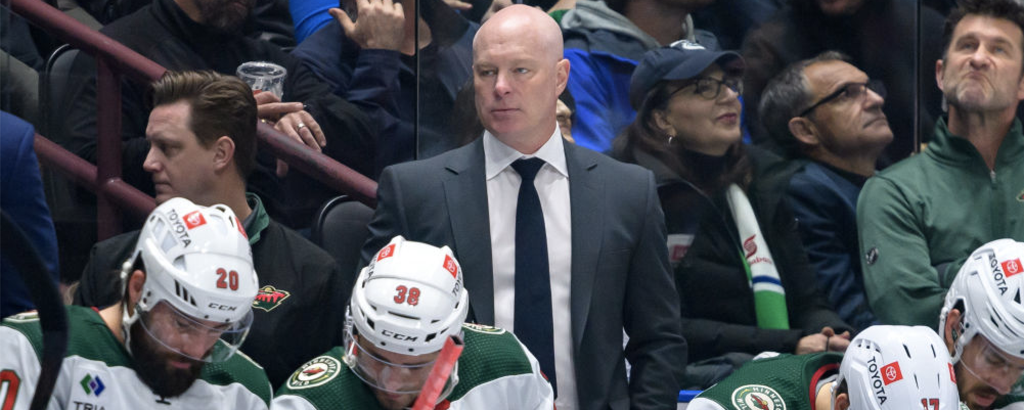
After a rough start to the 2025-26 NHL season, the Minnesota Wild went from the bottom of the standings to now being one of the top teams in the league.
Despite the early losses, head coach John Hynes said his team remained focused on the end result.
No, not the score, but the brand of winning hockey.
“Winning hockey, even though you might not win the game, it’s about players playing with the right habits,” said Hynes, now in his 10th season as an NHL coach and his third with the Wild. “When it’s all about wins and losses, it becomes an emotional roller coaster. When you take lessons — positive and negative — out of both situations, then you continue to grow as a team.”
That’s what Hynes, who spent six years coaching at the U.S. National Team Development Program and served as an assistant coach of the gold-medal-winning 2004 U.S. World Junior Championship squad, wants particularly stressed at the youth level: growth instead of the season record.
“Everyone wants to win,” said Hynes, a Warwick, Rhode Island native. “That’s why we play sports and games. But if you are only focused on the winning aspect, you’re not going to find success.”
Focus on the Basics and Good Habits
Sometimes the best hockey is simple hockey. There’s no need to overcomplicate things with systems and breakdowns all the time — especially at the youth levels.
First, make sure your players understand the fundamentals of the game and their positions.
“You want to be able to have certain circumstances where kids understand when is the right time to make plays and when it’s the right time to not make plays,” said Hynes, who will serve as an assistant with Team USA at the 2026 Winter Olympics. “From a defensive standpoint, teaching them the ability to understand how to play defense — not necessarily in a system — but good stick details, being able to check with your feet, skating, understanding defensive body positioning, being on the right side of people in one-on-one plays, or things like that.
“And from an offensive perspective, it’s very similar. Teaching them that when you have time and space, you want to be able to make plays and be creative with the puck. And with that, understanding when you don’t have those situations, you can create offense in multiple ways. It might be time and space and you make plays. It might be situations where you have to get into the offensive zone and compete for pucks and get around the net front.
“So, it’s not so much system at the youth level, but it’s those habits.”
Few habits are more important to create and nurture than the big three: work ethic, teamwork, and competitiveness.
“Those are huge at any level,” Hynes said. “Your effort and your competitiveness are really important. That’s the winning style, regardless of what the score is.
“I think being a good teammate is super important, too. Having good energy, cheering on your teammates, picking a teammate up when they’re down. Maybe the goalie lets in a bad goal — go give them a tap. Those things are really, really important not only to the game, but also are part of being on a good team and a winning team.
“You’re teaching those kids the importance of play on the ice, but a huge component off the ice, too. This is a team sport.”
Hynes said those three things are what make Matt Boldy so special. The Millis, Mass., native shows up every day with compete and a positive attitude that helps elevate his own play, as well as those around him.
“Boldy, with his work ethic and competitiveness, it’s there all the time — practice, games,” Hynes said. “As far as a teammate, he’s vocal on the bench, he’s encouraging. When things are going well, he speaks up. When maybe we hit a little bit of a rut or a guy makes a mistake, he’s always there to pick up the team or pick up a teammate.
“I think when you look at his game, he’s a dynamic offensive player, but he’s a strong penalty killer, and he has a willingness and a respect for the game to play both sides of the puck — with and without the puck — at a high level.”
The Final Takeaways
At the final buzzer, it’s important to remember that there’s always learning in the score. It’s those lessons that embody the real brand of winning hockey.
“At the youth level, results are results, but there’s always learning out of it,” concluded Hynes. “When you win the game, it doesn’t mean everything is great. There are always things you can take away from that game to be better.
“When you lose a game, it’s not all bad either. You want to pick some positives out of that game, and then identify the things you’re going to work on and improve for the next time. Remind players that if they keep doing things the right way, we’re going to be able to have success.”
