
Shortly after celebrating the gold medals won by the 2026 U.S. Olympic Women’s and Men’s Ice Hockey teams, USA Hockey is gearing up for another significant achievement — exceeding 100,000 registrations for female players.
“It’s remarkable,” stated Kristen Sagaert, USA Hockey’s director of girls hockey. “We’re thrilled about it.”
Following the U.S. women’s victory in 2018, USA Hockey experienced a notable rise in female registrants. Sagaert noted, however, that registration typically sees an “Olympic bump” every four years, regardless of the U.S. teams’ results. When audiences witness thrilling hockey on the global stage, it often motivates them to take to the ice themselves.
With this being the first instance of a double gold in U.S. history, Sagaert acknowledged that she anticipates a considerable impact nationwide from these exciting victories.
“We’re going to see more girls on the ice,” she remarked. “We’re going to have more leaders coaching. We have all these incredible athletes who have just achieved [Olympic] success and are already active in their communities. I believe the visibility and discussions surrounding our athletes are the greatest benefits following an Olympic victory. It’s already evident across social media.”
Sagaert indicated that female registrations with USA Hockey have increased by over 4.2% year on year. She mentioned that this growth is expected to exceed 5% this year.
“We’re going to surpass last year’s figures, which is exciting,” Sagaert stated. “We recognize that international success enhances the visibility of women’s hockey both nationally and globally. It symbolizes years of commitment and serves as a means of inspiring the next generation through the growth we’ve experienced. The next generation is already registered. They’re already here.
“It’s our responsibility to leverage the success of the women’s national team to motivate them and expand the game. We have established a solid foundation for girls’ and women’s hockey throughout the United States.”
Sagaert acknowledged the significant contributions of USA Hockey Girls’ Council volunteers from the 12 districts in fostering the sport’s growth.
Adult women represent 29% of the overall growth nationwide, according to Sagaert. She has also observed strong participation at the 10U and 8U levels through Try Hockey for Free and Learn to Play initiatives.
“If they have a positive experience at the 8U level, they’re likely to remain in the sport,” she noted. “We appreciate growth across all age groups.”
Utah has experienced the fastest growth in female registrations year over year — 30% — partly due to the Mammoth joining the NHL in 2024. Other states showing significant growth include traditional hockey strongholds like Wisconsin and Minnesota, as well as non-traditional markets such as Florida and Texas, Sagaert reported.
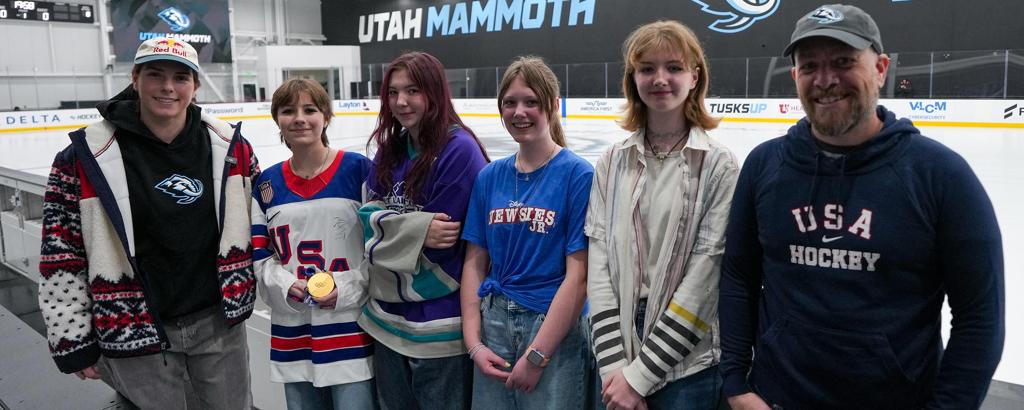
Joanna Gilligan, a 13-year-old from Millcreek, Utah, was officially recognized as the 100,000th female registrant. Gilligan, who participates in the Utah Mammoth’s new all-girls league, was surprised at the Mammoth’s practice facility by two-time Olympic gold medalist and captain of the U.S. Olympic Women’s Ice Hockey Team Hilary Knight on Friday afternoon.
Opportunities for girls and women have expanded significantly since Sagaert played the sport in the 1990s. She noted that now over 200 colleges and universities offer women’s varsity or club hockey.
“That’s remarkable,” she remarked. “It truly reflects that a foundation is being established at every level.”
Sagaert emphasized that USA Hockey’s objective is not only to attract new players but also to retain them.
“How do we create the best possible environment for those players?” she asked. “There has been considerable effort to ensure that girls’ hockey is sustainable. It’s actually a long-term system designed for the sustainability of girls and women in the sport.”
During this year’s Olympics, broadcasts frequently featured Hilary Knight taking photos with players like Hannah Bilka, Laila Edwards, Caroline Harvey, Tessa Janecke, and Haley Winn when they were children, helping to inspire a future generation of gold medalists.
Since the U.S. team returned from Italy, Sagaert mentioned that they have been active in their communities, serving as role models for younger players.
“It’s all about continuing to inspire future generations,” she said. “The cycle of our athletes and their commitment to being the best possible role models for the next generation is the most powerful outcome we can achieve from the Olympics because it embodies the idea that ‘If she sees it, she can be it.’ It’s truly accurate.”
Story from Red Line Editorial, Inc.
