
Goaltending Development Camp Aims to Ensure American Goalkeepers Rank Among the World’s Best
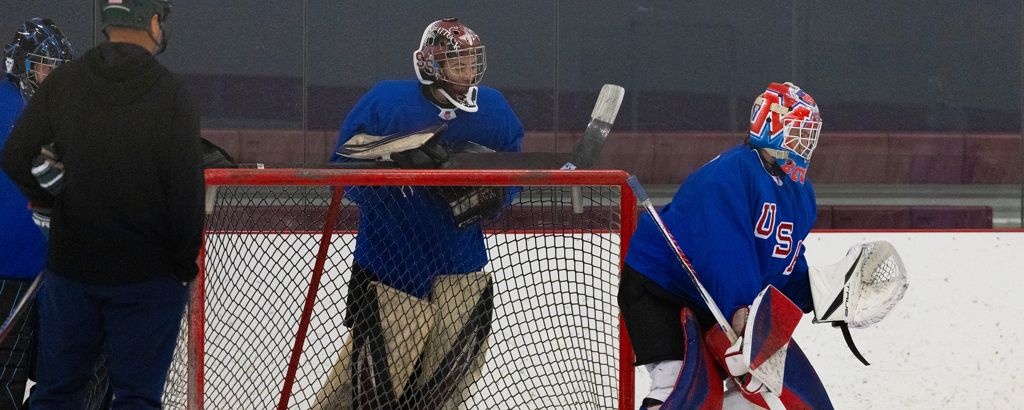
Steve Thompson aims to cultivate a familial atmosphere among USA Hockey goaltenders, one that could eventually lead to goalies embracing each other at the Olympics, recalling their shared experiences at a goaltending camp over the years.
This is a primary objective for USA Hockey’s National Goaltending and Women’s Defense Development Camp.
“We are striving to create this family environment where it doesn’t matter how long your hair is or what gender you are; you’re part of the USA Hockey goalie family, and we’re all training together, working together, and accessing the same resources,” stated Thompson, who serves as the manager of player development – goaltending for USA Hockey.
The camp, which took place from May 18-21 at the NSC Super Rink in Blaine, Minnesota, welcomed 25 goaltenders and 12 defenders.
Participants received on-ice training, skill enhancement, video analysis, and team-building activities from a total of 31 coaches representing various levels.
David Lassonde, USA Hockey’s national goaltending coach, described the camp as “one of the crown jewels” of the organization’s efforts to develop goaltenders. Numerous American goaltenders currently in the NHL have previously attended this camp.
The invitees primarily consisted of prospects for the women’s national team, either in college or younger—approximately ages 16-22. Many World Junior prospects also participated on the men’s side. About half of the attendees were newcomers this year, while some returned for as many as their fifth time.
It is always interesting to observe athletes who arrive feeling “star-struck,” and by their fourth or fifth year, they become more at ease and assist younger participants, Thompson noted.
Alli Altmann, the goaltending coach for the U.S. Olympic Women’s Ice Hockey Team, highlighted how Aerin Frankel attended this camp multiple times as a leader. Currently, goalies like Ava McNaughton (Wisconsin) and Annelies Bergmann (Cornell) serve as veteran leaders among the present campers.
Although the format of this camp has evolved over the years, USA Hockey has conducted it annually since 2019, typically at USA Hockey Arena in Plymouth, Michigan. This year’s relocation to the Super Rink in Blaine, due to maintenance at the Plymouth facility, proved to be a positive experience, according to Thompson.
Coaches concentrate on skills necessary for success at the collegiate, professional, or international levels, including skating, technical edge work, play-reading, and decision-making.
“We’ve shown them numerous videos featuring different NHL and PWHL decision-making examples from the world’s best, and we aim to recreate those scenarios during practice,” Thompson explained. “We want to provide them with new skills to work on throughout the summer.”
Altmann advised goaltender Quinn Kelly, a 16-year-old among the younger participants, that the experience is not about completely altering one’s game, “but if you can leave with one takeaway that resonates with you, something to continue working on… that’s what truly matters.”
From a coaching standpoint, Altmann views this camp as an opportunity to gain “a really good grasp” of the American player pool and monitor the athletes’ development. Her aim is to avoid falling behind in identifying the top goaltenders at each birth year in the U.S. for roster selections.
“Conversely… we want to provide all the information we can, along with the details to assist these kids in developing their games,” she said. “It’s about identifying who has potential and how we can help accelerate their growth or expand their capabilities.”
The athletes are assessed at the camp not only by coaches but also by themselves, evaluating their performance relative to their peers and identifying areas for improvement, Lassonde noted.
“We want them to enhance their game,” Lassonde stated. “We want them to improve. We want them to be exposed to the coaches we bring here.
“There are numerous resources available for these kids to utilize, allowing them to understand the expectations placed upon them, and the goalie tools they can incorporate into their skill set to aid in their development and improvement.”
All these resources are utilized with the aim of ensuring that the best American goalies become the top goalies globally, Thompson remarked.
The camp combined defenders and goaltenders to work on defensive-zone strategies on the women’s side. Effective communication and ensuring that defenders and goaltenders are aligned is crucial, Thompson emphasized.
Ideally, the defenders and goalies will be well-coordinated at the next Olympic Games due to their years of attending this camp together, Thompson added.
One of the camp’s goals is to simulate pressure situations at the end of each skate. Coaches maintain scores and leaderboards to acclimate goalies to the stress and pressure associated with competing in a gold-medal game, Thompson explained.
At the conclusion of the camp, coaches present awards for the top goalie on both the men’s and women’s sides, as well as an award for the best teammate.
“The reasoning is that there will be moments when you win a gold medal, and you may not be on the ice,” Thompson remarked. “We ensure that you are still contributing to your team’s success, whether by cheering from the bench or supporting from the stands, ensuring that everyone is working together and recognizing your role as a good teammate.”
Story from Red Line Editorial, Inc.
