
As Academics and Hockey Fuel Jaryn Chubb, She’s Glad to see Indigenous People Highlighted for Native American Heritage Month
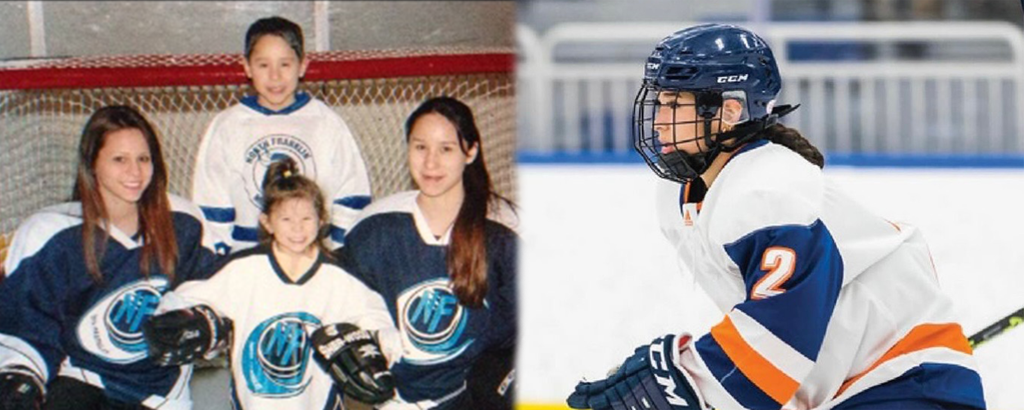
Jaryn Chubb needed a reset after her first college experience wasn’t a good fit.
Hockey was always a focus for her, but this time, she looked at schools with academics in mind.
“Hockey’s always been everything for me,” Chubb said. “It was a really tough decision to just come based on academics and deciding to not play hockey anymore. But once I found the team, it was like a relief.
“It felt like everything was just lining up perfectly.”
So far, so good for Chubb in both her studies and as a member of the University of Rhode Island women’s club hockey team.
Chubb grew up in Akwesasne, New York, right on the border of the United States and Canada. With three older siblings who laced up their skates, Chubb started skating when she was 4 years old because she “wanted to be just like them,” she said.
But the reservation didn’t offer much for competitive hockey teams. Chubb, a dual citizen of Canada and the United States, played on a boys’ hockey team in Canada until she was about 12 years old. Then she switched to girls’ hockey, playing year-round after finding summer camps and leagues to join. When she was in high school, a camp coach approached her and offered her a spot on his team at the Hockey Training Institute in Utopia, Ontario.
Chubb focused on hockey, but she also knew that her mom, being a teacher, wanted her daughter to return to the U.S. for academics and college. She played a year of hockey at Salem State University in Massachusetts, but it just wasn’t the right fit for her.
Having been away from home for five years, Chubb returned to the reservation to reevaluate what she wanted. She toured schools and talked to hockey coaches but also had the intention of choosing a school for academics.
She chose University of Rhode Island based on academics without knowing much about the hockey program. Once on campus, she made a last-minute decision to attend tryouts for the women’s club hockey team, and made the squad.
Being part of her new team has been a great experience so far, from “really sweet” teammates to coach Nikki Friesen, who Chubb says is “very dedicated to the team.”
“It feels like family away from home, which is really, really nice,” said Chubb.
Chubb is the youngest of four. She has stuck with hockey the longest of the group. Her two older sisters played until high school. Her brother played at Kimball Union Academy before playing junior hockey. Chubb also played on the same team as her brother — a boys’ team — growing up, an experience which helped her learn how to use her body and small size to her advantage.
Chubb said hockey is “a break from all the stresses of life,” which is something she can use to her advantage.
Wherever she plays the sport, she brings a hard work ethic to her game.
“I’m more of a grit player,” Chubb said. “I’ll get in the battles, and I’ll use my body to fight through it.”
Chubb found her opportunities to play hockey, even if it's meant leaving her home and the reservation. In general, she thinks the spotlight hasn’t been on Indigenous people until more recently. Native American Heritage Month is one way to shine the light on them.
“It’s just really cool seeing us finally being acknowledged and finally feeling seen,” Chubb said. “I know definitely all the people at home are super proud of anyone who puts themselves out there to go above and beyond and play.”
She’s focused on her education and is enjoying playing hockey at Rhode Island this year. Her major is undeclared as she still considers her options, but she’s on track for the creative side of psychology and nutrition as areas of interest. She hasn’t determined what might be in store for her in the future after college, but she sees herself still playing hockey.
“I feel like it’s always going to be a part of me,” Chubb said.
Story from Red Line Editorial, Inc.
