
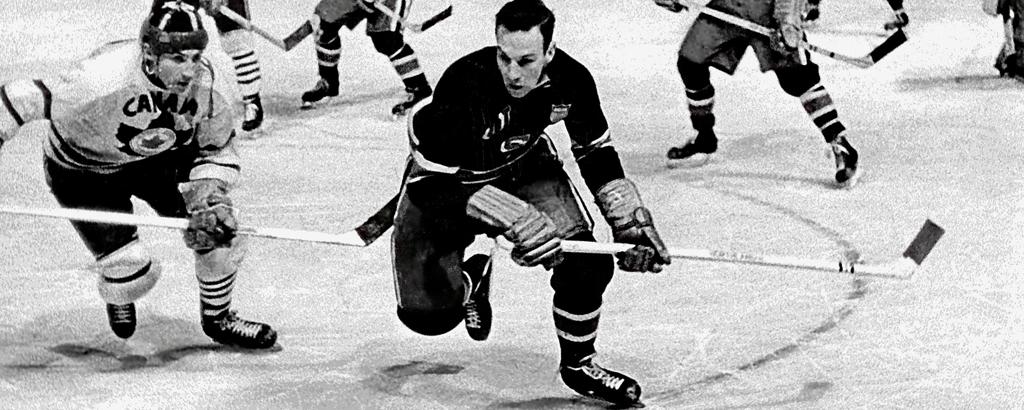
As the 2026 Olympic Winter Games commence in Milano-Cortina, Italy, some fans might not remember that 70 years ago, during the 1956 Cortina D’Ampezzo Olympic Winter Games, 17 American hockey players made history by becoming the first U.S. Olympic Team to triumph over Canada.
The final score was 4-1, with three of the goals scored by the premier American player of his time, John Mayasich.
The next morning, Mayasich wrote a letter to his wife, which is included in his recent biography: “John Mayasich: Immigrant Roots to Olympic Gold.”
Wednesday, Feb-1-1956: “Dearest Carole, I am so happy this morning – We defeated the Canadians last night 4-1 and we actually accomplished the impossible. I have never felt this joyful after a game, Hon. I scored 3 goals and received the game puck. I injured my knee again and felt unwell during the first period. I suppose I overexerted myself – The doctor mentioned my pulse was too elevated after the first period, so I was fortunate to continue playing. My pulse tends to spike when I play like that. We have a day off today and will face the Swedes Thursday night. We play Russia Friday night and the Czechs Saturday night. I truly hope we can secure a win now. The Russians are quite strong. We must compete fiercely against them, just as we did against the Canadians. I plan to watch the men’s free skating this afternoon. All I seem to do here is sleep and eat. I will be relieved when it’s all over, especially if we emerge victorious. Ike performed exceptionally well in goal, and the defense was solid last night.”
Mayasich concluded the tournament with 10 points (6G, 4A), and the U.S. ultimately secured the silver medal in Cortina. Four years later, Mayasich was one of four defensemen in front of goalie Jack McCartan when the U.S. achieved its first hockey gold medal at the 1960 Winter Olympic Games in Squaw Valley, California.
Born in May 1933 as the 11th of 12 children of Croatian immigrants, Mayasich was raised in Eveleth, Minnesota, a mining town that, in the early 20th century, produced nearly a dozen NHL players. Mayasich’s father worked in the iron ore mines surrounding Eveleth, while his mother managed the household.
The Great Depression had a profound impact on working families, prompting Mayasich and his siblings to take jobs outside the home and contribute their earnings to their mother. The rationing and hardships of World War II framed Mayasich’s early adolescence. The family residence had three bedrooms: one for his parents, one for his sisters, and one for his brothers. During his upbringing, Mayasich often slept sideways on a bed shared with two, three, or four brothers at once.
The vibrant hockey culture in Eveleth played a significant role in introducing Mayasich to the sport. More crucially, Mayasich dedicated time to honing his skills to excel in the game. By the time he reached the 7th grade, he was banned from Saturday morning indoor hockey at the renowned Eveleth Hippodrome. The reason for the ban?
No one among his peers could prevent him from scoring.
He made coach Cliff Thompson’s varsity team as a freshman. Eveleth never lost a game with Mayasich on the roster, and he established still-unbroken Minnesota high school tournament scoring records during an era of 12-minute periods.
For further insights into Mayasich, refer to “John Mayasich: Immigrant Roots to Olympic Gold” by Roger Dier.
