
Rory McIlroy’s Saturday setback paves the way for an intense Sunday at the Masters.
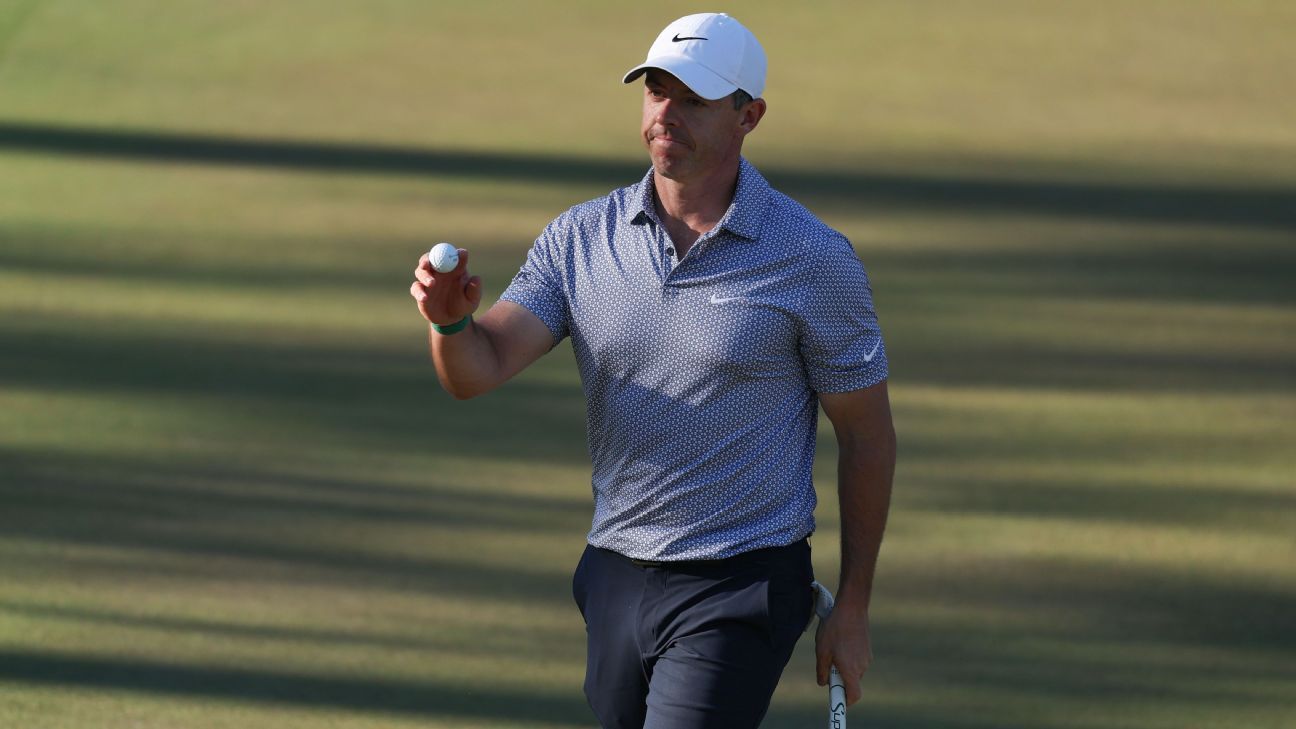
AUGUSTA, Ga. — The drooping shoulders and exasperated sighs, the hands running through his hair and vacant looks skyward returned. Behind Augusta’s renowned 12th green Saturday afternoon, a flushed Rory McIlroy suddenly appeared as if he had encountered a specter he believed he had already evaded.
In just a few hours, the six-shot advantage he had built over 36 holes — the largest at this event — had dissipated into the warm Georgia atmosphere.
Not only had McIlroy’s lead vanished, but the Masters had abruptly shifted from a likely rout to an open contest.
“I didn’t quite have it today,” McIlroy stated.
It was never going to be straightforward. Not at Augusta National, where every angle of the course can become a pitfall the moment you start admiring the scenery, and especially not for McIlroy, who is acutely aware that 18 holes can feel like an eternity and 36 holes may as well be an endless stretch. A six-shot lead was unprecedented, but it was never secure considering the unpredictable nature of both this course and McIlroy himself. 2011. 2025. And now, 2026.
Last year, McIlroy seemed to have conquered the venue that had haunted him repeatedly, albeit in a thrilling playoff. Or so it seemed. Skeptical and intrigued, the golfing community arrived this year ready to honor McIlroy and witness his victory lap. McIlroy enjoyed the moment but also prepared; he aimed to win once more.
In the lead-up to the tournament and during the first two days, he exhibited a demeanor that was calm, composed, and self-assured. For two rounds, he navigated Augusta National with the confidence of a champion. Things were different now — McIlroy acknowledged it himself — and how could they not be? Even if he had come to terms with the fact that achieving the grand slam and donning a green jacket was not his “destination,” it was certainly comforting to have them within reach.
Then Saturday came, and McIlroy found himself once again facing the prospect of a collapse.
“This golf course has a way of, when you’re not quite feeling it, you struggle,” McIlroy remarked. “You have to dig deep.”
It is evident that McIlroy finds a degree of comfort in being assertive. In the documentary about his 2025 victory, he discusses how, when he reached the 15th hole that Sunday after losing what was once a 5-stroke lead, he recognized the need to be aggressive, which led to one of the most memorable shots of his career.
“I needed to pull something out of the bag at that point because I was going in the wrong direction,” he said.
On Friday, he mentioned that his mantra throughout the week was to simply keep swinging. Over two rounds, he had missed fairways both left and right, yet he persisted, relying on his short game and putting to guide him. It was effective. Until it wasn’t. He overdrawn his approach shot on 11, found the water, and missed a short putt for bogey. On 12, his abbreviated swing appeared uncertain, and the ball missed the green. By the time he teed off on 13, it was clear where the ball was headed, as it had all week: right and into the trees. In the previous two days, McIlroy had still managed to make birdie. On Saturday, he had to scramble for par.
“I kept committing to trying to make good swings,” McIlroy said. “But yeah, there was probably a little — when I made the double at 11, I probably got a little bit uneasy on 12 and 13.”
When he was in his mid-20s, fearlessly dominating the golf scene, leads did not seem to unsettle McIlroy. In other tournaments, that has largely remained true. Yet here, the dilemma continues.
Just look at Saturday. Once he lost the lead, McIlroy birdied 14 and reached 15 in two shots, setting up another birdie opportunity. The lead was his once more. He made par on 16 and then found the trees on 17, leaving his par putt just short. He was the only player within the Top 12 on the leaderboard who shot over par on a day when the scoring average was 70.63 — the second lowest of any round in Masters history.
The way McIlroy’s game can produce such peaks and valleys, often contrasting with the rest of the field, is unique, and he is well aware of it. When asked on Friday if he would prefer to win in dramatic fashion or by a large margin, McIlroy responded.
“What do you think?”
Naturally, McIlroy would favor winning by six or more, but here, he just cannot seem to achieve it. With one round remaining in this tournament, McIlroy both holds the lead and does not. At 11 under, tied with Cameron Young, the final round offers something he lacked when the chaos unfolded last year: a fresh start.
This time, aside from Young, six other players at 7-under par or better are eagerly pursuing, including two-time Masters champion Scottie Scheffler, last year’s runner-up Justin Rose, and Shane Lowry. All of them possess recent, tangible evidence from last year that McIlroy can be susceptible to relinquishing leads. On Saturday, he reminded them.
“I was aware that he wasn’t kind of stretching it out,” Rose said regarding McIlroy’s lead. “So it kind of made it feel like, yeah, all to play for.”
“I thought if Rory could shoot a 68 today he might run away with the tournament,” Lowry said. “It’s not easy to go out and go after it when you’re at the top of the leaderboard. It obviously wasn’t going to be an easy day for Rory to shoot a score.”
“I don’t feel like I’m out of the tournament,” Scheffler said after posting a Saturday 65 before McIlroy’s decline. He certainly isn’t now.
Even if McIlroy may feel more at ease chasing the leader rather than defending a lead, Sunday’s context will inevitably be that, should he fall short, he will have squandered the largest 36-hole lead in Masters history. Whether the burden of such a collapse is too heavy to bear or just enough to inspire the necessary aggression to repeat remains to be seen.
“I’d like to think that I’ll play a little bit freer and I’ll play, you know, like I’ve already got a green jacket, which I do. Sometimes I just have to remind myself of that,” McIlroy stated. “I wish I was a few shots better off, but I’m comfortable … I just know I need to be better tomorrow to have a chance.”
After addressing the media, McIlroy made his way to the tournament practice facility where the floodlights had just illuminated and began hitting shots into the night, hoping to rectify his missteps. On Sunday, he and Augusta will meet for another round. Whatever unfolds over the course of 18 holes, one thing is certain: it will not be dull.
“We all know it’s all about tomorrow,” Lowry remarked. “Obviously it matters, today, but when we get to tomorrow, that’s when we’ll see what everyone is made of.”
