
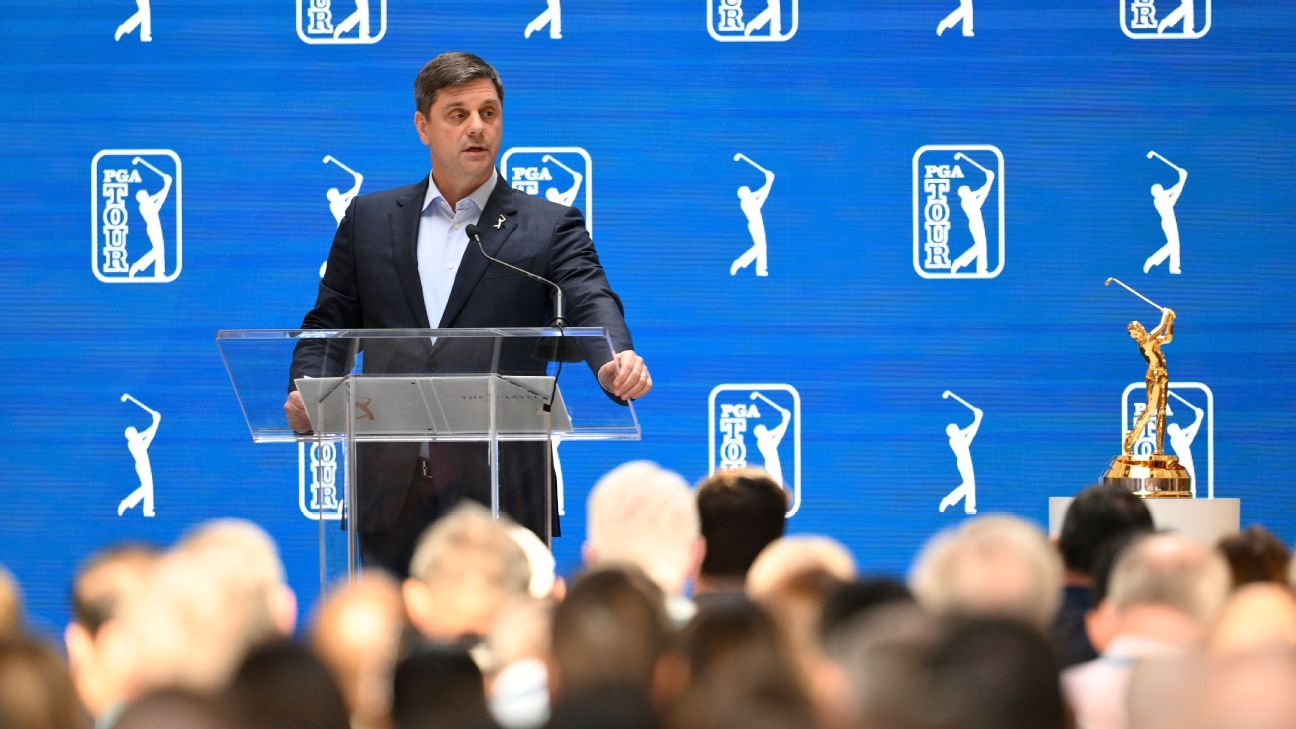
PONTE VEDRA BEACH, Fla. — PGA Tour CEO Brian Rolapp stated on Wednesday that he envisions a future tour featuring two tiers of tournaments that could promote and demote golfers based on merit within a restructured schedule, which would incorporate additional events in larger markets and a revised postseason that may include match play.
Rolapp, addressing reporters at PGA Tour headquarters prior to this week’s Players Championship at TPC Sawgrass, cautioned that the tour’s Future Competition Committee, led by Tiger Woods, is still in the process of finalizing the proposal and it is not yet a “baked cake.”
He mentioned that none of the player-led boards within the tour have given their approval to the proposals. Some modifications could be enacted before the 2027 season, while others might need to wait until 2028.
“The committee’s emphasis has been on a competitive framework based on merit,” Rolapp remarked. “This is not a closed shop. We aim to establish a more unified schedule with a more straightforward points system, allowing the top players to compete against each other more often.
“Fans recognize who the leading players are. They are the individuals who excel on the course. Our competitive framework will focus on elevating those who demonstrate their status as top performers inside the ropes.”
Rolapp indicated that six key themes have surfaced during the committee’s discussions regarding the future of the PGA Tour:
• The PGA Tour’s season is projected to commence in late January and conclude in early September, prior to the start of the NFL season. Future schedules may feature 21 to 26 tournaments within the first tier of elevated events, where top golfers would vie for the largest purses.
The 2026 PGA Tour schedule is set to include 45 events, counting the four majors, Players Championship, eight signature events, FedEx Cup playoffs, and the FedEx Cup Fall.
• Rolapp expressed that he envisions the number of signature events potentially increasing in future seasons.
• The Future Competition Committee aims to move away from smaller fields and no-cut signature events, which were introduced partly to prevent top golfers from leaving for the rival LIV Golf League.
He stated that the tour’s premier events in the future could feature 120-man fields with a 36-hole cut to provide fans with greater consistency. “That consistency is important,” Rolapp noted. “It helps fans know who they will see and highlights the most competitive players. It assists partners in understanding their investments, and it aids players in grasping the competitive landscape in their schedules, all while embracing meritocracy.”
• Rolapp mentioned that the PGA Tour aims to kick off its season “big” with a marquee tournament at a renowned golf course, ideally on the West Coast, allowing play to conclude during prime-time TV on the East Coast.
Historically, the PGA Tour has started its season with two tournaments in Hawaii, but sources have informed ESPN that future events there are uncertain due to logistical challenges and increasing costs.
This season, The Sentry at Kapalua was canceled due to drought conditions, so the season began with the Sony Open in Hawaii in Honolulu from Jan. 15-18.
Future seasons may start with a tournament at Torrey Pines, Riviera Country Club, or Pebble Beach Golf Links in California, or TPC Scottsdale in Arizona.
• The PGA Tour seeks to host more tournaments in the largest media markets in the country. Rolapp pointed out that the tour currently holds events in only four of the top 10 largest markets in the U.S.
He cited cities such as New York, Chicago, Philadelphia, San Francisco, Washington, D.C., and Boston as potential future locations.
“That represents an opportunity,” Rolapp stated. “Locations where there is strong fan interest in our sport and a chance to engage new fans.”
Rolapp clarified that targeting larger markets does not imply the tour will neglect the smaller cities where it has traditionally competed. “That is a misconception,” he remarked. “There is space for both.” – The second tier of tournaments, scheduled for the summer and possibly the fall, would enable golfers to qualify for the 21 to 26 larger events through promotion and relegation.
“There has been considerable discussion regarding scarcity,” Rolapp noted. “Ultimately, scarcity is not about the number of events we host. Instead, it is about ensuring that every event we have holds significance. Incorporating elements of that approach into the PGA Tour establishes real stakes, raising the competitive standard across the entire platform.
Rolapp likened the proposed merit-based system to that used in English professional soccer, where clubs are promoted and relegated between the Premier and Championship leagues based on their performance. He described it as an “added element that we would implement in the second tier of events.”
The relegation system would be a competitive framework with standings that are “easy to comprehend,” Rolapp stated.
“When you watch any of those tournaments, you’ll clearly understand the stakes,” he said.
“And for our members, the message is quite straightforward: Perform well and you earn the chance to compete in our premier events and for larger prizes.”
• A restructured FedEx Cup postseason could potentially incorporate match play, possibly at the season-ending Tour Championship or throughout the three postseason events.
“We have received feedback from our fans and partners; they desire more drama,” Rolapp remarked. “Introducing win-or-go-home moments to the conclusion of our season.”
Rolapp indicated that no decisions regarding the postseason format, which the tour has revised multiple times in the past, have been finalized, including whether East Lake Golf Club in Atlanta will continue to serve as the permanent venue for the Tour Championship.
