
Masters participants achieve low scores, establishing a third-round average record.
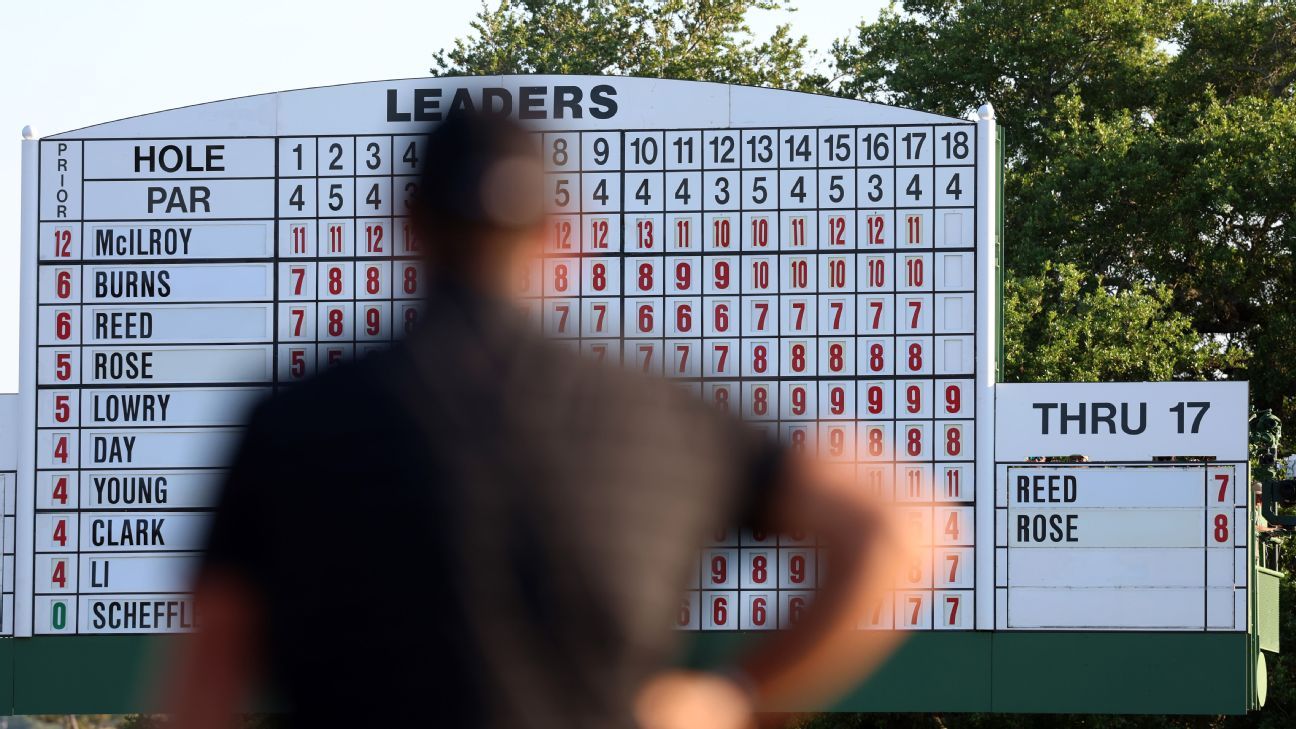
AUGUSTA, Ga. — The Masters appeared to be heading towards a decisive outcome as the weekend approached, but by the end of a thrilling Saturday, twelve players found themselves within six strokes of the lead.
At the beginning of the third round, only two competitors were within that six-shot margin.
This sets the stage for an exciting final round at the Masters: a championship that numerous prominent players have a chance to win, leading to a potentially intense conclusion.
While Rory McIlroy struggled with his driver, others were honing in on the flagsticks, with ten players achieving scores of 68 or better. Birdies were abundant, and eagles were within reach. Shane Lowry even recorded a hole-in-one on the challenging par-3 sixth.
The average score for the field on Saturday was 70.63, marking a Masters record for the third round, surpassing the previous bests of 70.769 in 2019 and 70.979 in 1986.
“The course is gettable,” Russell Henley remarked after posting a 66.
Reflecting on Saturday’s events, Jason Day suggested that being at the top of the leaderboard might not be advantageous.
“I feel like the guys that are leading right now have all the pressure,” said Day, who is at 8 under. “I’m just kind of, I’m the chaser. Usually the chasers don’t really have a lot of the pressure. Guys at the top of the leaderboard always are trying to defend the lead, whereas I’m pushing forward trying to cut into the lead.”
Cameron Young recorded a 65, matching Scottie Scheffler’s earlier round on Saturday, to tie with McIlroy. Sam Burns, just one shot behind the leaders, shot a 68. Lowry also finished with a 68 and is two shots back. Day (68) and Justin Rose (69) have moved within three of the lead, while Scheffler is tied for seventh, four back and still in contention.
“I was aware that [McIlroy] wasn’t really extending [the lead], so it felt like there was still everything to play for,” Rose stated.
Patrick Cantlay also shot a 66 after rounds of 77 and 67 in the first two days. He became the fifth player in the last 50 years to achieve back-to-back bogey-free rounds at a single Masters.
The average score has improved each round, decreasing from 74.65 to 72.85 to 70.63. The previous low for a third round was 70.77 in 2019.
“It’s playing a bit shorter because it’s firm,” Rose explained. “So if you are really on your game, there are a few more short irons, and the greens are just playable enough where with a 9-iron and a wedge, you can control your ball into certain pin locations. If it was playing as long as it typically does with the greens in their current state, that would be a pretty unplayable test of golf.
“I think what we’re gaining off the tee is offsetting a little bit the firmness of the greens.”
Rose understands that anything can transpire on Sunday at the Masters.
Last year, he trailed McIlroy by seven shots heading into the final round, only to catch him before ultimately losing in a playoff.
“I think I had to have a significant mental reset going into the final round last year,” Rose noted. “You know, this year it feels like — it feels like a little bit of a free run at it.”
Burns, who played in the final pairing with McIlroy on Saturday, mentioned that he simply aimed to concentrate on his own performance — a strategy he will continue on Sunday.
“I can’t control anything anyone else does,” Burns said. “I can only control myself, and so that’s kind of the mentality we took today. Just focus on our process and go out there and compete.”
On Sunday, Young will tee off in the final pairing with McIlroy.
He has some historical context on his side, as the last two Players Championship winners have gone on to secure the Masters title.
“Yeah, I’ll probably give myself some time to think about it right now for the next 30 minutes or so,” Young said regarding his 65. “After that, it’s kind of a battle of managing how you want to react to those things. To me, it’s just a matter of going right back to how am I going to run my day tomorrow.”
The Associated Press contributed to this report.
