
Proposed Solution for NBA to Address Tanking Issue: Focus on Win Totals
ON THURSDAY NIGHT, the Indiana Pacers will travel to the capital to compete against the Washington Wizards, marking the beginning of the NBA’s schedule following the All-Star break.
This matchup promises to be intriguing. Ivica Zubac, the Pacers’ newly acquired starting center, has yet to make his debut for the team. Similarly, both of Washington’s recent All-Star additions, point guard Trae Young and center Anthony Davis, have not played. With the presence of Pacers All-Star forward Pascal Siakam, there are numerous reasons to watch a game featuring teams with a combined total of 29 victories.
However, Zubac is still sidelined due to an ankle injury, which was confirmed by Pacers coach Rick Carlisle following Indiana’s trade for him—an injury that did not prevent him from participating in 15 of 16 games before being traded by the LA Clippers. Young is out with leg injuries diagnosed by the Wizards when they acquired him from the Atlanta Hawks last month, while Davis is also unavailable due to a hand injury sustained prior to his acquisition from the Dallas Mavericks earlier this month.
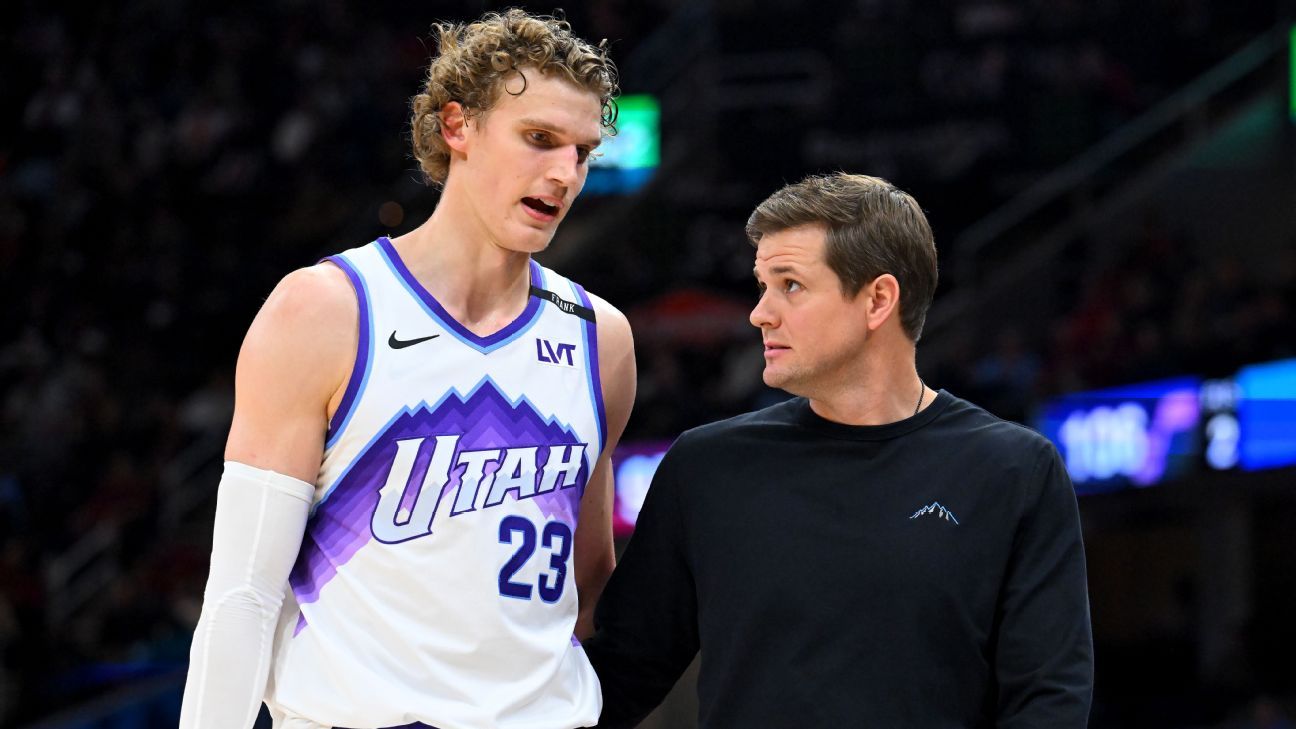
Later on Thursday, the Utah Jazz will face the Memphis Grizzlies in what would have been a homecoming for Jaren Jackson Jr., who was acquired in a surprising trade by the Jazz ahead of the February 5 trade deadline.
Instead, Utah—after playing Jackson in a few games and receiving a $500,000 fine for its management of his and Lauri Markkanen’s playing time in a game they won in Miami—has shut down Jackson for the remainder of the season following knee surgery. Both teams now appear focused solely on accumulating losses until the season concludes.
Rather than two games with captivating narratives for fans, these matchups are anything but. This is due to the fact that these three teams—Indiana, Washington, and Utah—each possess draft picks this year whose value hinges on their position in May’s lottery. They are not alone in this regard.
This is why, in two separate responses regarding tanking during his annual All-Star weekend press conference, NBA commissioner Adam Silver mentioned “incentives” five times.
“The incentives are not necessarily aligned here,” Silver stated. “I believe the tradition in sports where the worst-performing team receives the first pick from their partners, when any economist examines our system, they consistently point out: You have the incentives reversed there.
“That doesn’t necessarily make sense.”
However, in reality, it does. This is how the league has motivated teams in the lottery to act.
“Until the league alters the system,” an Eastern Conference executive remarked, “teams will continue to lose if that remains the best method to acquire players.”
Consequently, any conversation about tanking and potential solutions must begin with the same inquiry: What remedy exists that could modify those incentives?
What follows is a proposal aimed at addressing the NBA’s tanking issue from a veteran league executive.
IN MUCH OF the dialogue surrounding efforts to rectify tanking, the emphasis has been on diminishing the focus on losing. Each suggestion—from eliminating the ability to protect picks in the middle of the draft lottery to abolishing the draft entirely to completely equalizing the odds—would all make it less appealing for teams to lose.
However, none of these proposals encourage teams to win. But this plan does.
Currently, the order for the NBA draft lottery is determined by which teams have the highest number of losses at the conclusion of the regular season. But consider: At a specific point in the regular season—let’s say, the All-Star break—things would reverse, and for the remainder of the season, a team’s victories would contribute to enhancing its lottery odds instead.
How would this function in practice? Let’s use last season’s standings as an illustration. Here is how last season’s lottery standings would have shifted if this rule had been implemented for games following the All-Star break:
The Toronto Raptors (due to an exceptionally favorable schedule that even strong attempts to tank could not overcome), Chicago Bulls, and Hawks would have been the major beneficiaries. Toronto would have advanced from No. 7 to No. 2, Chicago would have climbed from No. 12 to a tie for No. 3, and Atlanta would have progressed from a tie for No. 13 to No. 8 in the lottery odds.
In contrast, the Jazz and 76ers—who each recorded a 4-24 record after the All-Star break—would have fallen from No. 1 and No. 5 in the lottery standings to a tie for No. 5 and a tie for No. 12, respectively.
Now, since I cannot rewrite history, let’s examine what the lottery would have looked like last season if teams had merely replicated their winning percentages from before the break through the final months of the season:
Utah would have dropped to No. 3 (from No. 1), and Philadelphia would have fallen to No. 7 (from No. 5), while Chicago and Atlanta would have risen to No. 8 (from No. 12) and No. 10 (from No. 13), respectively. Although there was some minor movement in the standings, it did not drastically alter the rankings.
One argument against implementing this system is that it would have too significant an impact on teams at the bottom of the standings. However, the fact that a Wizards team that went 9-45 before the All-Star break last season would still secure the top spot with a 5-23 record afterward highlights that this should not pose a major issue.
Moreover, the objective must be to create a necessity for teams to strive for victory.
“Anything that would reasonably motivate teams to win is better for the fans and results in a more favorable outcome than ‘the team needs to acquire a star,'” a Western Conference scout noted.
“The more enjoyable scenario at the end of the day is everyone competing.”
IN ALL THE conversations on this subject, it is that final point—endeavoring to create the best product possible—that often gets overlooked.
Envision a scenario where the Pacers, Wizards, and Jazz would all gain from playing Zubac, Young, Davis, and Jackson Jr. during the season’s final stretch. Would those teams not be significantly more entertaining, and their fans more engaged?
What about Kyrie Irving, who ESPN’s Shams Charania reported Wednesday has been ruled out for the season, being given a reason to return and gain some on-court experience with Mavericks rookie Cooper Flagg this season? What about resolving the soon-to-be awkward conversation between Milwaukee Bucks superstar Giannis Antetokounmpo, who has repeatedly expressed his desire to return and play this season, and a franchise that is much better off not having the best player in franchise history do so?
Then consider a young team like the Charlotte Hornets, a franchise that has been deprived of success for nearly two decades. Under the current system, if the Hornets make a strong push in the second half and miss the playoffs, they are likely to end up with a late lottery pick instead of a solid opportunity at acquiring another impactful talent.
Under this proposal, a team finishing strong like Charlotte would be rewarded with an improved chance of moving up in the draft.
At present, however, the opposite is occurring.
As of Thursday night, one could reasonably argue that nine teams—the Wizards, Jazz, Bucks, Mavericks, Pacers, Bulls, Grizzlies, Sacramento Kings, and Brooklyn Nets—will likely spend the next two months doing everything possible to lose every game. That accounts for 30% of the league (and it would be even higher if the Hawks and New Orleans Pelicans controlled their top picks).
All of this fosters damaging apathy.
“[This proposal] would be a very unique way to engage your fan base instead of this slow drift away until the lottery in May, because there’s nothing to cheer for,” an Eastern Conference scout remarked.
“It’s not just the teams. It’s communities, bars, restaurants… there are many people who depend on an entertaining product for their livelihoods. And I empathize with them.”
LIKE WITH ANY rule modification, specifics are crucial.
A definitive date would need to be established—some sources ESPN consulted advocated for the trade deadline, others for the All-Star break, and some preferred tying it simply to a number of games on the schedule. If it is the All-Star break, the NBA would need to adjust the schedule to ensure that every team played the same number of games prior to it.
Over the past week, ESPN spoke to more than 10 coaches, scouts, and executives across the NBA regarding this concept. Each individual supported its implementation, citing the fact that it genuinely affects the incentives that underlie how teams are operating. However, some had concerns they wished to address.
The first concern was to avoid severe penalties for the worst teams. To tackle that, one source proposed a modification to this idea with weighted wins and losses; this approach, the source suggested, would still motivate teams to win but would not penalize the less-skilled teams as harshly.
The second concern involved teams with a star player who might suffer a legitimate injury, which could derail an otherwise promising season and, under this proposal, negatively impact their lottery positioning.
A third concern was that teams, knowing they had two fewer months to implement any tanking strategy, would be even more aggressive in attempting to do so in the early months of the season.
That said, given how the initial months of this season have unfolded, it is difficult to argue that competitiveness could deteriorate much further.
“We want to ensure fair competition,” Silver stated over the weekend. “We aim to have equitable systems and to prioritize the fans, most importantly, and their expectation that we will be presenting the best product possible.”
As the NBA begins to thoroughly evaluate how to address tanking in the coming months, and what measures it will implement to mitigate the issue, this should be the league’s guiding principle: how it will deliver its best product.
Every other plan that has been discussed or debated does the opposite. Each focuses on how to make the product less unfavorable, rather than enhancing it.
There is a reason the concept of relegation—while it will never occur for countless reasons in the NBA, or any other sports in the United States—is regarded as a method to eliminate this problem. There is no reason for an English Premier League team to enter a game contemplating losing. Instead, its sole focus is on winning.
This idea will be revisited at the NBA’s board of governors meeting next month, and it has some support. Whether it will be enacted, however, and whether the issue will finally be resolved, remains uncertain.
