
“Marcus Smart’s Comeback Following The Punch: A Look Inside”
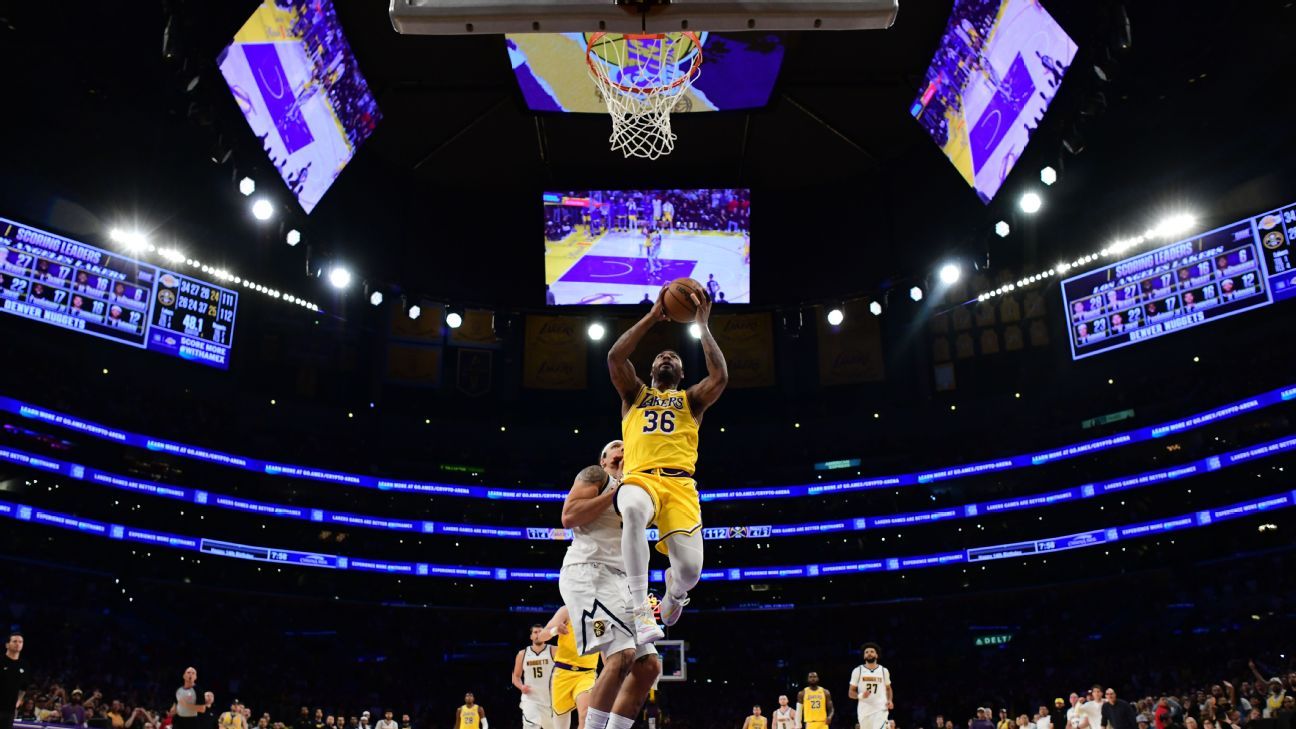
MARCUS SMART WAS examining Anthony Edwards’ shooting statistics in the box score while seated in front of his locker. It was March 10, shortly after the Los Angeles Lakers triumphed over the Minnesota Timberwolves 120-106, moving up from fifth to third in the Western Conference playoff standings.
As Smart analyzed the details, his fatigue shifted to a sense of satisfaction.
Edwards, the 24-year-old star of the Minnesota Timberwolves, managed only 14 points and shot 2-for-15 from the field, including 0-for-5 during the 23 possessions Smart defended him.
The same Edwards who had previously overwhelmed the Lakers’ wing defenders last spring, averaging 26.8 points in the lower-seeded Wolves’ five-game series victory over L.A., was effectively contained by Smart, the former Defensive Player of the Year who joined the Lakers on a reduced contract following that first-round defeat.
While the victory offered a flicker of optimism for this year’s Lakers team, which has shown inconsistency on both ends of the court, it held greater significance for Smart.
At 32, he was not expected to still be defending All-Stars.
This was particularly true after two injury-plagued seasons that rendered him less relevant.
He participated in 20 games for a 27-win Memphis Grizzlies team in 2023-2024 and 15 games for an 18-win Washington Wizards team the previous year, while his former team, the Boston Celtics, thrived without him.
Moreover, he certainly was not anticipated to be clutching the stat sheet with his right hand, which he had nearly lost eight years prior.
All these factors shaped Smart’s mindset for this season—one he has encouraged the Lakers’ star trio of LeBron James, Luka Doncic, and Austin Reaves, along with the rest of the roster, to embrace: If he can alter the course of his career at this stage, given his past challenges, who is to say the Lakers cannot do the same in the final months of the season?
“We’re tired of hearing people talk s—, basically,” Smart told ESPN. “I know I am. And if you’re a competitor, if you have any type of competitor in you, you’re going to be tired of that too. So you want to try to prove ’em wrong.”
DESPITE PLAYING 56 games for the Lakers thus far, and leading the team with a plus-minus of plus-209, the most pivotal shot of Smart’s career in L.A. occurred as a visitor.
On January 23, 2018, the Celtics, then the top team in the East, faced the Lakers, who were positioned at No. 11 in the West.
Former Lakers guard Kentavious Caldwell-Pope went to the line with 5.7 seconds left, L.A. ahead by one, but missed both free throws, with the second bouncing off the rim and into Smart’s possession.
Smart, who had already scored 22 points in the game, grabbed the rebound and raced up the court until he reached the 3-point line, where he attempted a shot at the buzzer.
His attempt hit the front of the rim and bounced out, resulting in a 108-107 loss for the Celtics.
Later that evening, at the team hotel, he replayed the moment in his mind, and frustration surged.
He struck a picture frame in his room, shattering the glass and embedding a 5-inch shard in his palm.
“I got rushed to the ER and lost a lot of blood,” Smart recounted to ESPN. “I passed out. … That’s how much I lost.”
Upon regaining consciousness, after receiving 20 stitches, Smart understood the seriousness of his injury.
“The doctor looked at me in my eye and told me, ‘I don’t know how you still have use of your right hand,'” Smart said. “‘You should honestly be thanking God every day.'” The shard of glass had come perilously close to severing the use of his hand entirely. “They said it laid perfectly in between every tendon in my hand without damaging anything,” Smart explained. “And they had to leave the extra piece in, because they said it would cause more damage if we went to remove it.”
Smart missed 11 games before returning to the court, aiding Boston in reaching Game 7 of the Eastern Conference finals that season before falling to James and the Cleveland Cavaliers.
The Celtics made the playoffs in all nine seasons Smart was with them, including a run to the 2022 NBA Finals to conclude his DPOY campaign, before losing in six games to the Golden State Warriors’ dynasty.
The following year, Boston was eliminated by the eighth-seeded Miami Heat in the 2023 conference finals, prompting the team to restructure, which resulted in Smart being traded to Memphis in a three-team deal that brought Kristaps Porzingis to the Celtics.
It was in Memphis that Smart began to lose his grip—both figuratively and literally—on his career.
SMART’S RIGHT HAND is crucial to his primary skill: his defensive anticipation. He has accumulated over 1,000 steals throughout his career by placing his hands in the right spots. However, his hand sustained further damage in Memphis.
In January 2024, he ruptured a tendon in his proximal interphalangeal joint—the area where the finger bends—resulting in the end of his season.
“I’ve had two dislocations with torn ligaments in two of the fingers,” Smart stated. “I’ve had glass in my hand. I’ve torn ligaments in my right thumb and had surgery there. I dislocated four out of my five fingers in total … my whole right hand has been through a lot. So to be honest, I’m blessed to even have my right hand.
“For six years after the incident with the glass, I still had glass in my hand and I played with it. And there were times when, because of that, my hand would go numb. Many times, during games, I couldn’t control it. I had to play, and there were numerous occasions when I was shooting the ball and just had no feeling in my arm or hand.”
Meanwhile, Memphis faced larger issues. Ja Morant, suspended for the first 25 games of 2023-24, played only nine games, leading to a roster so plagued by injuries that 33 different players participated at some point that season.
The Grizzlies missed the playoffs—marking the first time in Smart’s career that he was part of a team that did not qualify for the postseason—while his former team returned to the Finals to compete against Doncic and the Dallas Mavericks. “I was watching every bit of it,” Smart admitted. “Does it hurt? Of course it hurts because you were there from the beginning before 2014, when Avery Bradley was still there, you were in the rebuild, and you watched everything grow. You were there when the seed was planted. So it definitely hurt.”
The start of his next season in Memphis was even more challenging.
In the first five games, Smart averaged just 5.6 points on 23.5% shooting (16.7% from 3), and the Grizzlies stumbled to a 2-3 record.
After an ankle injury sidelined him for two weeks, Smart returned, and Memphis went 10-2 in its next 12 games before he suffered a partial tear of the proximal extensor hood of his right index finger.
During this period, Smart sensed a change in how the Grizzlies organization treated him.
He felt pressured to play through the injury.
“I wanted to be 100%, to give everything I got,” Smart explained. “As I’m still working out and getting ready, they’re just like, ‘No, your doctor said you’re ready now.’ And I’m like, ‘I hear what my doctor said, but … it’s how I feel. Yes, surgically the finger is fine. But physically, no. The finger is still weak. I’m still strengthening it. This is my dominant hand.’ So, they didn’t want to hear it and just kept insisting, ‘You need to play.’
Additionally, during his rehabilitation, Smart heard “a rumor going around that people said I don’t want to be here,” he said, despite actions that suggested otherwise—from gifting customized boxing gloves to his teammates, to his wife inviting the roster to his birthday celebration, to writing personalized holiday cards and including gift cards for all the staff.
After a 21-game absence, he returned to the lineup on February 5, 2025, against the Toronto Raptors.
His hand still felt off—he went 0-for-6—but Memphis outscored Toronto by five points during the 18 minutes he was on the floor in the victory.
What transpired next made him feel like the “scapegoat” for a franchise in turmoil, Smart stated. The following day, he was traded to Washington.
When contacted by ESPN regarding Smart’s assertions, the Grizzlies declined to comment.
The trade was part of a three-team deal with the Sacramento Kings. Memphis had to include a first-round pick in what effectively became a salary dump to relieve itself of the remaining $20.2 million on Smart’s contract for 2024-25 and $21.3 million for the subsequent season.
This maneuver allowed Memphis to avoid luxury tax implications with its planned extension for Jaren Jackson Jr.
“The Marcus that you got intel on from Memphis was probably not as consistent with the Marcus that he was in Boston and in his entire career,” a Wizards source told ESPN.
“I think a lot of factors contributed to that. But at the core, we knew who he was as a person and felt very comfortable adding him to our group. And he exceeded expectations in the short time he was with us.”
Smart commended the Wizards for their support during the 2½ months he spent with the team.
“Washington was great,” Smart said. “I just had to get healthy. … That was my main focus.”
In July, Smart reached a buyout agreement with the Wizards to become a free agent, returning $6.5 million of his 2025-26 contract according to ESPN’s NBA front office insider Bobby Marks.
Then the Lakers expressed interest.
L.A. HAD LIMITED options to enhance its roster following that playoff defeat to the Wolves.
Aside from trading a future first-round pick, the Lakers’ only means to reshape their roster was to open up the $14.1 million non-taxpayer midlevel exception by not re-signing Dorian Finney-Smith, along with the biannual exception.
Deandre Ayton and Jake LaRavia split the MLE, and Smart—who was recruited with a phone call from Doncic—received the biannual exception, agreeing to a two-year, $11 million contract, with a player option for the second year.
He aimed to demonstrate that despite being 12 years into his career, his last two seasons were outliers, not indicative of a decline.
Upon his arrival in L.A., he discussed with coach JJ Redick the role he envisioned for himself.
Redick recalls their conversation.
He was at a Fini Pizza in Amagansett, in the Hamptons, and stepped outside to take the call.
“I told JJ, ‘I’m going to go out here and give you everything I got,'” Smart said. “‘I just ask that if I do earn it, then let me have it. Don’t play too many politics.’ And that’s all I asked, and that’s all you can ask.”
Redick conveyed three key points to Smart, now that he had cleared waivers from Washington and was deciding on his next destination. “It was, ‘We need you. We need your defense. We need your voice,'” Redick said. “The second part was, ‘I know you because I’ve played against you and I’ve competed against you. … You’re at your best when you’re playing for something. If you come here, we can be playing for something.’ And he agreed with that.”
And the third? “‘You’re going to play,'” Redick said he told Smart. “‘I don’t know exactly what that looks like, but I’m very confident that if you’re at your best, you’re going to play a lot.’
Redick kept his promise, starting Smart in 49 games as he has averaged 9.6 points, 2.8 rebounds, 2.8 assists, and 1.4 steals per game, and tolerating his 40.3% shooting from the field and 34.0% from 3 largely due to the Lakers’ 111.1 defensive efficiency with Smart on the court. It drops to 117.7 with him off this season.
Smart has drawn 19 charges this season, tied for the second most in the NBA, already surpassing the 16 he drew during his DPOY campaign—with still a month remaining in the regular season.
“He competes every night,” Reaves told ESPN. “It’s not always pretty, but his competitive level’s going to be at an all-time high every single night. And you need guys like that. I think he’s the one that sets the example for us on the court to go out there and play as hard as we possibly can, because you know he’s going to do that.
“When he’s doing that, every single night flying around, it makes you be accountable to the effort that you bring.”
“WHO TOLD YOU to miss it?” a surprised Smart asked Reaves.
On Saturday, just after the Lakers had edged the Denver Nuggets 127-125 in overtime, Smart was not inclined to discuss his strip of Aaron Gordon that led to a crucial layup with less than a minute remaining in the fourth quarter, one of his five steals.
He was also not interested in talking about the go-ahead 3 he made with 30 seconds left in OT that put the Lakers ahead by two.
He didn’t even want to mention his role in limiting a notorious Lakers nemesis, Jamal Murray, to five points on 1-for-14 shooting.
What excited Smart was his contribution to the strategy, advising Reaves that when he went to the foul line for two shots with 5.2 seconds left in the fourth and the Lakers down by three, he should intentionally miss the second shot.
Reaves executed the miss flawlessly, and L.A. held on in the extra period to maintain its late-season momentum.
“I feel like every game,” Doncic remarked about Smart after the Denver win, “he does something different to help us win.”
His defensive commitment has remained unwavering.
Smart has limited 2026 All-Stars, such as Murray and Edwards, to a 44.3% effective field goal percentage when he has defended them, ranking fifth among 75 players who have defended over 100 shots this season, according to ESPN Research.
“He brings a grittiness and a point-of-attack defender that maybe they didn’t have a year ago,” said Wolves coach Chris Finch. “A guy that can mark somebody all by himself, without a ton of help. Which is really significant, particularly in the playoffs.”
And on a team with Reaves, Doncic, and James making headlines, Smart has made his presence felt in the locker room as a vital voice.
“On this team, we have a lot of egos, which isn’t to say that these egos are out of control or negative. It’s just that everyone is different,” Smart explained regarding his approach. “We have various personalities, and sometimes they just don’t mesh at the right time. It’s all about timing with everything.
“And sometimes you might not feel good on a particular day or you might be having a poor game or a bad stretch, and it just doesn’t feel right. So for me, my leadership was to ensure I can keep the guys united, maintain positivity, and prevent us from falling into that sunken place that you see most teams enter when they’re struggling.”
There have been challenging periods for Smart this season as well—just as for the team. He has missed games due to back spasms. He went 1-for-12 in a loss to the LA Clippers, 2-for-9 in a loss to the New York Knicks, and 0-for-7 in a loss to Boston.
Nevertheless, he has persevered. On March 3, with L.A. clinging to a four-point lead in the closing minutes against the New Orleans Pelicans, Smart received a pass from Doncic in the corner and made the 3-pointer to extend the lead to seven with 1:34 remaining, sealing the victory—in a game where he also recorded seven assists, four steals, and three blocks.
“To have the trust to say, ‘You know what? I’m going to give it to this guy in the corner right here,’ I definitely think that it stems from the blocks, the steals, the energy that I bring,” Smart stated. “Knowing that this guy’s working. And let’s reward him.”
He has recorded the third-most starts, fifth-most minutes, and sixth-most shot attempts this season for the Lakers. He has been involved in every aspect of their play.
“He’s made an impact on winning,” Redick said. “And I think that ultimately is … that’s how you rewrite the narrative of your career, is if you’re on a winning team.”
ESPN’s Matt Williams contributed to this report.
