
Jalen’s Impact: A Singular Name’s Influence on the NBA Unmatched by Others
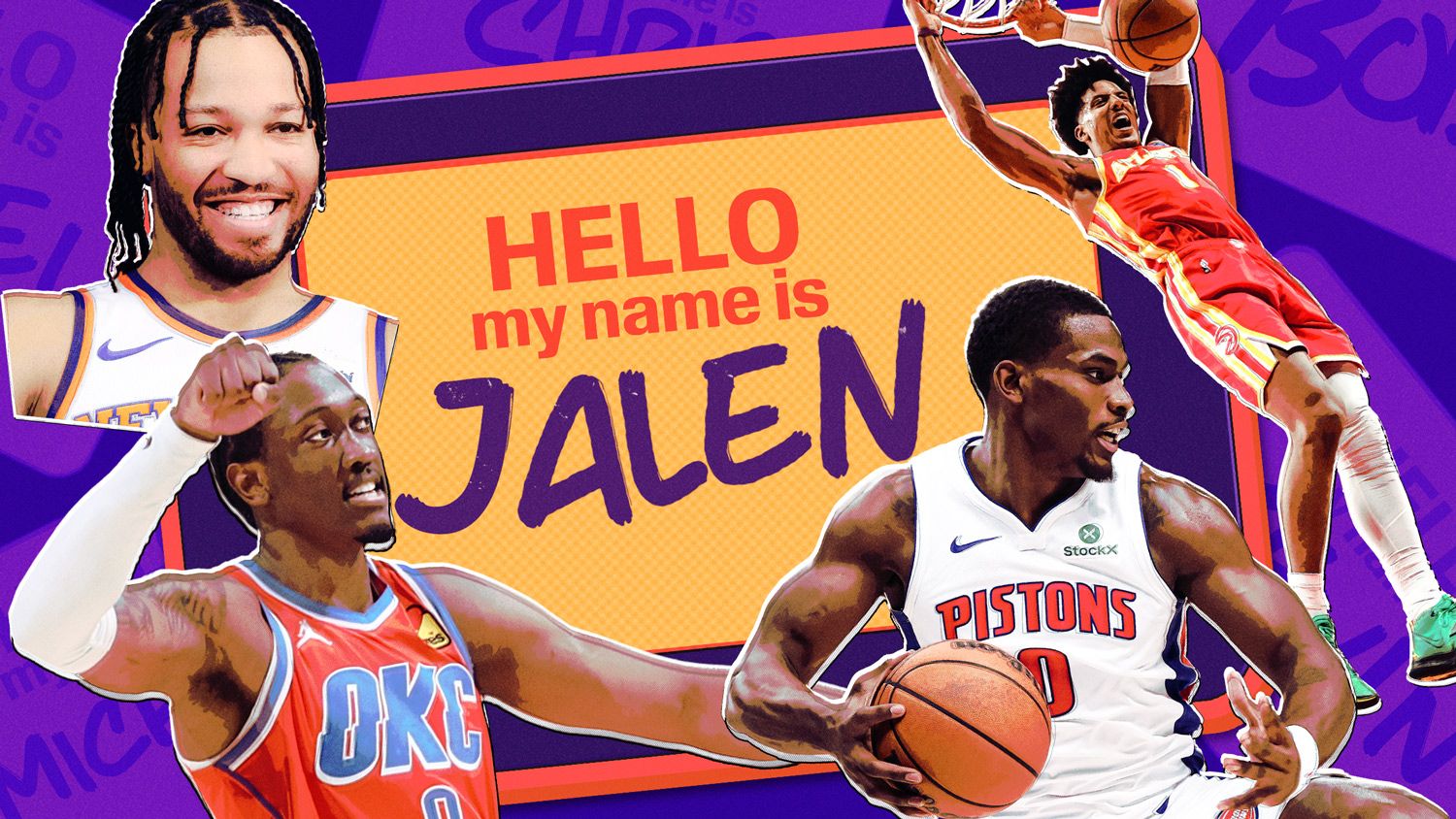
This year’s NBA All-Star Game introduced a fresh format: 16 American players, eight international athletes, and four players sharing the same name.
These players alone constituted one-third of the Eastern Conference’s representation. Jaylen Brown earned his fifth All-Star selection, Jalen Brunson made his third consecutive appearance, while Jalen Johnson and Jalen Duren received their inaugural All-Star honors. The four players collectively set a record for the most same-name All-Stars in a single NBA season.
Additionally, more Jalens (along with Jaylens, Jaylins, and Jaylons) beyond this All-Star group are thriving in the NBA. For instance:
-
Jalen Williams, Oklahoma City Thunder: An All-NBA and All-Defensive selection who scored 40 points in a Finals game last season.
-
Jalen Suggs, Orlando Magic: A recent All-Defensive team member boasting some of the league’s top advanced statistics.
-
Jaylon Tyson, Cleveland Cavaliers: Emerging in his second season with the Cavaliers, Tyson is averaging 14 points with a 48% shooting rate from beyond the arc.
-
Jaylen Wells, Memphis Grizzlies: Last season’s third-place finisher for Rookie of the Year.
-
Jalen Smith, Chicago Bulls: A player who initially seemed to be a bust but is quietly evolving into a solid two-way big man.
-
Jaylin Williams, Oklahoma City Thunder: A versatile backup big who contributed to defending Nikola Jokic in last season’s playoffs.
There are also Phoenix Suns’ Jalen Green (who has seen limited action this season due to injury but averaged 20.9 points over the past three seasons), Minnesota Timberwolves’ Jaylen Clark, Denver Nuggets’ Jalen Pickett, and Brooklyn Nets’ Jalen Wilson.
This totals 14 players, featuring a well-rounded mix of stars and role players; guards, wings, and big men; as well as scorers, shooters, rebounders, and defenders. In essence, a team composed of Jalens could secure numerous victories.
The statistics support this. According to the projection system managed by ESPN’s Kevin Pelton, if these players united, Team Jalen would forecast the best offense in the league with a projected record of 55-27.
Clearly, the Jalens could establish the top same-name team in the contemporary NBA. But how do they compare historically?
We aimed to address this question with a playful hypothetical: Imagine a fantastical scenario—akin to a hoops fan version of Marvel Comics’ Beyonder—staged as a tournament featuring every same-name team in NBA history. Who would be the frontrunners?
We combined nicknames with their official names, so players known as Mike and Michael are on the same team, and we disregarded spelling variations as long as the pronunciation remains consistent, thus including Jaylen, Jaylin, and Jaylon in the Jalens team.
Applying these criteria, we compiled a list of over 1,000 eligible same-name teams throughout NBA history, meaning at least five players with that name participated in the same season. From this, we ranked the top 10 historical contenders alongside the 2026 Jalens, limiting each set of same-name players to one entry. For example, since the 2026 Jalens are included, the 2025 Jalens are not.
Many of the greatest players in NBA history were not eligible for consideration. For instance, LeBron James does not feature on any of these teams, as there have only been two LeBrons in NBA history. Meanwhile, other names have star duos and trios but lack sufficient depth to qualify, such as these modern combinations:
-
Anthony Davis and Anthony Edwards
-
Tyrese Haliburton and Tyrese Maxey
-
Paul George, Paul Pierce, and Paul Millsap
-
Nikola Jokic, Nikola Vucevic, and Nikola Mirotic
To qualify for this list requires star power, depth, and a widely recognized name. As we countdown to the projected winner of this hypothetical tournament, here are the best same-name teams in NBA history, along with their starting lineups and any notable reserves they would deploy in our NBA battle world throwdown.
Thanks to Mike Lynch of Basketball Reference for his research assistance.
Jump to an All-Name team:
1956 Bobs | 1969 Bills
1973 Daves | 1978 Bobs | 1988 Michaels
1989 Marks | 2004 Michaels | 2005 Jasons
2008 Chrises | 2012 Kevins | 2026 Jalens

11. 2008 Chrises
G Chris Paul, New Orleans Hornets
G Chris Duhon, Chicago Bulls
G Chris Quinn, Miami Heat
F Chris Bosh, Toronto Raptors
C Chris Kaman, LA Clippers
Notable Reserves: F Chris Wilcox, Seattle SuperSonics; F Kris Humphries, Toronto Raptors
The first team on this list illustrates the difficulty of assembling a well-rounded same-name team. The youthful Paul/Bosh duo is the highlight here, as Bosh partners with another member of the banana boat squad, three years prior to his collaboration with LeBron James and Dwyane Wade in reality. However, the absence of true shooting guards or small forwards—unfortunately, Khris Middleton did not join until the latter part of Bosh’s health-impacted career—leaves the Chrises in a challenging position on the wing.
The 2009 Chris squad was also considered for this position, featuring the same starters except Kaman, who was replaced by Chris “Birdman” Andersen, who received award votes in his first full season back from a drug suspension. The 2008 group receives a slight edge, however, as Paul finished second in MVP voting that year.
10. 2004 Michaels
G Mike Bibby, Sacramento Kings
G Michael Redd, Milwaukee Bucks
G Michael Finley, Dallas Mavericks
F Mike Miller, Memphis Grizzlies
C Michael Olowokandi, Minnesota Timberwolves
Notable Reserves: G Mike James, Boston Celtics/Detroit Pistons; G Mickael Pietrus, Golden State Warriors; F Mike Dunleavy, Golden State Warriors
The 2004 Michaels boast the best shooting team in the field: In 2003-04, Bibby, Finley, Miller, James, and Dunleavy all shot 37% or better from 3-point range, while Redd earned All-NBA third team honors due to his dynamic perimeter performance. Redd ranked 12th among qualified players in points per game, while Finley (29th) and Bibby (32nd) also posted impressive scoring figures.
The roster’s evident weakness lies in size, lacking true power forwards and featuring only subpar centers. Nevertheless, the 2004 Michaels would play an entertaining, fast-paced style of basketball—ironic, considering that 2003-04 was notoriously one of the slowest-paced, lowest-scoring seasons in NBA history.
9. 2005 Jasons
G Jason Kidd, New Jersey Nets
G Jason Williams, Memphis Grizzlies
G Jason Terry, Dallas Mavericks
G Jason Richardson, Golden State Warriors
C Jason Collins, New Jersey Nets
Notable Reserves: G Jason Hart, Charlotte Bobcats; F Jason Kapono, Charlotte Bobcats
Similar to the Michaels from the same era, the 2005 Jasons are lacking in size and defense—their four best starters and top two reserves are all perimeter players—but are rich in playmaking and entertainment value. Every fast break would present a highlight opportunity, with Kidd and “White Chocolate” Williams throwing alley-oops to two-time dunk contest champion Richardson.
Terry and two-time 3-point contest champion Kapono would contribute ample shooting, as both players shot over 40% from beyond the arc in 2004-05.
The Jasons would not win the tournament, as they would struggle to defend against any star taller than 6-foot-6. However, they might be the most entertaining team.
8. 1989 Marks
G Mark Price, Cleveland Cavaliers
G Mark Jackson, New York Knicks
F Mark Aguirre, Dallas Mavericks/Detroit Pistons
C Mark West, Phoenix Suns
C Mark Eaton, Utah Jazz
This starting lineup lacks a true top-tier superstar but is filled with solid contributors. Price and Jackson were young All-Star guards in 1989. Aguirre averaged 19 points and was a key midseason acquisition for the champion Detroit Pistons. Eaton won his second Defensive Player of the Year award and received down-ballot MVP consideration.
Unfortunately, the Marks’ bench is quite thin—forward Mark Alarie is the only Mark outside the top five who logged 1,000 minutes in 1988-89—and they lack shooters beyond Price. However, this team is balanced enough that it would not be an easy opponent for anyone.
7. 1956 Bobs
G Bob Cousy, Boston Celtics
G Bobby Wanzer, Rochester Royals
G Bob Harrison, St. Louis Hawks
F Bob Pettit, St. Louis Hawks
C Bob Houbregs, Fort Wayne Pistons
Pettit and Cousy rank among the best players in NBA history, finishing first and third, respectively, in the inaugural MVP voting in 1956. (They actually placed 1-2 in MVP voting in 1957, with Cousy winning, but the supporting cast for the Bobs was weaker that season.) Their presence is the reason for the Bobs’ inclusion on this list, as the earliest team among the contenders.
Cousy and Pettit are certainly the most notable Bobs from the early NBA, but they were not alone in talent. The lesser-known Wanzer made his fifth consecutive All-Star appearance in 1956 on his way to Hall of Fame induction. Harrison—who later coached at Harvard and once scored all 139 points for his team in an eighth-grade game—averaged 8.6 points and was also an All-Star. Houbregs also achieved Hall of Fame status despite playing only five seasons and averaging a career 9.3 points. Early professional basketball, it must be noted, was a peculiar environment.
6. 1969 Bills
F Bill Bradley, New York Knicks
F Billy Cunningham, Philadelphia 76ers
F Bill Turner, San Francisco Warriors
F Bill Bridges, Atlanta Hawks
C Bill Russell, Boston Celtics
This team features some of the best top-end talent in this entire analysis. Three of the starters are Hall of Famers, with Cunningham and Russell finishing third and fourth, respectively, in MVP voting in 1969. Bridges, meanwhile, was recognized as an All-Defensive selection.
While opposing 11-time champion Russell might be a fool’s errand—especially since the Bills would excel in defense and rebounding—they would likely face challenges in scoring and playmaking. Only in his second season, Bradley was not yet in his prime during the 1968-69 season—he shot just 43% from the field, a figure he would surpass in every subsequent season of his career—and Russell led the team with 4.9 assists per game. Thus, the Bills rank in the middle of the pack rather than near the top.
5. 2012 Kevins
G Kevin Martin, Houston Rockets
F Kevin Durant, Oklahoma City Thunder
F Kevin Garnett, Boston Celtics
F Kevin Love, Minnesota Timberwolves
C Kevin Seraphin, Washington Wizards
The Kevins would struggle due to the absence of a bench. None! There were only five Kevins in the NBA during the early 2010s.
However, what a quintet this is. It includes at least two, possibly three Hall of Famers. (Garnett is already enshrined in Springfield, Durant is on track for induction after retirement, and Basketball-Reference’s model gives Love a 68% chance of being inducted.) This group features one of the greatest scorers, one of the best defenders, and one of the top rebounders in NBA history.
In 2011-12, Durant secured the scoring title and finished second in the MVP race, Love ranked fourth in scoring and second in rebounding, leading to a sixth-place MVP finish, while Garnett remained a formidable presence near the end of his career, averaging 16 points and finishing fifth in Defensive Player of the Year voting. This was a down year for Martin—his last in Houston before joining Durant in Oklahoma City via the James Harden trade—but it marked the best of Seraphin’s career.
Ultimately, this team revolves around the star trio, with Martin’s 3-pointers serving as a bonus. If only there were more Kevins to create a bench so that 35-year-old Garnett wouldn’t have to play every minute of this hypothetical tournament, the Kevins might have a chance to win it all.
4. 1973 Daves
G Dave Bing, Detroit Pistons
G Dave Wohl, Portland Trail Blazers/Buffalo Braves
F Dave Stallworth, Baltimore Bullets
F Dave DeBusschere, New York Knicks
C Dave Cowens, Boston Celtics
Four Hall of Fame Daves existed in the 1970s, but since DeBusschere retired before David Thompson entered the NBA, the Daves are limited in this tournament to just three future inductees: Bing, DeBusschere, and Cowens. Cowens won the MVP award in 1973, while DeBusschere, a leader of the championship Knicks, and Bing were All-Stars who received MVP votes.
Similar to the Kevins, the Daves face challenges due to a lack of depth beyond their big three; even Wohl and Stallworth, the other two starters, averaged single-digit points in 1972-73. Unlike the Kevins, however, there are some lesser Daves available to fill out a rotation. The balance among three NBA legends—one guard, one forward, and one center—suffices to elevate them into the top four.
3. 2026 Jalens
G Jalen Brunson, New York Knicks
G Jalen Williams, Oklahoma City Thunder
F Jaylen Brown, Boston Celtics
F Jalen Johnson, Atlanta Hawks
C Jalen Duren, Detroit Pistons
Notable Reserves: G Jalen Suggs, Orlando Magic; G Jalen Green, Phoenix Suns; G Jaylon Tyson, Cleveland Cavaliers; G Jaylen Wells, Memphis Grizzlies; F Jaylin Williams, Oklahoma City Thunder; C Jalen Smith, Chicago Bulls
The 2020s represent a golden era for Jalens across sports, largely due to Jalen Rose. The name Jalen does not appear on the U.S. Social Security Administration’s list of the top 1,000 baby boy names in any year prior to 1992, which coincided with Rose’s first season as a member of the Fab Five at the University of Michigan. However, it has been recorded every year since, peaking among the 150 most popular names for baby boys in 2000, 2001, and 2002—when Jalen Williams, Johnson, Suggs, Smith, Green, and Wilson were born. The alternate spelling of Jaylen also surged during Rose’s time at Michigan and now ranks among the top 300 boys’ names annually.
All these Jalens would form an exceptional basketball team; there is a distinct gap in overall quality between the top three teams in this tournament and their competitors. The Jalens possess five All-Star-caliber starters and strong reserves, benefiting from excellent balance in scoring and defense across various positions.
They could improve even further in the future. Brown, Johnson, and Duren have all made significant strides and are candidates for Most Improved Player this season, while Jalen Williams and Suggs could see enhanced performance with better health in upcoming seasons.
However, one relative weakness prevents the Jalens from ranking higher: Their top-tier talent does not quite match that of the competition. Brunson and Brown are the most likely future Hall of Famers from this group, but they still have a considerable journey ahead to reach Springfield, as their odds of induction if they retired today are in the single digits, according to Basketball-Reference. In contrast, other historical same-name teams feature multiple Hall of Fame inductees in their prime.
2. 1988 Michaels
G Michael Adams, Denver Nuggets
G Michael Jordan, Chicago Bulls
G Michael Cooper, Los Angeles Lakers
F Michael Cage, LA Clippers
C Mychal Thompson, Los Angeles Lakers
<
