
How the sports collectibles sector works to combat fraud
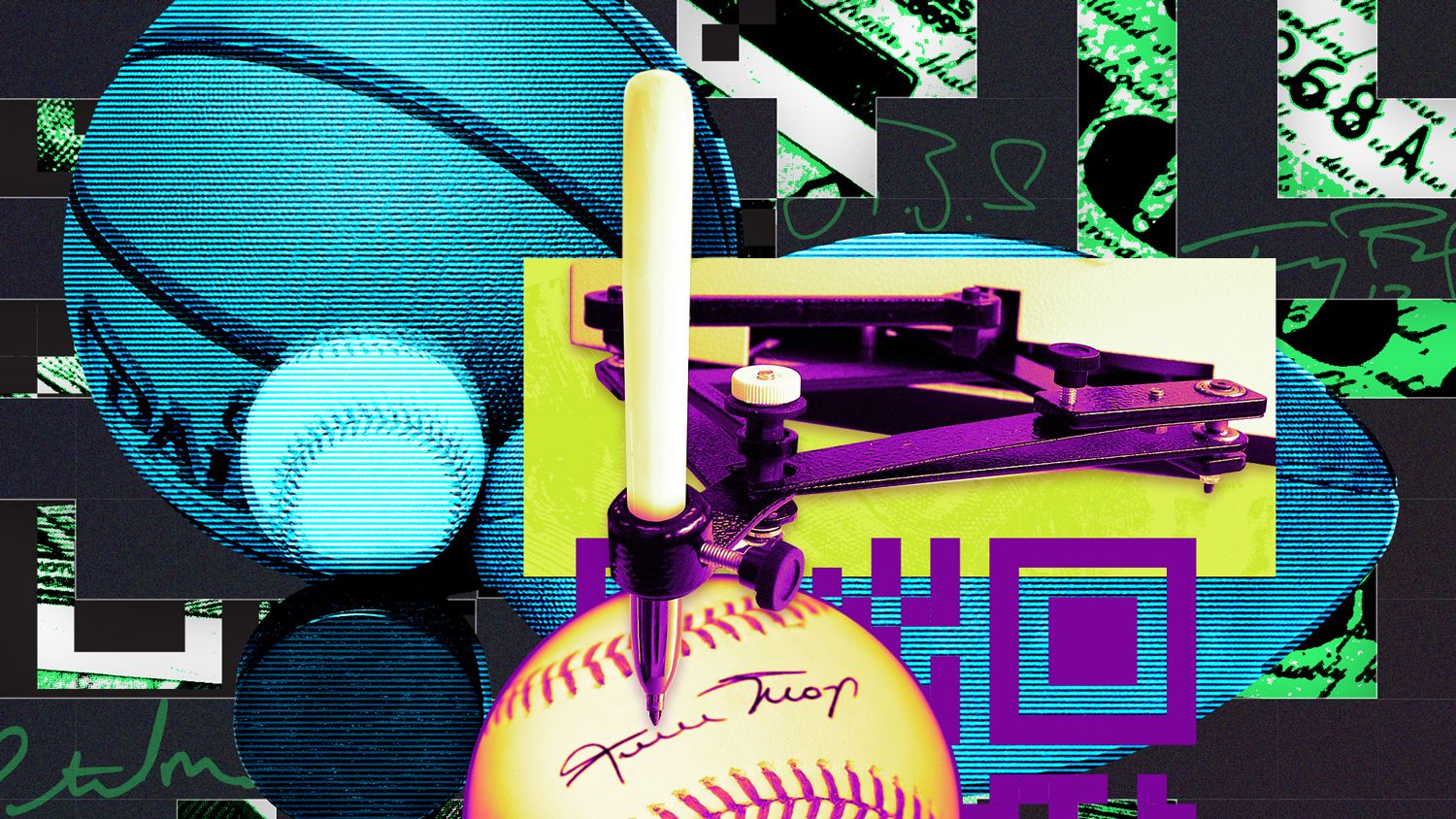
Last week, two individuals admitted guilt to federal charges related to a 15-year scheme that prosecutors claimed involved trading counterfeit baseballs and bats allegedly autographed by Babe Ruth, Lou Gehrig, Honus Wagner, and Cy Young.
Brothers Donald and Mark Henkel, residents of Michigan, each entered a guilty plea to one charge — mail fraud and wire fraud, respectively — as per documents submitted to the U.S. District Court in the Northern District of Illinois. Prosecutors contended that the brothers utilized vintage pens to forge signatures, fabricated false provenances, and enlisted co-conspirators to act as “straw sellers” who confirmed the histories of the counterfeit items.
In their plea agreements, the Henkel brothers acknowledged their involvement in “a scheme to defraud and to acquire money from victims, including art galleries, auction houses, and individual buyers … through materially false and fraudulent pretenses and the concealment of material facts.” The documents provide instances where the brothers generated false provenances for baseballs or bats that they subsequently sold for approximately $120,000. Collectively, Donald and Mark Henkel confessed to fraudulent actions that resulted in financial losses of $780,000 and $332,500, respectively, to victims.
This case is among several criminal inquiries into alleged memorabilia fraudsters that have compelled companies within the collectibles industry to reassess and modify their practices to ensure the authenticity of items available in the market. Although collectibles fraud is not a recent issue, industry specialists indicate that fraudsters have recently taken advantage of a surge in consumer interest in memorabilia since the pandemic, along with the capability to sell counterfeit items across various platforms.
“We must remain vigilant and aware,” stated Ryan Hoge, president of grading and authentication at Professional Sports Authenticator (PSA). “And if [we] begin to notice different styles or large quantities of items where the style appears slightly off, we will regroup.”
Hoge further remarked that “where there’s profit to be made,” alleged wrongdoers will find ways to benefit.
Other alleged fraud cases
In February 2025, authorities in Indiana initiated an investigation into Mister Mancave LLC, a business established by Brett Lemieux, who allegedly marketed counterfeit sports memorabilia through an online store and other channels. Westfield police reported discovering a “significant” amount of evidence at his properties, including documentation and other materials linked to the counterfeit operation.
During the investigation, Lemieux published an online statement claiming to have sold over 4 million items for more than $350 million in the past two decades.
In the statement, Lemieux asserted that he replicated holograms created by Fanatics, TriStar, James Spence Authentication (JSA), Panini, and Steiner Sports. He also claimed to spend eight hours daily at an autopen machine forging signatures, faking collectibles of Tom Brady, Patrick Mahomes, Barry Bonds, and Willie Mays. He mentioned that he “produced 80,000” fraudulent Kobe Bryant items following Bryant’s death in 2020.
“Even if he accomplished 10% or 20% of [what he claimed], it’s still an astonishing figure,” noted Steve Grad, a principal authenticator at Beckett Authentication Services, which agreed to be acquired by PSA’s parent company in December.
Shortly after Lemieux’s social media post, authorities discovered him deceased from an apparent self-inflicted gunshot wound. The Westfield police informed ESPN last week that the Lemieux case is “still being examined/analyzed” and that they have engaged authentication companies to assess the seized items, which are currently held at the department.
“There have been millions of dollars in sales with potentially tens of thousands of victims,” stated Westfield’s assistant chief of police Billy J. Adams. “The intention at some point is to establish a victim fund — how that will be executed is still uncertain, or if it is even feasible.”
In a separate case, two individuals faced charges of trademark counterfeiting, a third-degree felony in Texas, in January 2025 after investigators from the Collin County Sheriff’s Office uncovered “fictitious certificates of authentication and thousands of sports memorabilia items that were falsely represented as genuine” at a residence in McKinney, Texas.
Wendell Gidden-Rogers and Lisa Skolnick allegedly manufactured and sold counterfeit footballs, basketballs, baseballs, helmets, and jerseys that bore fake authentication stickers featuring the names of established companies in the industry, according to a lawsuit filed by Beckett against the two individuals in March 2025, alleging trademark infringement and other claims.
Beckett asserted that Gidden-Rogers and Skolnick researched serial numbers for sports items authenticated by Beckett and recreated those items by forging athlete signatures and applying counterfeit stickers with the serial numbers found in Beckett’s database. The individuals utilized a Ghostwriter autopen machine, which can be programmed to replicate a celebrity’s signature, as stated in the lawsuit.
The “fraudulent scheme of selling fake sports memorabilia items bearing counterfeits of the Beckett Marks and seal threatens to undermine not only Beckett’s entire reputation but the entire sports memorabilia industry,” Beckett stated in the lawsuit.
In November, a judge in the U.S. District Court of Eastern Texas ordered Gidden-Rogers and Skolnick to pay Beckett nearly $600,000 in damages and attorneys’ fees.
Attorneys representing Gidden-Rogers and Skolnick, as well as those for Beckett, did not respond to requests for comment.
“We’re all striving to improve in terms of ensuring that people are aware the items are genuine, but individuals like Brett and Wendell complicate matters significantly,” Grad stated.
Collectibles industry reaction
Chris Ivy, director of sports auctions at Heritage Auctions, referred to the cases as a “black eye” for the industry and mentioned that his company invests “a lot of time” vetting the memorabilia it consigns. This often involves employing photo-matching — a method that aligns fibers, threads, stains, or tags to historical photography archives — along with physically inspecting and testing materials and scrutinizing autographs.
Consequently, approximately 20% to 30% of autographs do not pass the company’s authentication process, and only about 50% of game-worn items reach auction, Ivy noted.
“If it’s a game-used item, and it’s expected to sell for $4,000 or less, we’re likely breaking even or incurring losses due to the time spent on vetting,” Ivy stated.
Jason Masherah, president of The Upper Deck Company, indicated that his company dedicates “an inordinate amount of time” to monitoring fraud and copyright infringement.
“You’re not merely observing eBay or card shows,” he explained. “You’re monitoring Facebook Marketplace, Instagram, TikTok, Snapchat, issuing cease and desist orders, and prosecuting counterfeiters regularly.”
Leaders at authentication firms and auction houses reported employing a variety of strategies to combat fraud — sometimes in direct response to recent criminal cases. They emphasized the importance of the hologram sticker for protection.
“People see that hologram, whether it’s Fanatics or another brand, and they will purchase [an item] believing it’s authentic,” Grad noted.
Zohar Ravid, president of specialty business and new ventures at Fanatics, stated that the company’s fraud monitoring teams identified Lemieux at least two years prior and reached out to marketplaces to deactivate his accounts.
Simultaneously, Ravid mentioned that Fanatics updated its hologram. He clarified that Lemieux was not the sole reason for this change; the company had identified other potential fraudsters and would have altered its hologram regardless. He stated that, to the company’s knowledge, no one has yet managed to replicate the new hologram.
In 2021, Beckett Authentication Services began utilizing tamper-proof holograms, akin to those employed by Major League Baseball’s authentication team. MLB utilizes self-destructing authentication stickers, which leave permanent marks behind when an attempt is made to remove them.
Masherah noted that the company employs matching holograms on its collectibles: “One on the item and one on the certificate of authenticity. A significant number of fake items only possess the hologram on the item; they never include the corresponding certificate. If both holograms are not present, there is an issue.”
Card grader PSA connects hologram certification numbers to images of the product; the company photographs every item that enters its facilities. Nonetheless, to further enhance the authentication process, PSA’s Hoge encourages signers to autograph memorabilia at the company’s headquarters, with the process filmed by the company’s cameras.
“We maintain a vast library of exemplar signatures to facilitate comparison, observe time periods, and [see] how signatures evolve,” Hoge stated. “We enforce strict controls on our materials; we do not utilize a network of third parties — it is essential to maintain tight inventory controls on materials that could be exploited for fraudulent purposes.”
The introduction of the autopen has enabled fraudsters to produce large quantities of counterfeit material. However, James Spence III, vice president of JSA, remarked that autopens replicate fake signatures almost too flawlessly.
“It can inscribe on a baseball, a football helmet; I’ve seen it on golf Masters pin flags — and the autograph is impeccable,” Spence noted. “But it’s not live ink; it’s not hand-signed. We have developed methods to detect this.”
“When you sign your name 20 times on a piece of paper, there are numerous variations. That’s what we, as authenticators, examine to determine the validity of autographs.”
Other companies have adopted more extreme measures to reinforce authentication.
Metabilia, a firm that collaborates with NFL and NBA teams to sell game-used and autographed memorabilia, employs tamper-proof stickers equipped with a tiny epoxy disc containing diamond nanoparticles.
“It’s invisible to the naked eye; it’s its own fingerprint,” explained Nicole Johnson, co-founder of Metabilia. “It’s indestructible.”
Another company, MatchWornShirt, partners with soccer clubs — including Paris Saint-Germain, Real Madrid, Arsenal, Chelsea, AC Milan, and Bayern Munich — as well as several NBA teams to auction game-worn, signed jerseys directly from players. The company utilizes a chip embedded in jerseys that uploads a digital certificate of authenticity and match-worn details to customers’ mobile phones.
One authentication firm, The Realest — established in 2023 by Los Angeles Rams in-house DJ Scott Keeney — employs a proprietary chemical solution to identify its memorabilia. Other companies are also investigating this chemical approach.
Nick Cepero, CEO of Sports Trader Collectibles and former head of memorabilia at PWCC Marketplace, stated that many collectors do not conduct sufficient research before making purchases. He recalled a residence he visited in Texas where, in his estimation, 99% of a collector’s 30,000 signatures were counterfeit.
“It’s a challenging conversation,” Cepero, a former consignment director at Heritage Auctions, remarked. “You see receipts: ‘I paid $3,000 in 1990 for a Babe Ruth autograph,’ and now the company no longer exists.”
Upper Deck’s Masherah expressed concern about how fraudsters might react to advancements in authenticity measures.
“The challenge with preventing fraud is that, whenever money is involved, the fraudsters continually adapt,” he stated. “We have been exploring numerous technologies that we believe are game-changing … and fraudsters have already devised methods to circumvent those.”
