
How Jaylen Brown revitalized the Boston Celtics’ pursuit of a championship
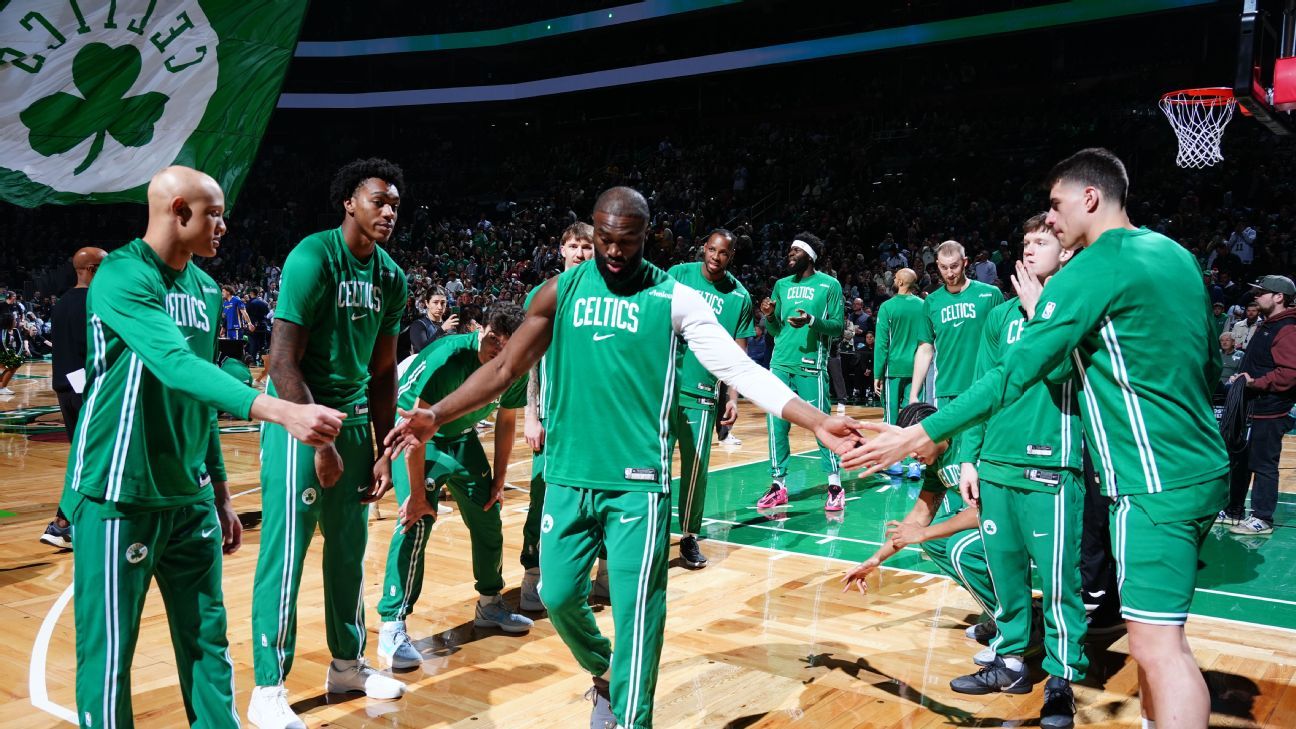
FRIENDS AND FAMILY were reaching out to him. Teammates were sending texts and messages. He understood their intentions were good, but he preferred not to accept their support. Their encouragement. Their understanding.
All Jaylen Brown desired was solitude.
Three weeks prior, the Celtics’ swingman had undergone surgery to mend a torn meniscus — and he found himself alone in his Boston residence.
“One of my toxic traits is that I struggle to let others see me vulnerable,” Brown shared with ESPN.
On the court, Brown was confronted with a season filled with uncertainties. Three starters from the Celtics’ 2024 championship roster had departed — Jrue Holiday and Kristaps Porzingis were traded in financially driven moves, and Al Horford was left unsigned in free agency. Longtime teammate Jayson Tatum had collapsed in the middle of Madison Square Garden after tearing his Achilles’ tendon in the second round of the playoffs.
Now Brown was isolated, accompanied only by his thoughts.
Alone with the insecurities that had infiltrated his mind and lingered there. How could he be the Finals MVP yet not chosen for the Olympic team? Why was he consistently the subject of trade rumors for a “superstar”? Why was there always speculation regarding his All-NBA team status each year? Why was everyone discussing this as a gap year without Tatum?
“I was questioning everything,” he stated. “Mentally, will I be the same? Will my athleticism remain intact? Can I lead this group?”
Brown had engaged in meditation for years. He had utilized martial arts and oxygen deprivation training to cultivate the mental skills necessary for moments like these.
But this was reality, not a practice scenario, and both his legacy and the Celtics’ future were at stake.
“I feel like when my back is against the wall and the world is against [me], that’s when you see the best version of me,” he remarked. “That’s when you get the opportunity to discover what you’re made of.
“Even if it’s not entirely accurate. Even if the world isn’t truly against you. If you perceive it that way and isolate yourself, that’s where growth occurs. One of my favorite quotes is, ‘If you want to make a man great, isolate him.’
Brown fully embraced the isolation. He woke with the sun each day and retired when it set, attempting to synchronize his body with its natural circadian rhythms.
He read and meditated. He explored his teammates’ astrological charts and numerology to customize his leadership approach for each of them. He performed red light therapy on his knee multiple times daily to expedite his recovery.
“My injury wasn’t even that severe, but it still leads you to question yourself,” Brown explained. “Whether you will retain your abilities. You can’t combat those thoughts. They will arise. You simply observe them and let them drift away.”
This season has been Brown’s response.
Not only has he quieted his internal doubts and all those real — or perceived — grievances that comprise his ever-growing burn book, he has emerged as a legitimate MVP contender and propelled the Celtics back to a position few anticipated this season: genuine contention.
The Celtics are firmly positioned as the No. 2 seed in the Eastern Conference, driven by Brown’s career-high averages in points (28.8), rebounds (7.0), and assists (5.2), alongside a career-high usage rate of 36.2%, ranking second in the NBA, only behind Luka Doncic.
“From a financial perspective, this was a rebuild, right?” he said. “But I didn’t perceive it that way. … I viewed it as an opportunity to demonstrate to the world who I am and what I can accomplish.”
MECHELLE BROWN LAUGHS when she hears her son refer to his “toxic trait.”
“That’s what men think,” she chuckled. “You’re not weak. You’re just recovering after surgery. It’s similar to a car. You need maintenance to improve. So get your tune-up, receive your maintenance, and return even better and stronger.”
She conveyed this to her son last summer when he expressed his desire for solitude and insisted he needed nothing. She visited once anyway, she said — moms are entitled to do that — but quickly realized there was no cause for concern.
“He was strategizing,” she noted. “He’s always required space to contemplate things.”
Mechelle enjoys recounting the story of when Jaylen walked at 9 months old so he could play with his older brother’s basketball. Jaylen carried that basketball everywhere, even to his daycare in Norcross, Georgia.
Initially, the daycare informed her that he couldn’t bring the ball because it would make the other children envious. But once Jaylen began sharing the ball, they allowed him to continue bringing it.
“He figured out he needed to be a team player,” she remarked.
This past summer, Brown faced a different challenge. All those doubts that kept resurfacing. The walls he felt he was pressed against. Each time she called, Mechelle reminded Jaylen that he wasn’t alone in this situation. It might seem as though everything rested on his shoulders, but there was also an entire team to rely on.
“In his mind, everything was stripped away from him, meaning the team,” she said. “But what I kept telling him was, ‘These guys are already in the league, which means they can play ball. They have been drafted, so they are talented. You just have to lead them.’
After Brown’s period of isolation, which he claims lasted about six weeks, Celtics president of basketball operations Brad Stevens encountered him in the weight room at the team’s training facility and conveyed the same message. Boston was still in the process of finding answers to the significant questions surrounding its season, Stevens informed him.
“Many players would have misinterpreted that and not achieved what he’s accomplished,” Stevens told ESPN. “And what he’s done is he’s played exceptionally well, and he’s empowered others. We needed him to do both for our team to excel.”
The Celtics didn’t require a hero, nor did they need Brown to play hero ball and attempt to score 50 every night. They needed him to lead.
Stevens reminded him that the Celtics had undergone several roster changes since Brown joined them in 2017 as the No. 3 pick. He reassured him that Boston still aimed to compete this season, despite Tatum’s injury, roster changes, and financial adjustments.
“The only thing that many of these players were, was untested,” Stevens stated. “I believe [Brown] recognized that Jordan Walsh could play. That Baylor Scheierman could play. That [Neemias Queta] and Luka Garza could play. But he also understood that by showing faith in them, he would elicit a lot from them.”
And he has.
The Celtics have an effective field goal percentage of 65.2% off passes from Brown this season. This is the fifth-highest rate among players with 500 or more assists this season, according to GeniusIQ. Teammates Payton Pritchard, Sam Hauser, Derrick White, and Queta are all achieving career highs in points per game.
“Jaylen has had faith in this group from the beginning, including during the summer and when we were 0-3, and I believe that’s helped bring out the best in all of those players,” Stevens remarked.
“He seems to have found a lot of joy in helping them prove themselves.”
50 wins in a gap year ☘️
— Jaylen Brown (@FCHWPO) March 30, 2026
ON HIS FIRST visit to Boston as a member of the Celtics nine years ago, Brown declared he was ready to “go to war” for the city. It was a bold assertion, particularly for a 19-year-old about to join such a prestigious franchise.
“I’ve always conducted myself in that manner,” Brown stated. “If you have me in your life, you have someone who will fight for you. Perhaps in another life, I was a warrior.”
Brown grew up idolizing Michael Jordan and Kobe Bryant, players who embodied a certain code. He was inspired by their work ethic and legendary competitiveness, but also by how consistently they maintained that mental and physical level. He pondered whether he could exist that way daily. Or if there was also space for some normalcy in his life.
“I would be dishonest if I claimed I matched their level,” Brown admitted. “Like, I think Kobe and Jordan operated on a different mental plane. But I do experience phases in my life and moments where I enter that mode, and those around me can certainly sense it.”
Last summer was one of those periods.
Brown recognized he needed to evolve into the role for the Celtics to compete and believed he had to isolate himself and reflect inward.
To achieve this, he continued confronting his doubts and questions — and exploring various systems of thought and perspectives.
“I love to learn. That’s one aspect of me. I don’t shut my mind off to anything,” Brown stated. “Even if I disagree or don’t comprehend, I still maintain an open mind. I believe that is a sign of intelligence that people should embrace more.
“So this season when we lost nearly half of our roster — I’m essentially desperate. I want to win. How are we going to win? How can I galvanize this group, communicate with them? Build chemistry in a short time?”
During his single year at the University of California, Berkeley, Brown studied astronomy and mentioned he would have pursued an advanced degree in astrophysics had he remained. He has always felt that celestial bodies and phenomena influence individuals in ways we are just beginning to comprehend.
“Astrology is merely constellations, right?” he explained. “The sun is a star. The sun provides nutrients, vitamins, minerals, all these different — red light. Other stars offer similar benefits as well. Ancient civilizations understood that. And it was a more common practice in the old world than it is in this new world. Nowadays, discussing it can make you seem eccentric.
“But, you know millions of people, billionaires, CEOs — they utilize these knowledge systems to their advantage all the time. They just don’t publicly acknowledge it.”
Brown was born on October 24, 1996, making him a Scorpio, born in the Year of the Rat according to the Chinese Zodiac, and his life path number is five. Rats, Brown explains, have a fixation on winning. Fives are typically adventurers and visionaries. Scorpios are intense, determined, and strategic.
Coach Joe Mazzulla was born on June 30, 1988, making him a Cancer with a Capricorn moon, born in the Year of the Dragon with a life path number of eight.
Individuals with an eight life path are associated with authority and intense discipline. Cancers with a Capricorn moon are linked to high-achieving leaders who are disciplined and deeply focused on family (or team).
Brown has memorized all of these numbers for each player and coach on the Celtics and uses this background to guide his communication with each individual.
“If it only worked 10%, it’s worth it to me. I believe it is much more effective than 10%, though,” he stated. “I learned more about Chinese astrology. I learned more about numerology, life path numbers. I created a chart of all my teammates. I know it sounds unusual, and it’s probably a bit controversial because people have their beliefs. But the approach worked.”
His teammates can only take his word for it.
Walsh mentioned he has a close bond with Brown — he refers to him as “Unc” due to the mentoring relationship they’ve developed — but doesn’t recall Brown providing him with any kind of readout of his numerology or astrological chart.
Neither does center Queta, whom Brown has advocated for this season — most recently pushing him for Most Improved Player and the All-Defensive Team. Queta speaks in detail about the team dinner Brown hosts at the beginning of the season and the guidance Brown has offered him. However, he also doesn’t remember Brown using numerology or astrology to connect with him.
“I need to communicate with everyone. I need to bring everyone together, so I have to understand [them],” Brown stated. “This had to be my best leadership year. So if I’m being honest, this stuff I’m discussing, it helped.”
THREE YEARS AGO, Brown found himself in a different, darker place. The Celtics had just faltered in the Eastern Conference finals, losing to the Miami Heat after rallying from an 0-3 deficit to force a Game 7. It was a shocking collapse, a regression after Tatum and Brown had come so close to a title in 2022, falling to the Golden State Warriors in the Finals.
It was the kind of crushing defeat that could prompt a franchise to lose patience and, after years of speculation about fit and potential, concede defeat and dismantle a superstar duo that had yet to yield championship success.
Especially when one of those stars, Brown, was on the verge of becoming the highest-paid player in NBA history and the other, Tatum, would surpass him the following year.
The pressure was immense. After suggesting to Tatum that they train together in the offseason for the first time, Brown decided to channel that pressure in one of the most unexpected, unconventional ways imaginable.
“I don’t know how to articulate it,” Brown said. “It’s like essentially training yourself to drown.”
He contacted big-wave surfing legend Laird Hamilton and requested to learn how to train under extreme oxygen deprivation to strengthen his mind for optimal performance under stress and anxiety.
“It’s a method to mentally learn how to cope with anxiety,” Brown explained. “You become accustomed to it. … The worst thing you can do is panic. That’s true in the water, but also in life.
“If you panic in the water, you drown faster. So the water teaches you to remain calm when you’re in that fight or flight mode, to just relax.”
Laird and his wife, former volleyball star Gabrielle Reece, have trained numerous professional athletes at their facility in Los Angeles. They use heavy weights to help submerge you underwater, simulating the conditions of being pulled under a wave. The objective is to learn how to release as much air as efficiently as possible as you sink, so you have energy to propel back up and inhale as much air as possible.
“Our focus is to train the organism, which in this case is the body and the mind, to be more efficient,” Reece told ESPN. “So what does that entail? ‘Oh, I’m uncomfortable. I feel stressed, but I actually can’t afford to react because I’m going to waste more energy.’
Over time, the athlete learns precisely how much time they have underwater before needing to breathe again. They learn to release small amounts of air to lower their CO2 levels and extend their time. And they learn to control their mind and conserve energy when every fiber of their being is urging them to escape the situation as quickly as possible.
Brown, Reece noted, was a quick learner.
“Jaylen is a mental giant, so he grasped it very quickly,” she said. “He doesn’t succumb to his discomfort or think, ‘I can’t’ or, ‘That’s frightening.’
Brown trained with Laird and Reece for several months during the summer of 2023 and has maintained close contact. Occasionally, he’ll invite a teammate or coach to try one of his pool workouts. So far, no one has accepted his challenge — although Mazzulla mentioned he was intrigued.
“I’ve seen him in the pool doing his workout, and he kind of sounds like a dolphin,” Walsh told ESPN. “He goes straight up and down to the deep end with the weights. He suggested I try it a few times, and I’m like, ‘JB, that looks like torture. I’m not sure that’s for me.’ But maybe I should because clearly it’s working for him.”
Brown states he thrives on discipline and structure like this. It provides him strength and a sense of control. And that’s something he has been developing for a long time.
 play2:15Stephen A.: ‘Boston looks like the most formidable team in the Eastern Conference’
Stephen A. Smith explains why the Boston Celtics are the team to beat in the Eastern Conference.
THE CELTICS’ LOCKER room on the night of April 1 was one of the happiest places in the NBA at this time of year. Brown had led them with 43 points on 17-of-29 shooting. Tatum recorded his sixth career triple-double and first since returning from his Achilles’ injury on March 6.
Boston had maintained a lead for most of the game, scoring 53 points in the first quarter on 11 three-pointers, defeating Miami for the fourth consecutive time — the same franchise that had sent the Celtics into such an existential crisis in the spring of 2023.
About the only indication of everything they had all endured in the past year was the size of Tatum’s right calf.
It remains noticeably smaller than his left calf, a clear sign of someone recovering from a recent Achilles’ injury.
Brown’s influence is larger than it has ever been, both in respect and standing around the league for guiding the Celtics to a place only they believed possible.
Tatum attended as many practices and games as he could while sidelined. He did this to show support but also to stay connected to the team as he navigated his own challenging, monotonous rehabilitation process.
Tatum underwent surgery the morning after tearing his Achilles to give himself a chance to return in time for the playoffs this season. He pushed himself six days a week to potentially contribute if the team remained in a position for that to matter.
Brown’s leadership — and performance — made it significant.
“Obviously [Brown’s] someone who’s always been capable,” Tatum told ESPN. “This was just an opportunity where more was required from everyone, but especially him. The NBA is all about opportunity and those who truly capitalize on it. The exceptional ones do, and that’s precisely what he’s managed to achieve this year.”
In the past, much of Brown’s motivation has stemmed
