
Five challenges confronting the New York Knicks as they approach the playoffs
New York Knicks head coach Mike Brown discusses a standard reminiscent of that articulated by former Pittsburgh Steelers coach Mike Tomlin.
“The standard is the standard,” Tomlin frequently stated during his nearly two-decade tenure. This standard was centered around Super Bowl appearances. Tomlin led the Steelers to two Super Bowls, securing one victory. This level of achievement is something the Knicks, who last reached the NBA Finals in 1999, have yet to attain.
Consequently, the standard Brown refers to is more focused on the immediate. The coach, who guided the Cleveland Cavaliers to the Finals in 2007 and served as an assistant on three championship teams with the Golden State Warriors, was appointed last July with the expectation of advancing the Knicks to play into June. However, this begins with instilling winning habits during the regular season.
“You want to embrace your standard,” Brown remarked Monday night in the Intuit Dome in Inglewood, California, prior to a loss against the LA Clippers.
“I believe our players have embraced the standard of sacrifice, competitive spirit, connectivity, and overall faith in each other’s process.”
Over the past two months, Brown’s message appears to have resonated with his team. Following a 2-9 stretch from December 31 to January 19, the Knicks lost only four games for the remainder of January and throughout February, buoyed by significant victories over the Houston Rockets and San Antonio Spurs that seemed to rekindle championship aspirations.
However, a challenging period of three losses in five games—including two consecutive defeats in Los Angeles against the Clippers and Lakers—has revived concerns about inconsistent performances, fueling skepticism among critics who doubt the Knicks’ ability to make a deep playoff run in the competitive Eastern Conference. This would not be acceptable to owner James Dolan, who stated on WFAN in January that the minimum standard for the Knicks this season is to reach the Finals.
“We want to get to the Finals,” Dolan expressed. “And we should win the Finals. This is sports, and anything can happen. But reaching the Finals is something we absolutely must achieve.”
With six weeks remaining in the regular season, Brown recognizes the Knicks must elevate their standard. They currently hold a record of 42-25, placing them third in the East, 1.5 games ahead of the Cavaliers. At this point last year, they were 43-24.
Here are five challenges the Knicks need to address before the postseason commences on April 20:

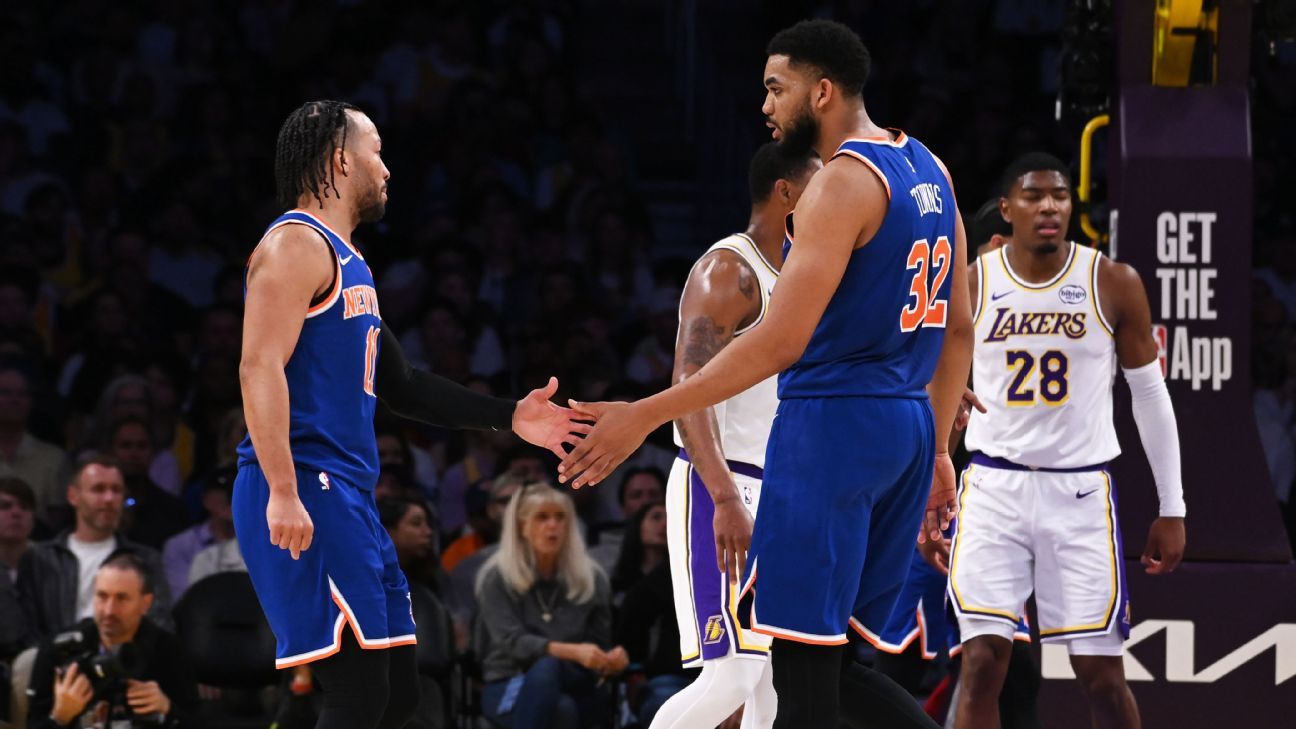
Maximizing Karl-Anthony Towns
Statistically, Towns is experiencing a solid, though not exceptional, second season in New York. His minutes, production, and efficiency have declined across the board—his 20.0 points per game represent his lowest average since he recorded 18.3 as a rookie in 2015-16—as he has occasionally struggled to adapt to Brown’s offensive system.
He has demonstrated the capability to lead the Knicks during stretches, including on Monday night. Twenty-one of his game-high 35 points were scored in the first half, while New York’s bench failed to contribute any points and finished with a total of 14 for the game.
However, depending on Towns to carry the team has not proven to be a successful strategy. The Knicks have a record of 16-11 when he attempts at least 15 shots and 24-12 when he takes fewer than 15 shots.
In February, prior to the Knicks’ comeback victory over the Rockets, Brown emphasized that the offense should revolve around Brunson. When asked about Towns’ season and the perception that he has underperformed, he raised his hand about six inches above his head to indicate Brunson as the primary option, then lowered it a few inches to signify Towns as the secondary option.
“I view KAT as being right where he should be,” Brown stated. “Perhaps he should be the leading scorer; I can’t say for sure. He receives the second-most attempts, just behind Jalen.”
“It’s a work in progress, and we must continue to feel and evolve as a group, ideally around the players we need.”
Brown has indicated that he has simplified the offense to accommodate the entire roster, not just Towns. While Towns is as talented an offensive option as any big man in the NBA, he must assert himself without forcing his offense—an approach that can appear disjointed when he does. At the same time, he must ensure he does not fade into the background.
“My career has been quite unpredictable, and I’ve had to learn to adapt,” Towns told ESPN later that evening. “My usage is high, so I need to make the most of that. When my usage is low, I must capitalize on my opportunities to help others get going.”
When informed of Brown’s remarks, Towns commented, “You’re accustomed to having the ball, finding a rhythm in the game, and with lower minutes, you have less time to get into the flow.”
“It’s a different experience, something I’ve not encountered before in my career.”
Hunkering down on defense
Last season, the Knicks ranked among the top five teams in clutch situations, finishing 19-12 in games decided by five points or fewer in the final five minutes. Their experience in clutch moments was evident during the Eastern Conference semifinals against the then-champion Boston Celtics, where they secured two comeback victories in the opening games on the road.
They were a team that could not be easily dismissed, even if statistics indicated they were an average defensive unit under former coach Tom Thibodeau.
This season, they have improved overall, ranking eighth in defensive efficiency. Since January 15, they have been the best defensive team in the league, allowing 106.1 points per 100 possessions during that period—a significant improvement from the previous two months, where they ranked 23rd at 117 points per 100 possessions.
Josh Hart expressed surprise when informed of the recent statistics.
“If that’s what the numbers indicate, I don’t believe they are incorrect,” Hart told ESPN on Sunday. “I think our success stems from great attention to detail and a level of physicality. I believe we can maintain that. We have talented, intelligent players. We understand the formula for our success; now we just need to refine it.”
Brown mentioned that defensive coordinators Darren Erman and Brendan O’Connor showed players film of some of the league’s top defensive teams—the Detroit Pistons, Oklahoma City Thunder, and Phoenix Suns—to illustrate what they can get away with and examples of effective physicality.
“When we watch our games against those teams, we can see the contrasts and differences in those aspects,” Hart noted. “You can learn from other teams, identify where you can be physical, how to leverage that physicality to your advantage, and where the referees allow more leeway.”
The Knicks faced setbacks against the Lakers and Clippers but have upcoming opportunities against lower-ranked offensive teams, including a potential matchup against a Stephen Curry-less Golden State Warriors team at Madison Square Garden on Sunday.
They will face four top-10 offenses for the remainder of the season, including an April 9 clash against the Celtics, who are currently second in the East and recently welcomed back Jayson Tatum from the Achilles injury he sustained against the Knicks last year.
Getting Brunson on track
Brunson is central to everything the Knicks execute offensively. When Mikal Bridges and OG Anunoby have attempted to create plays, the results have not always been favorable—all paths lead back to Brunson as the only dependable shot creator from the perimeter.
However, teams have become more aggressive against the Knicks. The typically reliable Brunson committed seven of the team’s 19 turnovers against the Lakers, and the roster collectively contributed to 20 turnovers the following night.
Anunoby’s assist-to-turnover ratio is nearly even, and while Bridges has been positioned to facilitate more offense, Brown has not tasked him with making decisions from the top of the floor.
Brunson’s 30.3% usage rate ranks 13th in the league, just behind Cade Cunningham and Nikola Jokic, slightly above his rate from last season (29.5%). He is facing more double teams as teams attempt to force the ball out of his hands—he and Brown have devised strategies to free him, but more sophisticated defenses will be more physical.
Brunson has avoided significant injuries this season—he missed a month due to an ankle sprain last season, which hindered him in the first round against Detroit. Keeping him healthy and energized is a priority as the Knicks approach the final stretch.
It may have been signs of fatigue or strategy when he experienced a challenging three-game stretch, shooting 16-of-50 against the Lakers, Nuggets, and Thunder.
“He’s human, and he will have nights like that,” Brown remarked Monday. “His history indicates that he will bounce back.”
Brunson’s scoring has declined since January, averaging 23.1 points over his last 31 games compared to 29.4 in the first 30. Is this due to Brunson’s increased defensive efforts?
“It’s possible, but we won’t dwell on that,” Brunson stated. “We’re more focused on executing the fundamentals. The offense will take care of itself.”
Maintaining the Mitchell Robinson plan
The strategy for the frequently injured yet crucial backup center has exceeded expectations. After participating in only 48 games over the past two seasons due to various injuries, Robinson has played 48 games this season, with the team managing his participation in back-to-back games and keeping his minutes at a reasonable level (19.2 per game) to ensure he is prepared for a heavier workload during the playoffs.
He averaged 17 minutes per game in November and 19.9 in December. In January, his most demanding month to date, he averaged nearly 22 minutes and surpassed the 10-rebound-per-game mark for the first time since November 2023.
Casey Smith, the Knicks’ esteemed vice president of sports medicine, has led Robinson’s plan. Smith has been involved in multiple runs with the U.S. men’s national team during the Olympics and received the 2024-25 NBA Athletic Training Staff of the Year award.
“The primary objective is to ensure [Robinson] participates in games this year and remains healthy,” Brown stated Monday.
Robinson’s presence provides the Knicks with an advantage on the offensive boards, which Brown has indicated is part of their strategy to enhance their 3-point shooting capabilities. Many of their comebacks, such as on Christmas Day against Cleveland or recently against the Rockets, were significantly aided by Robinson’s offensive rebounding, which creates disarray for the opposing defense and opens opportunities for shooters.
Robinson’s struggles at the free-throw line have resurfaced (39.5%) after he achieved a career-high 68% last season, but his offensive rebounds per 36 minutes rank first in the league (8.0). This is a skill Brown intends to utilize extensively in the coming months.
Holding everyone accountable — including Brown
Brown has had to acclimate to a team that was already familiar with itself prior to his arrival. The transition, particularly in November when players, including Hart, expressed dissatisfaction about being benched during fourth quarters in consecutive games against Memphis and Orlando, has not always been seamless.
However, Brown has adapted—and so have the players. The Knicks have evolved into one of the league’s top 3-point shooting teams (sixth in makes, fourth in percentage), while improving from a fifth-ranked offensive team to third this season. They ranked 14th in defense last year and are now eighth.
“Everyone is significantly better regarding accountability,” Brown noted. “It’s not just about ensuring we hold each other accountable but also being comfortable with being held accountable.”
Brown has mentioned relying on the assistants who remained from Thibodeau’s staff for guidance in managing player relationships. His collaborative approach and openness to suggestions made him an appealing choice following Thibodeau’s tenure. However, that does not mean he refrains from being assertive when necessary.
After Sunday’s defeat to the LeBron James-less Lakers, he displayed visible frustration, perhaps reflecting the standard he aims to uphold.
He consistently remarked about the Lakers, “This is not a criticism of them…” before addressing the mistakes the Knicks made throughout the game: the turnovers, poor decisions, and inadequate defense.
“Whether it’s this game or another, I always communicate directly,” Brown stated regarding his message to the team. “There is no sugarcoating.”
The Knicks are two games behind the Celtics for the second seed in the East, a potential rematch of last season’s surprising semifinals. They are just ahead of the Cavaliers, who easily defeated the Knicks in their last encounter. If the Knicks fall to the fourth seed, they could face the Pistons, who are likely headed toward the top spot. Detroit has triumphed over the Knicks in three meetings this season, all decisively.
This is where Brown will ultimately be evaluated: by his team’s performance in the playoffs—and the path to achieving that over the next few weeks is equally crucial.
