
Team Cohesion Evident at USA Hockey-Long Drink Women’s National Championships
While the paths to victory at the 2026 USA Hockey-Long Drink Adult Women’s National Championships varied for some winners, they do possess a few common characteristics.
Many of the champions have a long history of playing together, and all participants eagerly anticipate the event each year.
The national tournament was held from April 16-19 at AdventHealth Center Ice in Wesley Chapel, Florida, attracting 900 players and 50 teams.
After suffering a loss in overtime during the semifinals last year, the Michigan Oilers secured the 30-plus division title with a 4-2 win over the Texas Stampede in the final match.
“We wanted to return because we believed we could perform better,” stated Mariah Mumford of the Oilers. “It was an excellent weekend. It was a total team effort. This is the highlight of our year. This tournament is what concludes our entire season. We look forward to it every year.”
Mumford emphasized that the Oilers are unique as a full-season team that begins their season in September and continues to skate together through the national championships.
“Most of our team has been playing together since college,” said Mumford, who attended Finlandia University in Hancock, Michigan.
She noted that the team includes several pairs of former college teammates. Some Oilers played together at Michigan State, while another group competed at Potsdam.
Mumford mentioned that some members of the Oilers have been together since they were in 10U hockey.
The strong team chemistry contributed to their success in the tournament, even though they competed with only 10 skaters and a goalie.
“We’re so accustomed to playing with each other that we feel playing alongside unfamiliar players might disrupt our rhythm,” Mumford explained. “We went undefeated in the tournament, but each match was challenging. We faced outstanding teams. What’s enjoyable about this tournament is reconnecting with old friends, former college teammates, and past rivals, almost like a reunion.”
Maintaining a skating routine in their 30s can be challenging for players for various reasons. Nevertheless, gathering weekly to play remains a priority for the Oilers.
“Balancing a demanding life with playing 60, 70, or 80 games a year is tough for our team,” Mumford said. “However, our team feels like a family, and the best part of our week is when we can come together and play hockey.”
Mary Catherine Finney, whose LA Lions triumphed over the Lucky Pucks, 5-3, to claim their second consecutive 21-plus Tier 2 title, expressed that her team always enjoys attending the annual tournament.
“It’s exciting to face competition from other states, especially being all the way out here in California,” Finney remarked. “We don’t often get to see a lot of high-level women’s hockey. That’s really our favorite aspect of going there—having the opportunity to compete against many high-caliber teams in a short timeframe.”
Finney and one of her Lions teammates played club hockey at the University of Michigan. She mentioned that most of her teammates participated in Division III, while two played Division I. Finney added that a few Lions are accomplished roller players who have transitioned back to ice hockey.
Although they compete in a 21-plus division, Finney noted that the Lions have only one or two players under 30 years old.
“In terms of the division, we probably lean towards the older side,” Finney acknowledged. “It’s reassuring to know we can still compete in the 21-and-up division. Some of us could qualify for the over-40 division, but we’re still hanging in there. Many of us have played together for several years, which certainly enhances our team chemistry.”
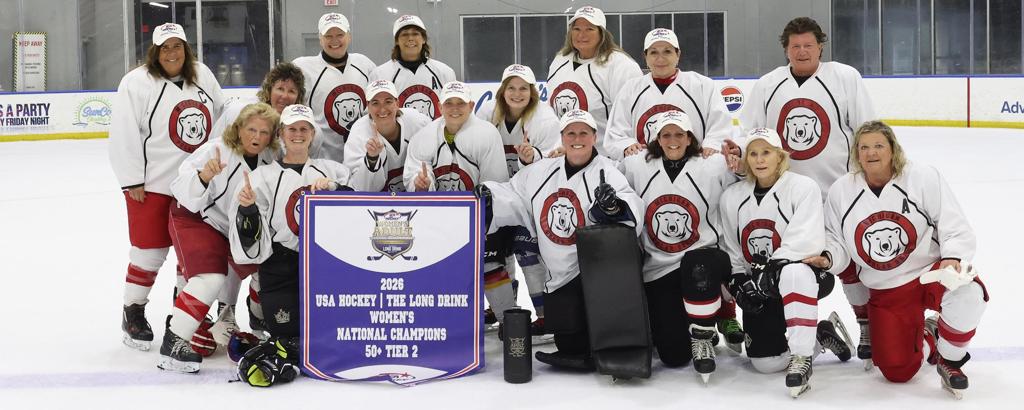
The 50-plus Tier 2 champions, the Polar Bears, who defeated the Lady Blues Senior 3-0 in their final, have also been together for an extended period. This victory marked their fourth title.
<p“About seven of us started playing together when we were 10 years old,” said Dawn Taylor of the Polar Bears.
61-year-old Debbie Benedict added, “A few players have already had knee replacements, and they’re still coming out [to play], which is remarkable. Recovery time is longer [at this age].”
Benedict noted that the Polar Bears brought three lines, including defenders, to the championships, which aided the team in reaching the final.
“That made a significant difference,” Benedict stated. “Everyone had energy, and we were definitely less sore when it came to the finals. At home, we play 12-minute periods. Here, they have 15-minute stop time. And what a difference three minutes can make.”
The other champions included: 21-plus Tier 1, Carolina Lady Hurricanes A; 21-plus Tier 3, Indy Speed; 40-plus, Texas Stampede; 50-plus Tier 1, CanAM; 60-plus, Coast-To-Coast.
Story from Red Line Editorial, Inc.

