
2026 NBA Draft Stock Update: Which NCAA Players Are Gaining Momentum?
The initial weekend of an NCAA tournament filled with prospective NBA talent has concluded. With the national championship game on the horizon in a few weeks, how did the leading 2026 draft prospects perform during the early stages of March Madness?
Candidates for the No. 1 pick, AJ Dybantsa and Darryn Peterson, saw their seasons — and likely their college careers — come to an end with early defeats. Prominent prospects such as Cameron Boozer, Darius Acuff Jr., Kingston Flemings, and Keaton Wagler propelled their teams into the second weekend. While there were some unexpected outcomes, including Florida’s exit in the second round, numerous other anticipated first-round selections progressed, setting the stage for several high-profile matchups among prospects this week.
This is not an exhaustive list or a definitive rankings update, but here are my observations on how the top players performed and which individuals enhanced their prospects, along with some intriguing stay-or-go decisions that lie ahead.
More NBA draft coverage:
Pre-tournament top 100 rankings | Latest mock draft


Darryn Peterson, SG/PG, Kansas
Pre-tournament rank: No. 1
Peterson’s unusual journey at Kansas concluded on Sunday, as the Jayhawks lost to St. John’s at the buzzer, ending their season in the round of 32. His performance in two tournament games mirrored his season, showcasing moments of high-level shot-making interspersed with longer stretches of minimal offensive contribution.
When Peterson is at his best, he is arguably the top scorer in this draft. There is a sentiment in NBA circles that his full potential was not realized this season due to various injuries, illnesses, and cramping issues affecting his availability. He shared with reporters during the Big 12 tournament about a full-body cramping incident in the preseason that has contributed to his difficulties.
The encouraging aspect is that Peterson has been available over the past month. However, his inconsistency has raised concerns. He averaged 20.6 points in his last nine games but shot only 38.8% from the field and 31.9% from beyond the arc in that limited sample. Some of his challenges can be contextualized: Kansas often appeared disorganized offensively this season, and he was utilized as an off-ball focal point with restricted playmaking chances. Notably, Peterson has generally been a positive defender, demonstrating good instincts in pursuing the ball and creating turnovers.
While it can be assumed he hasn’t been at peak strength — and a return to the dynamic downhill athlete he was in high school is certainly a possibility in the NBA — the diminished offensive impact in games where his shot was not falling highlighted some potential drawbacks. The question of which version of Peterson an NBA team will ultimately acquire and how to restore him to that level is a significant consideration for teams as they access his medical records and conduct interviews during the predraft process.
Thanks to his exceptional shot-making abilities, Peterson’s offensive potential remains among the best, keeping him a strong candidate for the No. 1 position as teams envision him in a role similar to Anthony Edwards with continued development. However, Dybantsa has narrowed the gap and can now be regarded as a highly likely top pick candidate based on discussions I’ve had with NBA executives in recent weeks.

AJ Dybantsa, SF, BYU
Pre-tournament rank: No. 2
Recent conversations with sources around the NBA suggest that the likelihood has shifted toward Dybantsa being the most probable choice for the No. 1 pick.
Dybantsa’s college career seemingly concluded with BYU’s first-round defeat to Texas, but he delivered a commendable performance: He played every minute, scoring 37 points on 25 shots, making all 12 of his free throws, and securing 10 rebounds. BYU had been facing challenges in winning games since Richie Saunders’ season-ending knee injury last month, and Dybantsa deserves recognition for his effort until the end, playing with his usual intensity without appearing fatigued. Although he was the focal point of the offense, he showed a consistent willingness to trust his teammates and made sound decisions throughout, despite finishing with no assists.
Dybantsa also had a No. 1 pick-worthy performance over three games at the Big 12 tournament, which was attended by several high-level decision-makers. He scored in various ways while managing a heavy workload. His aggressiveness, decision-making, and playmaking for teammates improved as the season progressed, addressing some questions about his style of play. Given the value of his archetype as a large wing scorer and the uncertainties surrounding Peterson, Dybantsa has positioned himself as the most straightforward choice in the minds of many in the NBA, although the competition remains tight.
Dybantsa has considerable room for improvement in his ball-handling, perimeter shooting, and individual defense, realistic areas for growth that will determine the level of stardom and team success he ultimately achieves. However, he will enter the NBA on a growth trajectory with several unteachable positive attributes.

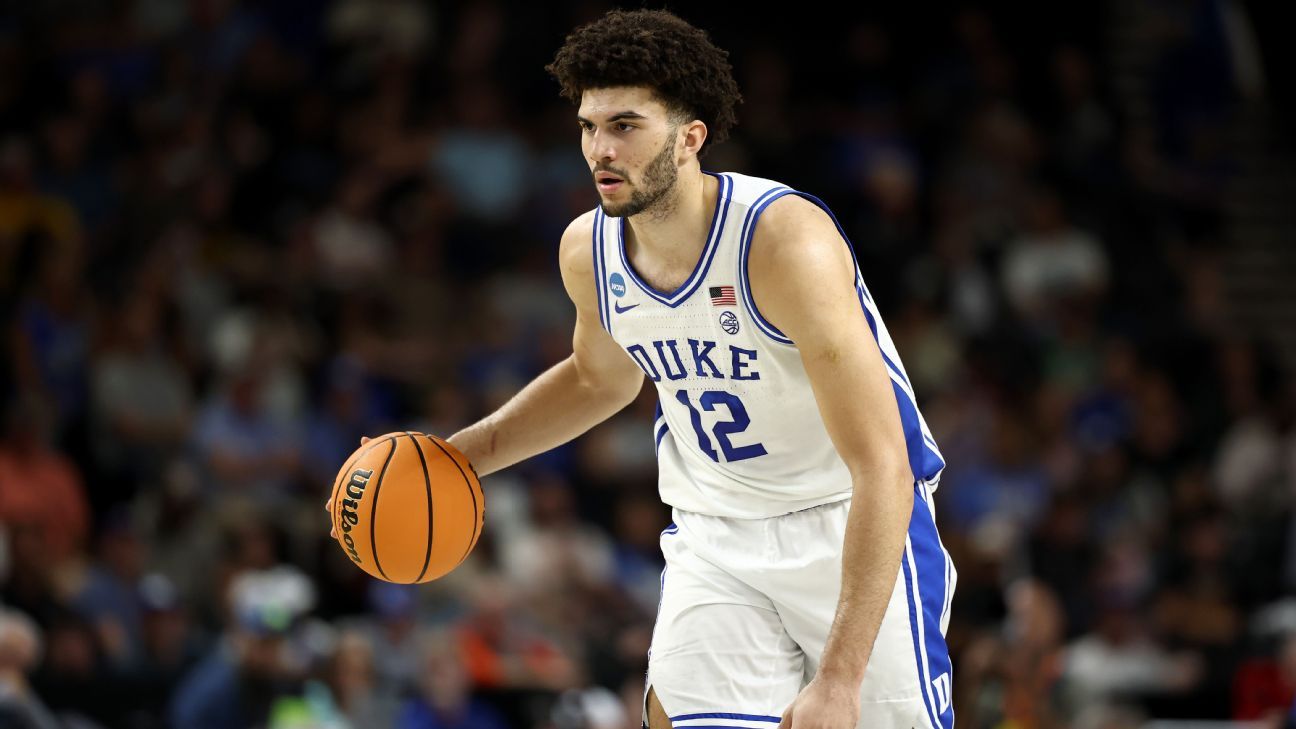
Cameron Boozer, PF, Duke
Pre-tournament rank: No. 3
Boozer and Duke faced a challenging path to reach the second weekend, but the Blue Devils managed to survive a scare against Siena and outlast TCU to set up a significant matchup with St. John’s. While not a major concern, Boozer faced some atypical struggles against Siena (a game in which Duke trailed by 11 at halftime). His limited foot speed, lack of vertical lift as a finisher, and rim protection were evident at times, particularly without an injured Patrick Ngongba II to support him defensively. Siena congested the paint, complicating Boozer’s efforts, but his box score production remained consistent at the end of both games.
Although many in the NBA view Dybantsa and Peterson as stronger candidates, Boozer has his supporters and should not be dismissed as a No. 1 option. Opinions vary regarding the aesthetics of his game, but there is little debate about the results he produces. Scouts appreciate that he possesses the most impressive winning record of any player in the draft, having secured every possible championship in high school and now in college, with only one remaining. Any team should feel confident selecting a player who has been a key contributor to winning throughout his career.
Boozer will face a physical St. John’s front line led by Zuby Ejiofor on Friday, presenting another quality test for Duke. Leading the Devils back to the Final Four would add another achievement to his resume.

Kingston Flemings, PG, Houston
Pre-tournament rank: No. 5
Flemings continues to be a key player for Houston, impressing scouts with his ability to handle pressure and responsibility on a veteran team that reached the title game last year. While he did not individually shine in the first weekend (18 points against Idaho and just nine against Texas A&M), Flemings contributed by minimizing mistakes, distributing the ball, and facilitating two blowout victories.
Arguably the most explosive downhill guard in the draft, Houston’s Sweet 16 matchup with Illinois will see Flemings face fellow top 10 projected pick Keaton Wagler. Flemings has risen to the occasion in critical moments this season and has a significant opportunity to demonstrate his skills against a team that can match Houston’s size and physicality.

Keaton Wagler, PG/SG, Illinois
Pre-tournament rank: No. 6
Wagler appeared to be in fine form during Illinois’ two victories over Penn and VCU, games in which he was not required to take control. Part of Wagler’s appeal at the next level lies in his ability to generate quality offense not only as a ball handler but also as a tall perimeter player (6-foot-6) who can see over defenses and is always willing to make the next pass, a quality scouts admired in Tyrese Haliburton at Iowa State. Wagler’s capacity to enhance lineups significantly raises his NBA floor, with his potential tied to how efficient and technical he can become as a lead guard.
Houston’s physical defense will present a particularly tough challenge for Wagler, who has occasionally struggled to finish in traffic and lacks vertical explosiveness. He will likely be matched up against Emanuel Sharp, who typically takes on the toughest assignments and will attempt to limit his space. Illinois will enter a challenging environment, facing the Cougars in Houston in a faux-neutral site scenario. Delivering a standout performance in such a setting would be a significant achievement for Wagler as he competes for draft positioning with other top guards.

Nate Ament, SF/PF, Tennessee
Pre-tournament rank: No. 7
Ament and Tennessee progressed to the Sweet 16 with victories over Miami (Ohio) and Virginia, although it wasn’t particularly smooth for Ament, who has not been at his best since injuring his ankle nearly a month ago. He did not score against Miami and finished with 16 against Virginia, showcasing flashes of tough shot-making but also struggling with his accuracy (4-for-11 from the field) at times.
While a scoreless game on the tournament stage was certainly a tough look, NBA teams recognize that Ament’s case involves projecting several years into the future, which has supported his candidacy in the draft lottery during an inconsistent freshman year. He has become somewhat polarizing among scouts, but his functional skills and shooting ability at 6-10 provide a blueprint for a long NBA career, and a pathway to success even if he does not develop into a star.
Tennessee faces a challenging matchup with Iowa State on Friday, a game that will likely require Ament to perform at a high level for the Volunteers to succeed. The key takeaway is that whichever team drafts him will need to offer patience and playing time as he adds physical strength and refines his game. He will be much more appealing to teams that can provide an optimal development environment.

Darius Acuff Jr., PG, Arkansas
Pre-tournament rank: No. 8
Acuff’s outstanding season continues as he led Arkansas past two double-digit seeds, defeating Hawai’i and winning a close game against High Point. Acuff has averaged 30.2 points and 7.2 assists in five postseason games, adding a Sweet 16 berth and SEC tournament title to his impressive achievements this season. As he continues to elevate his performance, he is positioned to potentially hear his name called in the top five on draft night — and will rise on my board in the next top 100 update.
The group of Acuff, Flemings, Wagler, and Mikel Brown Jr. (Louisville) provides real depth at the guard position for the lottery. Acuff’s body of work, consistency, and ability to perform in crucial moments have bolstered his case. His capacity to control the ball, elevate in traffic for difficult jumpers, and easily find open teammates off the bounce gives him genuine offensive star potential to enhance his candidacy. He has also managed to limit turnovers (2.2 per game) while handling a 29.3% usage rate.
As is common with many NBA guards of his size, Acuff may need defensive support. Scouts are eager to see how he measures at the combine, relative to his listed height of 6-3. However, his ability to run an offense and his shooting skills have significantly boosted his draft stock over the past month. A marquee matchup with one of the title favorites in Arizona is on the horizon, providing Acuff with a prime opportunity to make a statement against a team that features future NBA talent at every position.

Thomas Haugh, SF/PF, Florida
Pre-tournament rank: No. 11
Florida’s season came to an end in the closing moments of a second-round loss to Iowa, eliminating the Gators’ chances for a title repeat with their returning core of Haugh, Alex Condon, and Rueben Chinyelu. Haugh finished with 19 points, six rebounds, and made 11 of his 12 free throws, but he struggled with long-range shooting (2-for-8) in the final moments.
Haugh remains a candidate for teams considering late lottery picks, as a forward with positional size who makes quick decisions and contributes across the board. His advanced age (he turns 23 this summer) is the primary drawback in his projection. Florida’s early exit may not significantly affect his standing, as playoff-caliber teams in his range are likely attracted to his versatile, plug-and-play profile and strong competitive intangibles.

Yaxel Lendeborg, PF/SF, Michigan
Pre-tournament rank: No. 12
Lendeborg played a crucial role in Michigan’s second-round victory over Saint Louis, stepping up with 25 points and hitting three 3-pointers. It has been an impressive year overall for Lendeborg, who has been central to Dusty May’s strategy with his ability to handle the ball, initiate plays at 6-9, knock down open shots, play in transition, and defend across the floor. He will turn 24 before his rookie season, making him quite old for a first-round pick, but the range of skills he possesses suggests he can fill a useful role, even without significant developmental upside remaining.
Michigan’s next game is expected to be a fast-paced contest against Alabama, which should favor Lendeborg’s strengths and ability to influence the flow of a wide-open game with his physicality. Continuing to perform well in crucial situations will bolster his case, as some scouts still have questions regarding his motor and occasional tendency to float.

Braylon Mullins, SG, UConn
Pre-tournament rank: No. 14
While there is much to appreciate about Mullins in the long term, he often emerges as one of the more likely candidates among NBA executives to return to college next season to enhance his stock. He went 0-for-8 from 3 against Furman in the first round but demonstrated resilience by bouncing back with 17 points (despite five turnovers) in UConn’s victory over UCLA. Although Mullins is projected to be a quality shooter in the long run — he has a quick release, can shoot off the dribble, and plays with impressive confidence for his age — he has converted just 33% of his 3-point attempts this season.
Mullins has not achieved the level of consistency that would classify him as a clear one-and-done prospect in the current NIL era, making the prospect of staying in school financially appealing even for higher-level prospects. With the option to return to school and improve his stock in what is expected to be a thinner 2027 draft, Mullins has time to make an impression as UConn prepares to face a physical, experienced Michigan State team. The Huskies will need him to make shots as the competition intensifies.

Chris Cenac Jr., F/C, Houston
Pre-tournament rank: No. 15
Cenac has shown significant development since November, moving up and down our top 100 throughout the season. His performance in Houston’s two blowout victories highlighted that progress — he recorded a season-high 18 rebounds against Idaho, followed by 17 points and nine rebounds against Texas A&M in the second round. A fluid 6-11 big man with developing offensive skills, the strides Cenac has made in terms of competing consistently and handling physicality bode well for his long-term success in the NBA. Cenac has been asked to play out of position at power forward all season and has navigated some growing pains.
The 19-year-old Cenac will be an intriguing name to monitor this spring, with untapped potential and an opportunity to rise in the predraft process, considering his youth, tools, trajectory, and the lack of lottery-level center talent. He can continue to showcase his shooting comfort and improved work ethic
