
Top athletes requested to take off fitness trackers during Australian Open
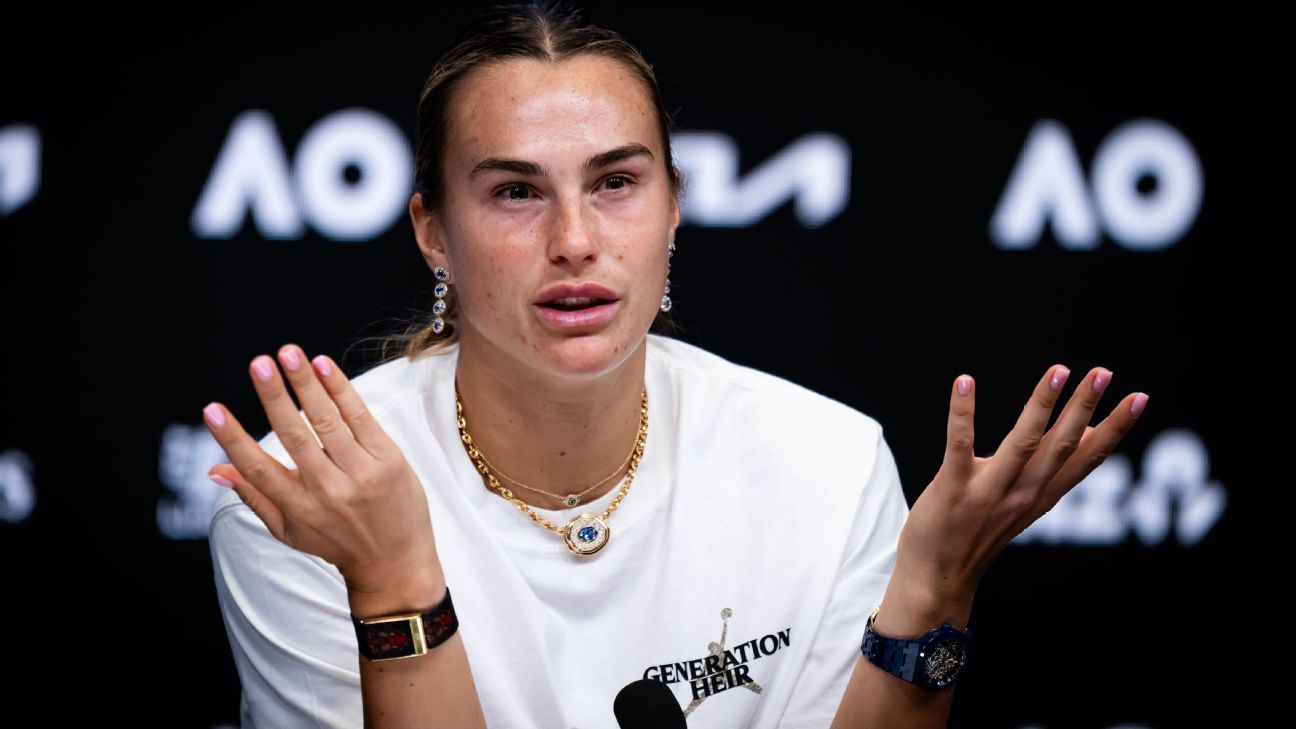
MELBOURNE, Australia — This year’s Australian Open has seen a notable focus on wearable fitness trackers, with prominent players Carlos Alcaraz, Jannik Sinner, and Aryna Sabalenka being instructed to remove their devices during matches.
The devices, commonly utilized in elite sports to gather physiological data that offers insights into health and performance during training, competition, recovery, and sleep, are sanctioned for use by the International Tennis Federation as well as the men’s and women’s tours. However, this approval has not yet been granted for the four Grand Slam tournaments, which include the Australian, French, and US Opens, along with Wimbledon.
Nonetheless, this could potentially change in future tournaments, as Tennis Australia stated, “Wearables are currently not permitted at Grand Slams. The Australian Open is engaged in ongoing discussions regarding how this situation could evolve.”
Sabalenka is advocating for the immediate lifting of the ban. The top-ranked player in women’s tennis, who is pursuing her third Australian title in four years, expressed after her quarterfinal victory on Tuesday that the Australian Open and the other three majors are not aligned with the rest of the tennis world.
Alcaraz and Sinner, who have shared the last eight major men’s singles titles between them, were approached by chair umpires during the fourth round on Sunday and Monday to remove the straps they typically wear on their wrists.
Tennis Australia noted that some wearables offer athletes insights into internal load — metrics such as heart rate — “which can provide them with a comprehensive view of their exertion and how their bodies respond.”
Tournament organizers mentioned that players had access to data at the Australian Open that assisted them in monitoring “key external load metrics” such as distance traveled, directional changes, high acceleration events, and the speed and spin of shots.
The technology provider, WHOOP, characterizes it as “your 24/7 wearable coach designed to help you enhance your health, fitness, and longevity.”
In a social media update, the company stated that the technology is “performance-enhancing — by design. That’s the whole point.”
“Removing that insight is akin to asking athletes to compete without vision.”
Sabalenka mentioned that she received an email indicating the devices had ITF approval and “I was unaware that the Grand Slams had not reached the same conclusion.”
“I don’t comprehend why, as we wear them throughout the year in WTA tournaments, all the events I participate in,” she remarked. “I don’t understand why the Grand Slams are prohibiting us from using them, and I sincerely hope they will reconsider their decision and allow players to monitor their health.”
Sinner, a two-time Australian Open champion, stated that the data gathered from his wrist device during matches aids in recovery and preparation for upcoming matches.
“There are specific data points we would like to monitor a bit on court. It’s not for live use,” he explained. “It’s more about what you can analyze post-match. These are data we would also like to utilize in practice sessions because from that you can train with heart rate, how many calories you burn, all these kinds of metrics.”
Following his fourth-round victory over fellow Italian Luciano Darderi, Sinner indicated that he accepted the umpire’s ruling without hesitation.
“It’s acceptable. There are alternative tools we could use — (like) the vest. But it’s somewhat uncomfortable for me — you feel as though you have something on your shoulders. It’s a bit different,” he noted. “But rules are rules. I understand. I won’t use it again.”
The Associated Press contributed to this report.
Source: espn.com
