
The challenges and nuances of delivering a runner-up speech in tennis
Five years ago, on the eve of the most significant match of her career, Jennifer Brady found herself in her hotel room in Melbourne, nervously jotting down notes on her phone.
Following an unexpected journey at the Australian Open, Brady had reached the first major final of her career and was set to compete against Naomi Osaka the next day at Rod Laver Arena. She was aware of the challenge that lay ahead in pursuit of a lifelong aspiration as the world looked on, but that was not her primary concern at that moment.
“I was so anxious about my speech and everything I would say afterward,” Brady shared with ESPN this month. “I was extremely stressed about not having anything to say — regardless of the outcome — or about making a mistake.”
At 25, Brady carefully listed everyone she wanted to acknowledge, searching her memory for all those who had supported her throughout her journey. She wanted to avoid freezing up while addressing the audience and understood how critically she could be evaluated if it did not go well.
Brady ultimately lost to Osaka the next day with a score of 6-4, 6-3, and despite her evident disappointment, she delivered a gracious and positive speech. During her address, which lasted two minutes and 22 seconds, she congratulated Osaka and her team, acknowledged everyone involved in the tournament, and expressed gratitude to her own support staff. She even elicited laughter when she mentioned her mother back home, “watching right now in front of the TV, probably crying.”
Brady mentioned that she does not recall much of what she said (though she remembers Osaka’s words more clearly). However, even after all this time, with only days remaining before two more singles players must prepare a runner-up speech following a potentially devastating loss, Brady vividly recalls the intense pressure she felt in that moment.
“You’re in the finals of a Grand Slam, and naturally, you want to win; it’s something you’ve dedicated your life to training for,” she explained. “Then, within five minutes of losing perhaps the most significant match of your career, you have to step onto a stage, thank everyone for making the tournament possible, and congratulate your opponent for defeating you.
“After that, you need to come up with something positive to say, even though all you want to do is wallow in your own sorrow for an hour, but you have to do it live and on global television without showing any hint of how you truly feel.”
Brady stated that the structure for a speech during the trophy ceremony is fairly straightforward, and it is a format that nearly everyone adheres to, regardless of whether they have won or lost.
A player must congratulate their opponent and their respective team, then acknowledge everyone who contributed to the tournament’s success, from officials to ball kids to sponsors, before turning their focus to their own team, family, and friends, and perhaps even mentioning how the loss will motivate them in the future. It is typically in the latter parts where a player can reveal a glimpse of their personality.
“There may be one or two remarks or jokes that someone makes that could endear them to fans,” Brady, a co-host of “The Player’s Box” podcast, noted. “And I think that’s what can make the speeches memorable and unique.”
However, for the loser, finding the right tone is essential, and it can be extremely challenging. Current ATP No. 6 Alex de Minaur has yet to reach a major final, but he has delivered his fair share of runner-up speeches, including at the Masters 1000-level Canadian Open in 2023, which he describes as one of the most difficult tasks in the sport.
“It is challenging to compose yourself and ultimately articulate the right things to say while quickly gaining perspective,” De Minaur told ESPN. “The player is understandably frustrated and somewhat angry after a loss, but at the same time, they must do their best to remain composed and find the right words as quickly as possible. It’s very tough.”
While perhaps not successful in terms of maintaining composure, that sentiment was evident following two Grand Slam finals in 2025, albeit with significantly different outcomes and reactions.
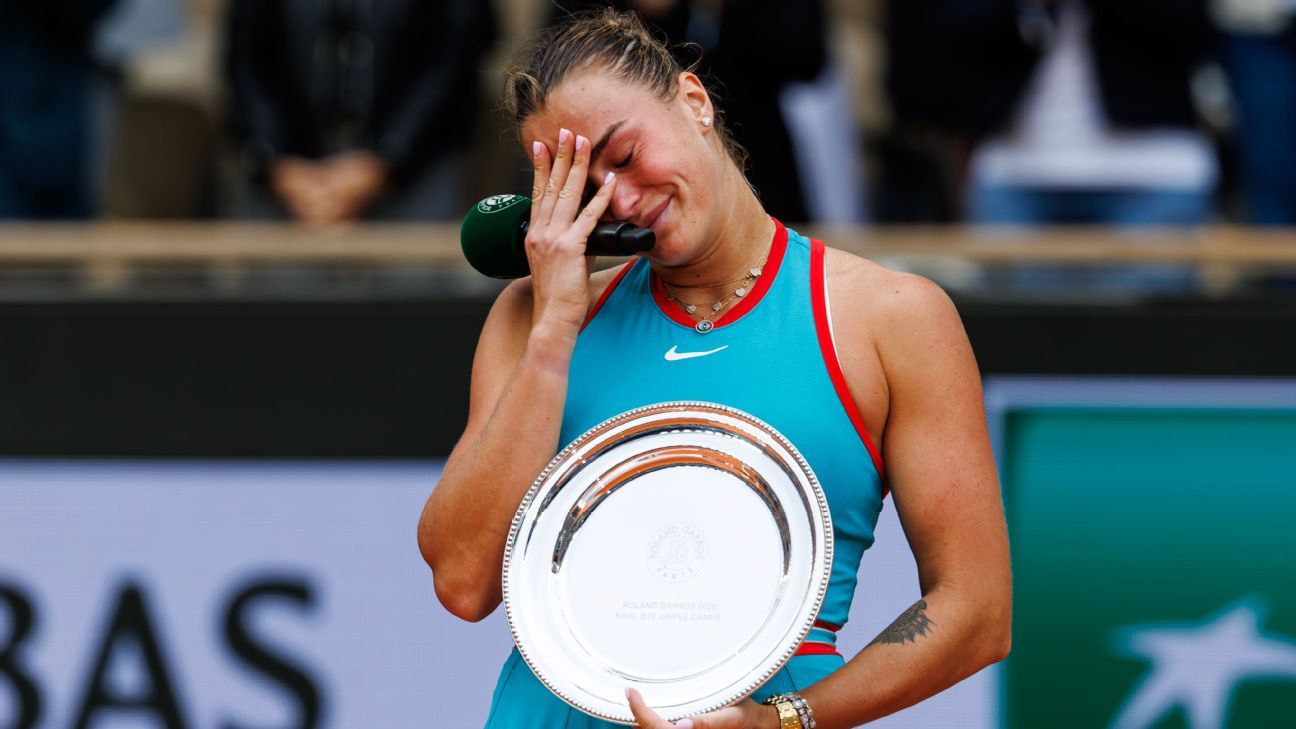
After losing to Coco Gauff for the French Open title in June, world No. 1 Aryna Sabalenka made headlines for what many perceived as disrespectful comments during her speech and in her subsequent news conference hours later.
“Honestly guys, this one hurts so much, especially after such a tough two weeks of playing great tennis,” Sabalenka expressed to the audience as tears streamed down her face. “And in these terrible conditions [to] show such terrible tennis in the final, [it] really hurt.”
Before concluding, she apologized to her team for “this terrible final.” She later reiterated her sentiments to reporters, labeling it the worst final she had ever participated in, claiming Gauff only triumphed due to her numerous mistakes. Following significant criticism, Sabalenka expressed regret for her comments, describing them as “completely unprofessional,” stating that her emotions had simply overwhelmed her.
Approximately five weeks later at Wimbledon, two days after defeating Sabalenka in a thrilling three-set semifinal, Amanda Anisimova faced the crowd. After an astonishing final, in which Iga Swiatek handed her a 6-0, 6-0 defeat in just 57 minutes, Anisimova appeared visibly upset as she approached to accept her trophy from the Princess of Wales.
No one knew what to anticipate when she took the microphone moments later on Centre Court. She wiped away her tears as the audience began to cheer in support. She praised Swiatek, referring to her as “an inspiration” and “an unbelievable athlete.” She expressed gratitude to the fans for the “incredible atmosphere” and credited them for supporting her throughout the fortnight. Her voice grew stronger as she spoke, and she smiled while acknowledging those in her player box.
However, when she mentioned her mother, who had flown in that morning, she broke down in tears once more. “My mom’s put in more work than I have honestly,” Anisimova said, her voice trembling as she covered her eyes with her hand before apologizing. “I’m so sorry. A few more words, I’m sorry.
“My mom is the most selfless person I know. She’s done everything to get me to this point in my life. So thank you for being here and breaking the superstition of flying in. I mean, it’s definitely not why I lost today.”
Ultimately, Anisimova spoke for over five minutes, blending genuine emotion and humor, fully captivating the audience and viewers worldwide with her sincerity.
“I think I was just trying to hold it together, honestly,” Anisimova later told reporters. “It was such a significant moment. I was trying to remind myself that this is an incredible moment, not to let that slip away and get overwhelmed by all the feelings I was experiencing. So I tried to maintain my composure and suppress all the tears and just speak from my heart.”
The speech went viral, and Anisimova received acclaim from across the tennis community and beyond. Amy Edmondson, a professor of leadership and management at Harvard Business School, referred to it as a master class in handling failure in an interview with The Athletic.
“It was courageous,” Edmondson stated. “It was honest, and then you realize how compelling it is and how few people truly take that opportunity to be honest, vulnerable, and generous after a devastating failure.”
However, for others, it raised a question: Should the runner-up be obligated to deliver a speech at all?
This practice is unique to tennis, perhaps a remnant of its outdated status as a “gentlemen’s sport.” It is difficult to envision the losing team in the Super Bowl or the NBA or WNBA Finals addressing a packed stadium or arena, searching for the right words about what the experience meant. Or an Olympian left off the podium speaking to the crowd during the medal ceremony about how it felt to walk away empty-handed.
“I don’t think [the losing player] should have to talk,” remarked Andy Roddick, the 2003 US Open champion and four-time major runner-up, on a recent episode of his “Served” podcast. “It’s cruel, it’s difficult, and it doesn’t occur in any other sport where you have to discuss it immediately afterward and come up with your own speech.”
Sabalenka, who has now delivered three consolation speeches at majors, concurs.
“I don’t understand [why] they keep the runner-up on court for all of that ceremony because it is the worst moment,” Sabalenka stated to Melbourne-based newspaper The Age ahead of the Australian Open. “Of course, I would love to go out there to thank my opponent, to thank my team, say thank you to everyone, and just leave the court. I don’t want to be there. I need my time to cool down, to kind of switch off from what happened.
“The moment you step off court, you’re completely exhausted, and there are no emotions left. You feel like you just want to disappear from this planet.”
The challenge can be even greater for those who are not native English speakers. While tournaments take place worldwide, English is traditionally the default language used.
“Having to do that in another language? Yeah, no thank you on that,” Brady remarked.
Yet, as challenging as it may be, even for someone without a language barrier, De Minaur has found a silver lining in the experience. He vividly recalls losing his first ATP final at the Sydney International in 2018 in front of a hometown crowd, which included family and friends. After losing to Daniil Medvedev, De Minaur was devastated as he accepted his runner-up trophy. However, having to speak just moments later forced him to process the defeat and his emotions in real time.
“I was extremely frustrated for not being able to secure the win, but at the same time, I had to start gaining perspective right then,” De Minaur explained. “I had a great week, I made the final, I was very close [to winning], and I enjoyed every moment of the week. Naturally, there was nothing I wanted more than to win that match in Sydney, but I told myself, and the crowd, that I would find another opportunity to do it — and I was able to come back the following year and redeem myself.”
He won the tournament in 2019 and delivered the first victory speech of his career in front of the same audience. “I was very proud of that,” he added.
Brady, who has been largely sidelined since 2021 due to a series of debilitating injuries and has participated in only two major tournaments since her last appearance in Melbourne, enjoys watching speeches, even if she does not always wish to deliver them, and believes they should be optional for the runner-up. She understands how challenging they can be but appreciates when “personalities come out” and they do not adhere strictly to the script.
While the now 30-year-old, who returned to competition this week at an ITF event in San Diego, admits she “kind of blanked” as soon as she stood in front of the microphone, the trophy ceremony from that day remains something she is recognized for and a clip that is sent to her countless times each year during the Australian Open.
Although her speech was without controversy, what followed did go viral. When Osaka began her victory speech, she asked Brady if she preferred to be called Jenny or Jennifer, to which Brady replied, “Jenny.” Osaka then proceeded to congratulate “Jennifer.” It was an awkward moment, highlighted by a perplexed expression on Brady’s face, and it spread across the internet rapidly.
A true queen ?@naomiosaka took time to praise and congratulate @jennifurbrady95 and her team after winning the #AusOpen pic.twitter.com/l7K6Yycn0C
— espnW (@espnW) February 20, 2021
For Brady, it served as a reminder of how nerve-wracking the experience of addressing the audience can be, even for someone who had just secured her fourth major title.
“I was very anxious when I began my speech, and I think she was too,” Brady reflected. “I think maybe she just wanted to break the ice for herself when she asked me that, but then she just wasn’t fully tuned in at that moment. I couldn’t really hear that well with the speakers in the stadium and the echo and all that, but when it sounded like she said ‘Jennifer,’ I remember thinking, ‘Oh no.’ When I left the court, my phone was inundated with messages about it.
“I remember the ‘Jenny or Jennifer?’ moment more than my own speech. It still gets mentioned frequently, more than one might expect. And it always resurfaces on the internet around this time of year.”
Source: espn.com
