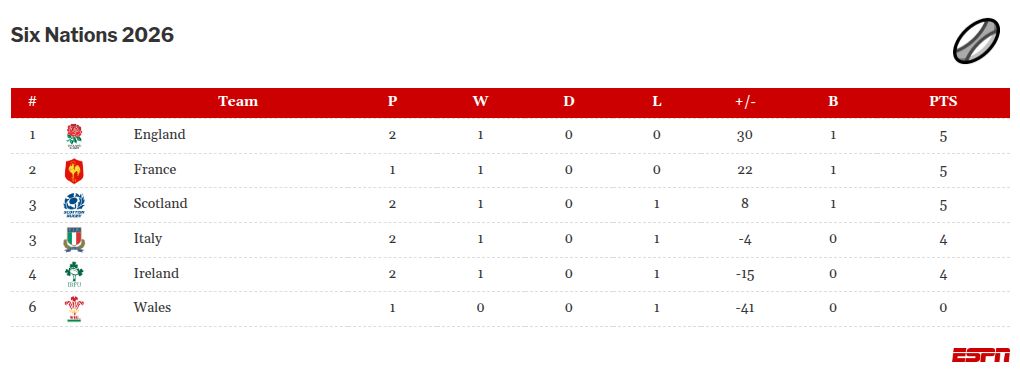
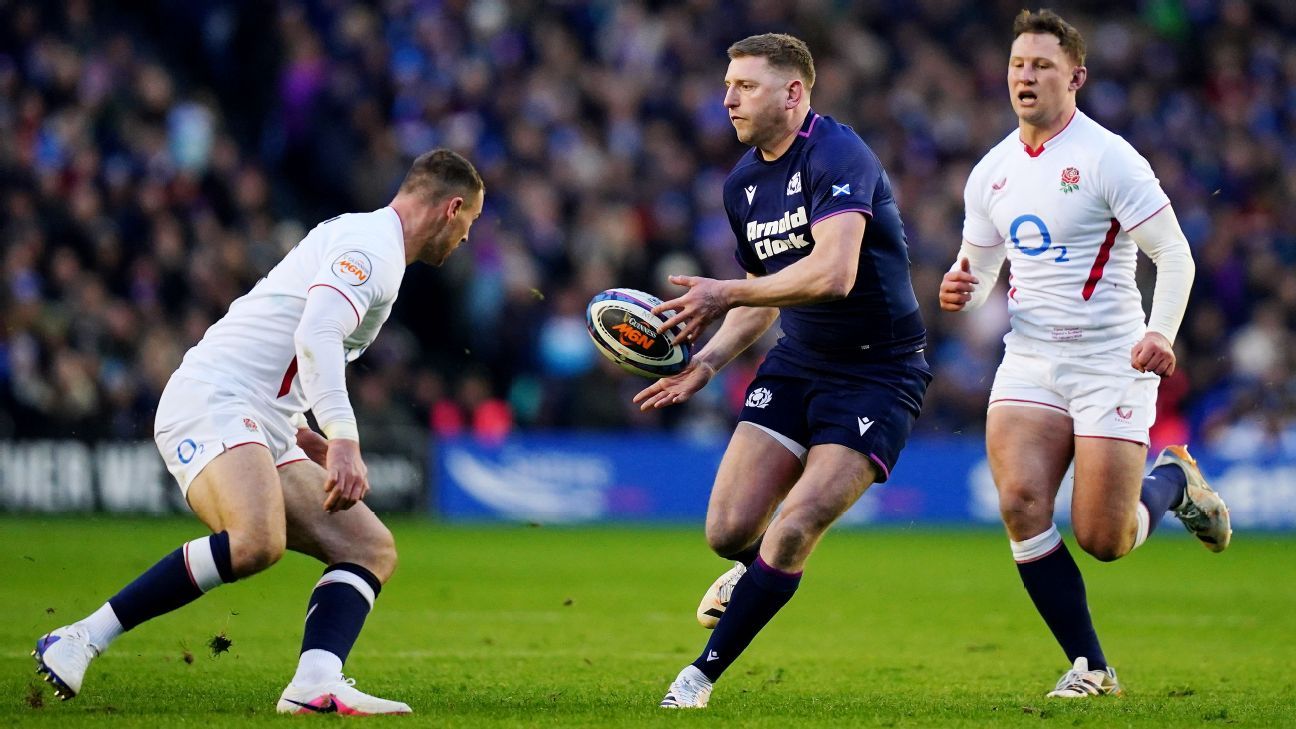
It should be clear by now that the Calcutta Cup defies logic, reason, and form. A remarkable Scotland dominated much of this encounter at Murrayfield, excelled in aerial contests, and had the captivating Finn Russell orchestrating play to end England’s winning streak.
England made the journey north aiming to build on last weekend’s comfortable victory over Wales, seeking their first win on Scottish territory since 2020. Despite discussing a Scotland side that appeared wounded after their loss to Italy last weekend, along with head coach Gregor Townsend under pressure, the visitors were considered the clear favorites.
However, the Calcutta Cup had its own surprises in store, and Scotland relishes a win against their oldest rivals. In this context, Scotland convincingly defeated England 31-20, securing a try bonus point in the process, alleviating pressure on Townsend while England’s search for a significant away win in the championship under Steve Borthwick continues. England faced a challenging situation, playing 30 minutes with 14 players after Henry Arundell received a yellow card followed by a second yellow later in the first half, resulting in a 20-minute red card. This numerical disadvantage proved detrimental for England.
Yet, there is a sense of celebratory frustration regarding Scotland’s performance: how can they display such precision, aggression, and dominance against England just days after their lackluster defeat to Italy, and previous capitulations against the All Blacks and Argentina in November? These contrasting performances are perplexing when compared to what transpired on Saturday in Edinburgh. Scotland was exceptional, and their display left spectators yearning for more.
Scotland entered this match with pressure mounting. Patience was wearing thin in the region regarding a talented group of players who had not been meeting their collective potential. Nevertheless, the Calcutta Cup has a unique ability to inspire them, regardless of form.
Even in the absence of Duhan van der Merwe and with players like Blair Kinghorn sidelined, Scotland excelled. Kyle Steyn dominated aerial battles, Matt Fagerson made a significant impact off the bench, Rory Darge was formidable at openside, and Russell was nearly flawless at fly-half. He played a crucial role in each of their first-half tries, while Sione Tuipulotu and Huw Jones excelled in the centers. This was achieved despite a struggling scrum.
All three first-half tries by Scotland showcased remarkable construction. Jones scored the first after Russell’s flicked pass created space on the flanks—an area Scotland clearly targeted from the outset. Their second try came as Scotland spread the ball wide, then switched direction, with Russell orchestrating play as he found Tuipulotu, who delivered a precise pass to Jamie Ritchie on the flank to score unopposed.
For their third try, Russell maneuvered past the typically formidable Guy Pepper and Sam Underhill to execute a kick behind England’s defensive line. Ellis Genge failed to gather the ball, allowing Ben White to seize the opportunity, igniting excitement at Murrayfield. For their fourth try, England seemed to be gaining traction early in the second half, applying pressure on Scotland’s line, but a charge-down changed the momentum.
Scotland anticipated George Ford attempting a drop-goal at some point, and when he lined up in the 53rd minute, Fagerson charged him down, collected the ball, and passed it to Jones, effectively sealing the match. England’s momentum was halted as Scotland maintained a high level of intensity to finish strong. Fagerson’s contribution from the bench—having come on at halftime for Ritchie—was pivotal, but Steyn, Dodge, and Russell laid the groundwork.
– Scotland stuns England at Murrayfield with a 31-20 victory: As it happened
– Six Nations players to watch: Pollock, Rees-Zammit, and other stars
This was not the England that had previously won 12 consecutive matches, dispelling any doubts raised against them. Instead, they appeared vulnerable defensively, struggled in aerial contests, lost the kicking battle, and while their scrum was dominant—deserving of further rewards—discipline was a significant issue.
They averaged just 1.1 points from nine entries into Scotland’s 22, with four instances of knocking the ball on just meters from the line. At times, England appeared one-dimensional, delivering a performance that was uncharacteristic, frustrating, and ultimately disappointing.
This result will be deeply disappointing for England. They seemed unprepared in the opening 20 minutes, caught off guard. Ben Earl played exceptionally well—though that was expected—but England never truly found their rhythm.
The poor start left them on the back foot, and Murrayfield is an incredibly challenging venue to regain momentum and form. The charge-down was the pivotal moment that secured Scotland’s victory, but England had opportunities deep in Scotland’s 22, only to be let down by handling errors. Their only try came from Arundell, but his match will be remembered for the two yellow cards that left England contesting 30 minutes a man short.
For England, this Six Nations was intended to be one where they entered the fifth round away at France still in contention for a Grand Slam. Following their impressive form throughout much of last year, this was expected to be the championship where they advanced and established themselves as title contenders.
Instead, they were sent back to the drawing board by a revitalized Scottish team. England will feel frustrated and wounded but still have a chance at the title, needing to regroup with Ireland visiting Twickenham next weekend.
As for Scotland, Edinburgh will be alive with excitement. They were exceptional and thoroughly outplayed their historic rivals. However, they must strive for consistency. Their inability to follow up strong performances with similarly intense displays has been their Achilles’ heel, hindering their momentum over recent years.
If they can bottle this performance and replicate this intensity, Scotland will finally take the long-awaited step forward. Townsend faced immense pressure leading into this match, and as Russell aptly noted post-match, that expectation will not diminish anytime soon with a trip to Wales on the horizon next Saturday. This marked Townsend’s 100th match in charge of Scotland, providing him a chance at the 101st and essentially a foundation for Scotland to build upon.