
U.S. Select Team Relishes Back-to-Back World Junior A Challenge Titles
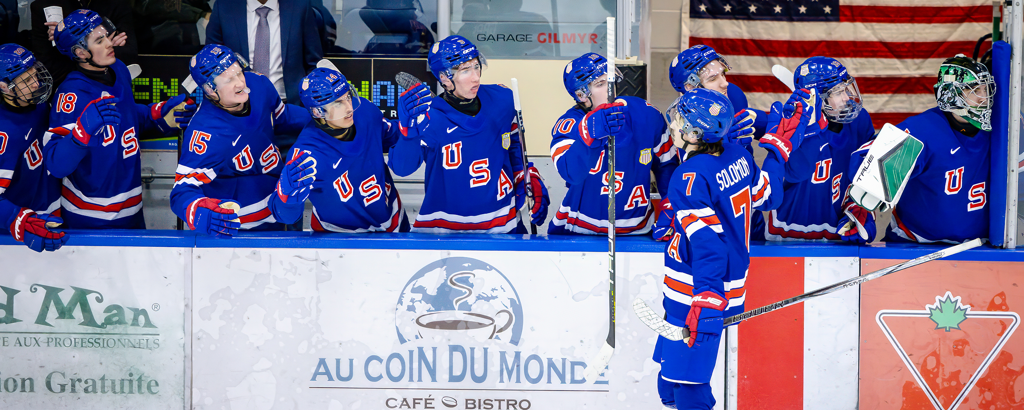
Any true champion will find a way to win, even on nights when it doesn’t play its best game.
That’s exactly what the U.S. Junior Select Team did in its 5-1 victory over Canada West in the championship game of the 2025 World Junior A Challenge.
“If I’m being honest, I don’t think we played our best,” said U.S. coach Andy Brandt. “There was a lot of emotion in the semifinal game against the Swedes. It was a physical, 200-foot, playoff-type hockey game. And I think it drained our group a little bit.”
The Americans, who had also beaten Sweden 7-1 in the preliminary round, survived the semifinal tussle with the Swedes and won 4-2. They then had to play in the championship game the following evening at the Colisée Vidéotron in Trois-Rivières, Quebec.
As U.S. assistant captain Carter Sanderson pointed out, he and his teammates knew that they didn’t have their “A game” against Canada West.
“Everybody came together and they kind of knew what everybody had to do to help the team best succeed,” Sanderson said. “Guys definitely found their B game, and we just stuck to that. When you don’t have your A game and having to work a little bit harder for that, it’s definitely more rewarding.”
Brandt praised Sanderson, a forward from Pierre, South Dakota, for his leadership throughout the tournament in helping Team USA claim its second-straight and 11th all-time Challenge championship.
“He was a driver of play,” Brandt said. “He’s a 200-foot guy. He played in all situations for us. He played in the power play, played on the penalty [kill], played five-on-five.
“We leaned on him in big moments, and he led our group. It was impressive to kind of stand behind the bench and watch him lead, both vocally and on the ice.”
Sanderson’s biggest moment came in the semifinals, as he scored his only two goals of the tournament to help the U.S. beat Sweden and advance to the title game.
Sanderson and his teammates had begun the Challenge on a down note when they dropped a 4-1 decision to Canada East in their preliminary-round opener.
“It was a tough loss for our group,” Brandt said. “And it wasn’t that we necessarily played poorly. We didn’t finish, and the [Canada] East team played well.
“It was probably the adversity that our group needed. Unfortunately, it kind of punched us in the nose right off the hop. We just couldn’t find a way to win. But we were able to rebound.”
The U.S. bounced back with a 7-1 win over Sweden, sparking a four-game win streak were the Americans outscored their opponents 20-4.
Brandt said the win against Sweden provided his players with plenty of confidence and the belief that they could beat anyone in the field.
Special teams’ play proved to be the key to the big 7-1 win against Sweden, Sanderson said.
“We had like three power-play goals,” he said. “We let up a shorthanded penalty-kill [score], but we had a number of penalties to kill off there and definitely had a high percentage on that. I think that special teams being able to go out and get momentum definitely helped in our favor.”
The Americans concluded preliminary-round play with a 4-0 win over Canada West and then dispatched Sweden in the semifinal.
“Coming into this, we knew that we were going to get each team’s best,” Sanderson said. “Sweden’s a fast, skilled team to play against. Us being able to maintain that speed and kind of us [dictating] the terms was really good for us and obviously worked out in the end.”
The U.S. then had enough left in the tank to get past Canada West in the championship game.
Sanderson pointed out that the U.S. players, who hailed from several United States Hockey League teams, were able to jell quickly as a group.
“I felt like we really bonded well together, and obviously it helped us out in the end,” Sanderson said. “Going out there battling with those guys during the [USHL] season and being able to come together for two weeks and take gold during a tournament like this was pretty special.”
“You’re expected to build chemistry and play together. Sometimes, that can be a little bit difficult. With the limited time that we had, I felt like we built enough chemistry here to do what we needed to do.”
Stars on their respective USHL teams, the U.S. players did what was necessary to win, Sanderson said.
“Coming together for a tournament like this and kind of owning your role as to what the team needs to succeed in the win is kind of what you need to do, right?” Sanderson said. “I think that if guys are willing to own their role, it’ll shake out well for them in the end.”
Story from Red Line Editorial, Inc.
