
Influential U.S. figures Brianna Decker and Jack Parker Inducted into the Hockey Hall of Fame
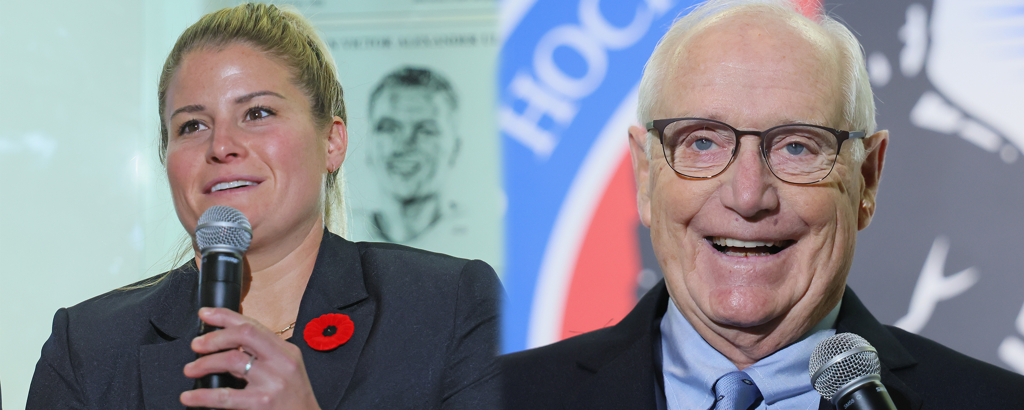
Brianna Decker never played hockey for the accolades, but being inducted into the Hockey Hall of Fame meant the world to her.
“Hockey has given me so much,” Decker said during her induction speech on Monday night. “It’s given me lifelong friendships, unforgettable memories and now this incredible honor. This represents all the people who poured into me along the way.”
Decker, a standout on the U.S. Women’s National Team, and Jack Parker, the longtime Boston University men’s hockey coach, were the two Americans inducted into the eight-member Hockey Hall of Fame on Monday in Toronto. Decker, Jennifer Botterill, Zdeno Chara, Duncan Keith, Alexander Mogilny and Joe Thornton were inductees in the players category, while Parker and Danièle Sauvageau were inductees in the builders category.
Decker starred during a revolutionary time for women’s hockey in America.
A native of Dousman, Wisconsin, Decker started her career playing on both boys and girls teams. In 2004-05, she helped the Madison Capitols 14U team win a Wisconsin state championship.
“For every young girl out there, never let anyone tell you that a woman can’t be inducted into the Hockey Hall of Fame,” Decker said.
Following a successful stop at Shattuck-St. Mary’s School in Faribault, Minnesota, Decker was a standout at the University of Wisconsin from 2009-2013 where she led the Badgers to a national championship in 2011 and won the Patty Kazmaier Award the following year.
Decker finished her UW career plus-175, tops all-time and ranks second with 115 goals and 244 points. Decker still holds the longest point-scoring streak in program history at 32 games, amassing 33 goals and 44 assists during that span from February 2011 to January 2012.
“I’m incredibly humbled, overwhelmed with gratitude and honestly I’m still in a little disbelief,” Decker said. “Being inducted into the Hockey Hall of Fame is an honor I never dreamt of. It’s hard to put into words what this means to me because nobody gets here alone and I certainly didn’t.”
A three-time Olympic medalist, Decker played a key role on the 2018 U.S. Olympic Team that claimed the country’s first gold medal in 20 years. She also earned silver medals in 2014 and 2022.
Decker helped the U.S. to six gold medals in IIHF Women’s World Championship play and two silver medals. She was the MVP and points leader during the 2017 tournament and still ranks third in assists, fourth in points and fifth in goals all-time among U.S. players at the Women’s World Championship.
“Thank you to USA Hockey for giving me the opportunity to represent something bigger than myself,” Decker said. “Wearing that jersey is still one of the proudest moments of my life.”
Parker was a transformative influence on college hockey in the United States. Many of his players went on to compete in the NHL and at the Olympics, while others became team executives. Four of Parker’s players were members of the 1980 “Miracle on Ice” gold medal-winning team, including captain Mike Eruzione.
“For close to a half century, his unprecedented winning results at Boston University combined with his influence on so many budding hockey players has given him legendary status,” said longtime NHL executive Lou Lamoriello, who inducted Parker.
“His contributions to hockey in the United States are at the very root level of the game’s growth and success there.”
Joe Quinn, Parker’s first hockey coach — and a former Boston University captain — played a pivotal role in his development.
“He was always hammering how important it was to outcompete the other guy,” Parker said. “Skill is important, but competition is more important … to beat the guy you’re up against. That stayed with me for a long time.”
Parker, a native of Somerville, Massachusetts, enjoyed an extraordinary 40-year career as coach at Boston University. He was a standout with the Terriers under Jack Kelley from 1965-1968, winning three Beanpot championships.
“The best professor I had at Boston no question was Jack Kelley,” Parker said. “He knew his subject better than anybody else and he demanded you know his subject better than anybody else. He was an unbelievable coach.”
A finance major, Parker graduated and started a career as a banker until a teammate called and asked if he wanted to be a high school coach.
“In my first year, I was obsessed about coaching,” Parker said. “I loved the planning, the practices, the interaction with players, the competition with other coaches. … it was a wonderful time for me.”
Parker returned to Boston University as an assistant and helped the Terriers to consecutive national championships in 1971 and 1972.
“When I was an assistant, it was like I was getting my doctorate in hockey,” Parker said. “It was a fabulous time to learn how to teach the sport, how to recruit and what to look for in a player. It was an amazing time for me, but it was also an amazing time for Boston hockey.”
Kelley soon left to become a general manager, and other personnel changes pushed Parker to become the head coach at Boston University in 1973 at the age of 27.
Parker led BU to three NCAA championships (1978, 1995, 2009), three ECAC regular-season titles, four ECAC championships, eight Hockey East regular-season titles, seven Hockey East championships and 21 Beanpot titles.
He earned NCAA Coach of the Year honors three times and Hockey East Coach of the Year on five occasions. He retired after the 2012-13 season and entered the U.S. Hockey Hall of Fame in 2017.
“We had great players, and I had great assistant coaches who stayed with me for a long time,” Parker said. “I’ll forever be grateful to Boston University for wanting to support our sport. They always wanted to be competitive at the national level in ice hockey.”
Story from Red Line Editorial, Inc.
