
“I don’t simplify things”: Rory McIlroy’s approach to securing consecutive Masters titles
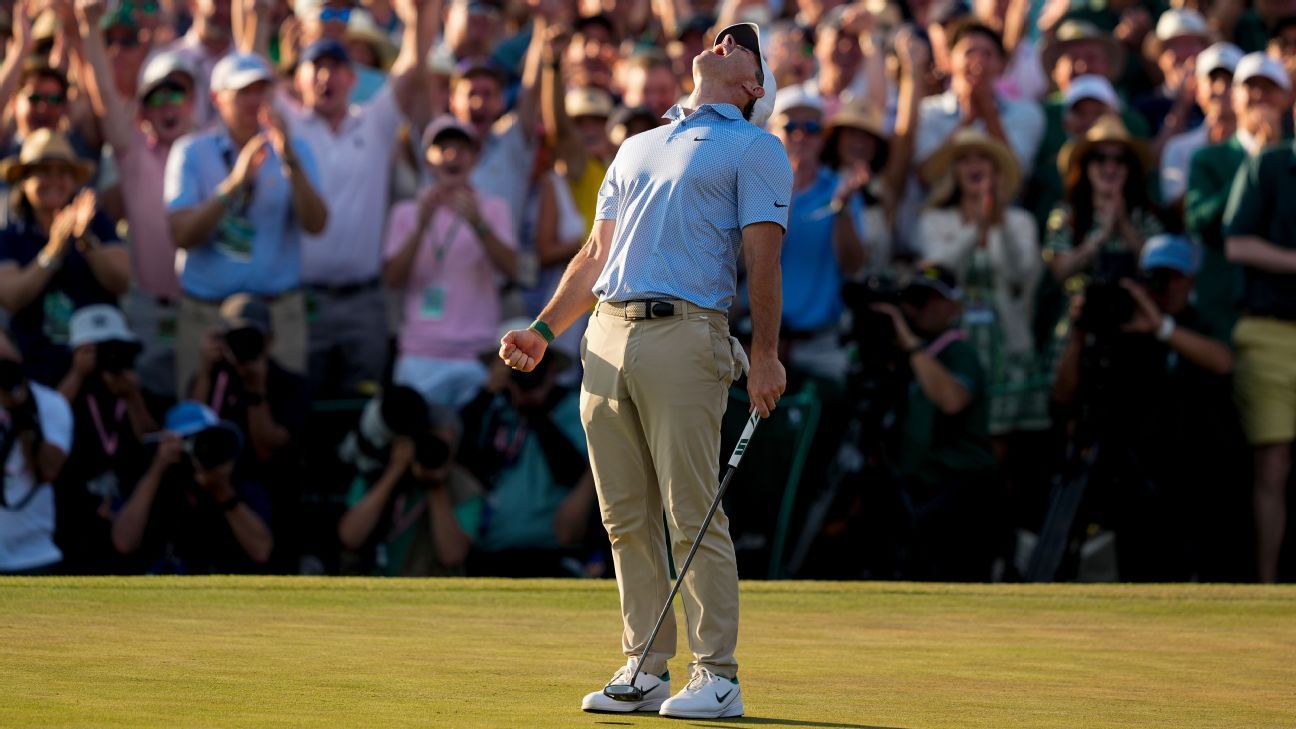
AUGUSTA, Ga. – The look on Rory McIlroy’s face conveyed everything. As he approached his ball positioned so far right of the 18th fairway at Augusta National that it was nearly on the 10th, he exhaled deeply and shook his head. It was clear that this would not be straightforward – not at Augusta National, not for him, especially after holding a six-shot lead after 36 holes and having previously tasted victory here.
The flawless final tee shot he executed last year to clinch the Masters in a playoff was now a distant recollection. He needed to find a way to complete the hole in five strokes to don the green jacket once more.
“I thought winning last year was incredibly challenging due to the pursuit of the Masters and the grand slam,” McIlroy stated. “Then this year, I came to understand that winning the Masters is just really tough. I tried to convince myself it was both.”
The two-shot advantage McIlroy held set the stage for an uncomplicated celebration. He needed to hit it into the fairway, place it on the green, and enjoy the moment – a relaxed stroll up the 18th fairway that he was unable to experience the previous year. Instead, McIlroy donned his glove and took a lengthy, unceremonious walk to clear a path for the spectators and create a clear sight of his target. He would need to execute one final escape.
“I don’t make it easy,” McIlroy remarked. “I used to make it simple in my early 20s when I was winning by eight shots. It’s just challenging. Winning golf tournaments is hard.”
Over the past year, McIlroy has exerted every effort to find freedom in a completed quest, but as he mentioned on Friday, he occasionally felt unmotivated. He recognized that the grand slam was not a fulfilling goal, merely a fleeting one. However, by the time the anniversary of his victory arrived, McIlroy’s outlook had changed. He had spent the three weeks leading up to the tournament away from competitive play, transforming this challenging golf course into his practice ground.
“I joked last week and leading into this week that this place feels like my home course,” McIlroy said. “I haven’t really played anywhere else in the last two or three weeks.”
He made day trips after dropping off his daughter Poppy at school, repeatedly playing the course, not necessarily seeking an advantage but rather to rekindle his affection for it. This seemingly insurmountable plot of land had become so frustrating that McIlroy had grown to dread his annual visit here in April.
Now, Augusta had evolved into a site of his greatest success, prompting McIlroy to return time and again. Recalling advice from Jack Nicklaus about preparing for tournaments by simulating a full tournament in practice, McIlroy played rounds at Augusta with a single ball and discovered new areas of the course he had never considered. The rumor circulating this week was that, in one of those rounds, he had recorded a potential course record 62.
At other times, he took his time, chipping and putting on the pristine greens as if he were revisiting a book he had developed a newfound appreciation for.
“I felt prepared in that regard. I felt ready that wherever I hit it on the course, I sort of know what to do. I know where to miss,” McIlroy stated. “I’m quite comfortable with all the shots around the greens.”
When he surged to share the lead on Thursday and extended his advantage to six shots on Friday after posting a 65, it was a reassuring validation: the effort he had invested had yielded results. Despite not having his best performance, missing fairways and pulling his irons, he was enjoying every position he found himself in.
“My scrambling, short game, and putting,” McIlroy noted. “That’s what secured the tournament for me this week.”
Yet even familiarity could not alter McIlroy’s tendencies. He quickly squandered his six-shot lead on Saturday and had to dig deep to salvage his chances in the tournament. Sunday proved no different. He lost his share of the lead on the second hole but regained it on the third. He double-bogeyed the fourth hole and added another bogey at the sixth, leaving him two shots behind.
The ups and downs continued: McIlroy birdied the 7th and 8th holes and arrived at Amen Corner with a one-stroke solo lead. He struck a 9-iron into the 12th that set up a birdie and successfully got up-and-down for another on the 13th. A year after navigating Amen Corner in 3-over par, McIlroy managed to traverse the trio of holes five shots better and with a lead he would not relinquish. Not this time.
On a day when no one seemed eager to seize the lead and maintain it, McIlroy once again did just enough and did it in his own manner – not through dominance but through drama. Not with certainty but by showcasing a full spectrum of emotions and bringing everyone along for the journey.
“Of all the major sports, I believe it is the most mental. It’s the most mentally challenging,” McIlroy remarked. “I think it’s difficult to maintain the same mental state for four consecutive days.”
After navigating his shot on 18 around every possible obstacle and into the bunker that nearly extinguished his dream last year, McIlroy watched his par putt roll by a few inches before marking it. Finally, there were no more doubts or potential pitfalls awaiting him.
He turned toward the back of the green, spotted his family, and raised his arms. It was more joy and less of an overwhelming surge of emotions than last year, he later explained. Those emotions hit later when, after donning his green jacket once again, he addressed his parents directly.
“Mom and dad, I owe everything to you,” McIlroy said, tears in his eyes. “You’re the most wonderful parents. And if I can be half the parent to Poppy that you were to me, then I know I’ve done a good job.”
Both had spent last April across the Atlantic, watching their son struggle late into the night before emerging victorious. This year, they were present – Gerry following Rory’s rounds throughout the week while Rosie carried a handbag adorned with newspaper clippings of McIlroy’s grand slam victory.
“I caught myself on the golf course a couple of times thinking about them, and I was like ‘no, not yet, not yet,” McIlroy said. “I had to sort of persuade them to come this year because they thought the reason I won last year was that they weren’t here. I’m glad we proved that wrong, so they can keep coming as long as they wish.”
When he finally allowed himself to think about them, McIlroy stepped off the 18th green and found their embrace. A year ago, he had transformed this place from a hall of horrors into his crowning achievement, but on Sunday, as he emerged a champion once more and buried his head in his parents’ shoulders, McIlroy was home.
