
Four decades on, Jack Nicklaus’ victory at the 1986 Masters remains remarkable.
AUGUSTA, Ga. — Jack Nicklaus had already secured 17 major championships, the highest total in history, when he arrived here in 1986 to participate in the Masters.
At 46 years old, he came to compete in the Masters. While he was eager to participate, he had entered a phase of semi-retirement, playing only around 12-14 tournaments annually. It had been six years since his last major victory, and he was not dedicating himself to his game as he once had.
There was an element of enjoyment involved. His son Jackie would carry his bag, and his mother and sister were attending the tournament for the first time since 1959.
“It seemed like I was pretty much finished with playing golf,” Nicklaus remarked Thursday after he, Tom Watson, and Gary Player commenced the Masters with ceremonial tee shots. “I really wasn’t, you might say, expecting to win anymore.”
Nicklaus’ status in golfing history and among the sport’s elite was assured, and it always will be. He did not require another victory.
Nevertheless, his success 40 years ago had a notable effect on his career and legacy.
Nicklaus was a formidable presence in the 1960s and 1970s, but by the mid-1980s, he had faded into memory. New golf enthusiasts of that decade, along with younger fans just beginning to follow the sport, had heard tales of Nicklaus’ brilliance but had not witnessed much of it firsthand.
That changed during one of the most thrilling Sundays in the tournament’s history, with five different players sharing the lead at various points. Nicklaus had recorded a third-round 69 to start the day tied for ninth, only to deliver an impressive 65 to secure his sixth green jacket.
He concluded the round with an eagle on 15, a near hole-in-one that turned into a birdie on 16, and then a final birdie on 17, thanks to his renowned downhill putt with a slight left break on the notoriously difficult green, with CBS’ Verne Lundquist providing the perfect commentary — “yes, sir.”
For those who needed to witness Nicklaus’ magic or be reminded of it, this was the moment.
“I think for many people, it sort of validated my career, I suppose,” Nicklaus stated. “It earned some career-ending respect for that, and for me as well.”
This victory became the most celebrated of all his achievements. It also extended his legacy, as he triumphed over some emerging champions, including Greg Norman, who had risen as one of the stars of the 1980s but finished second that day.
At that time, Augusta National still significantly restricted broadcasts of the Masters, allowing CBS to air only the back nine on Saturday and Sunday. Attendance appeared to be considerably lower, with images showing Nicklaus teeing off on 18 in the final round with only a few hundred spectators present.
The limited coverage made that remarkable performance even more significant. It is regarded by many as one of the greatest tournaments in golf history.
That he needed one more Masters is astonishing, yet the last one turned out to be his finest.
“Absolutely No. 1,” Nicklaus said. “… People ask me, what’s your favorite one? I loved them all, but ’86 was one where I wasn’t expected to win, past my prime and all the usual. And I won. It had to be the most special to me.”
Nicklaus’ career achievements are almost legendary. It’s not just the 18 majors (Tiger Woods is second with 15), but also the 19 second-place finishes. From 1962-1980, 76 major championships were held. Nicklaus finished in the top five in 47 of them, an extraordinary 61.8% of the time.
“I finished second 19 times in majors,” Nicklaus remarked. “To me, I just kicked myself for finishing [second] 19 times; I should have won some.”
“It was a good thing,” said Watson, his longtime friend.
“Actually, it was a good thing,” Nicklaus agreed. “But I didn’t like it.”
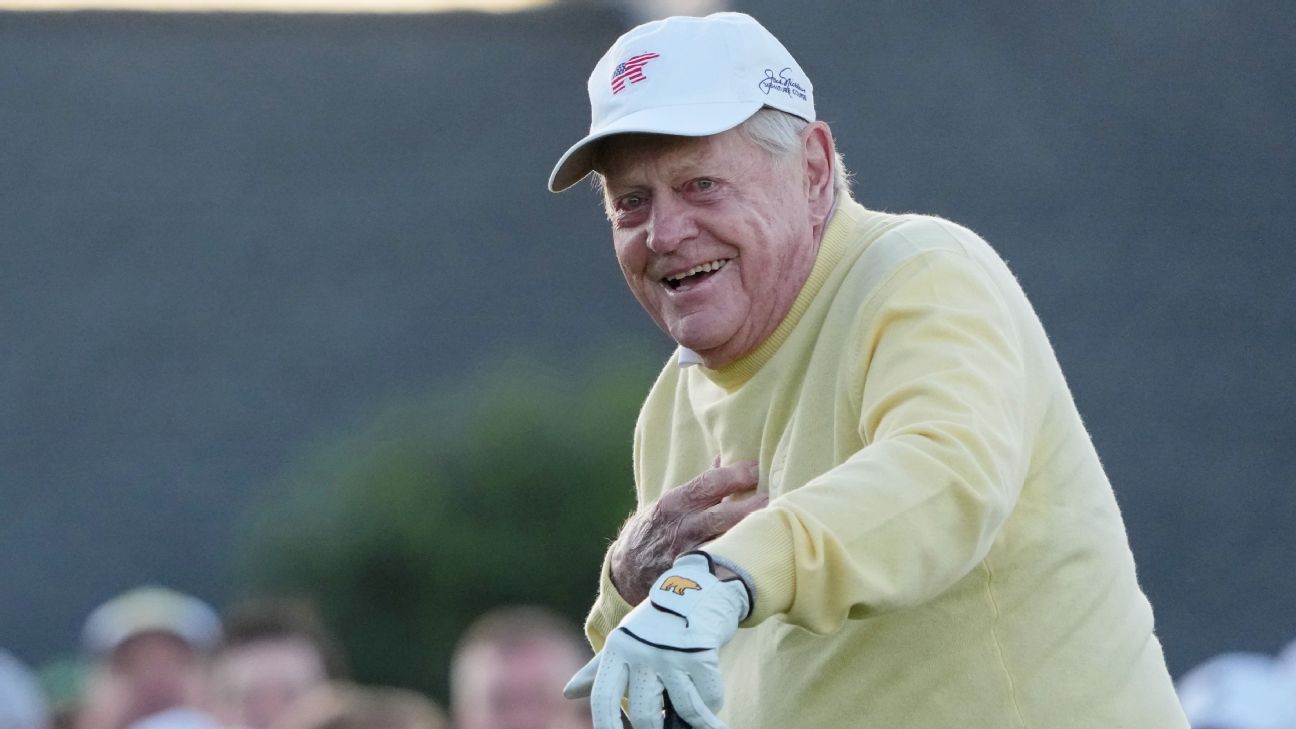
On Thursday, at 86, Nicklaus returned to Augusta National, standing on the ceremonial first tee, enjoying the cheers of the crowd as the sun began to rise over Georgia. He first visited here 57 years earlier, as a 19-year-old from Ohio State. He was well-known enough that he and his father were invited to Bobby Jones’ cabin on the grounds to meet the Augusta National designer personally.
Forever linked with golf, he hardly plays anymore, perhaps once a year. He underwent surgery for carpal tunnel syndrome five weeks ago, so he was concerned about gripping the club on Thursday. He had Jackie tee the ball up and encouraged the spectators to spread out, saying, “I don’t want to kill anybody,” with a laugh.
He managed to avoid that, partly because he sent a drive left over the crowd. At least, he noted, no one was hit. He considered pulling his tee from the ground but, fearing a loss of balance, simply laughed and waved at it.
“I don’t know what was going through my mind other than not to hurt anyone,” Nicklaus joked. “It’s always a great privilege and great honor … I’ve been doing it for a few years now; it’s pretty special.”
Forty years ago, he made one more remarkable charge, delivering a Masters that was not only unforgettable but also served to remind everyone of Jack Nicklaus’ brilliance.
“It was a nice way to finish a career, you might say,” he concluded.
