
PONTE VEDRA BEACH, Fla. — On Wednesday morning, outgoing PGA Tour commissioner Jay Monahan discreetly made his way to the back lawn behind the TPC Sawgrass clubhouse, carrying several blue Tiffany boxes.
In keeping with tradition, Monahan moved from player to player, presenting each of the 14 newly inducted PGA Tour members with a box containing silver cuff links, while engaging in brief conversations. A camera followed him until he had distributed all the gifts before he departed quietly.
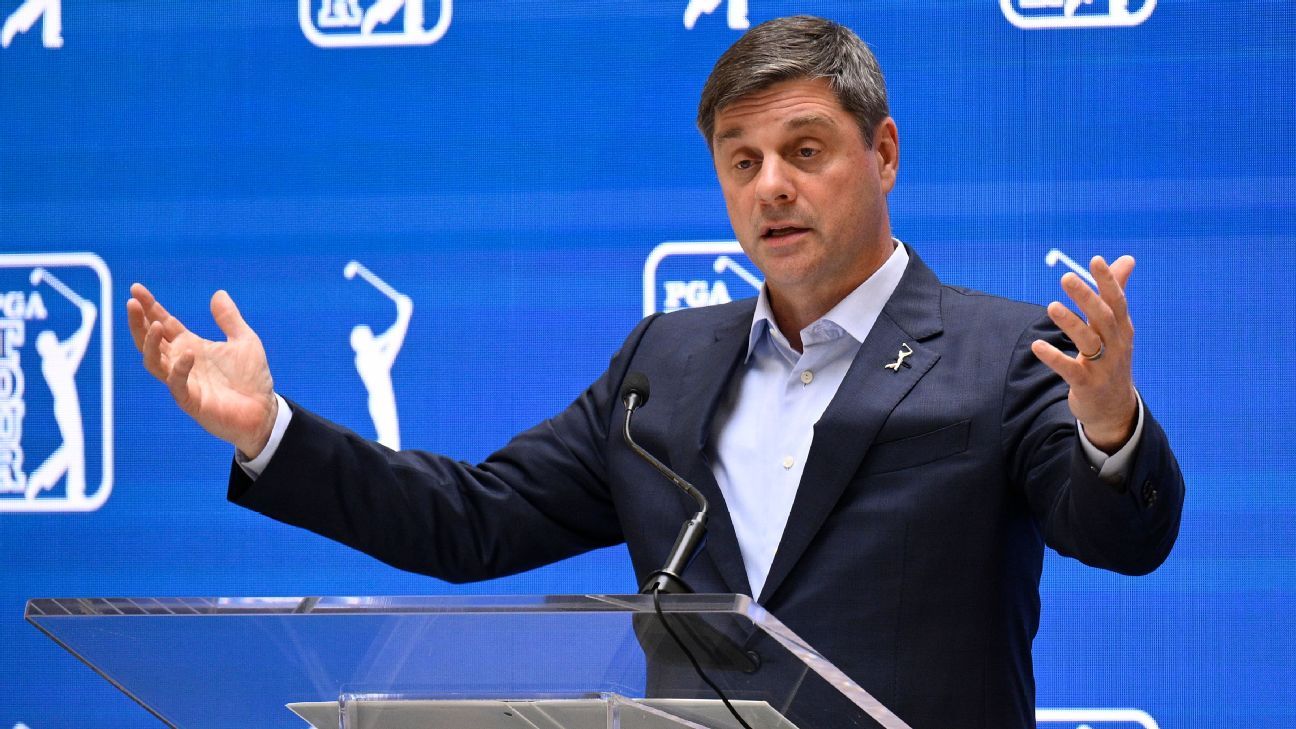
In any of the previous nine years, Monahan would have been scheduled to address the media in the press room on the same day. Instead, just a few hours later, Monahan was seated in the front row as new PGA Tour CEO Brian Rolapp took the stage — not in the media center but prominently at the PGA Tour’s Global Home headquarters, where 1,100 attendees awaited his remarks.
If the visual cues weren’t sufficient to indicate a transition in leadership, Rolapp’s statements further emphasized the clear message: The PGA Tour has embarked on a new chapter and is seeking a significant transformation. Rolapp even described it as a “blank sheet of paper.”
“We approached this initiative with a very specific goal,” Rolapp stated regarding the Future Competition Committee that was introduced last August. “To create the best version of the PGA Tour.”
What does that entail? It varies depending on whom you ask, but on Wednesday, Rolapp outlined his six-step strategy, which he repeatedly clarified was not yet formally established, yet clearly served a purpose in being articulated.
The centerpiece was the implementation of a promotion-relegation system, effectively dividing the PGA Tour into two distinct tiers — one for the elite players featuring 21 to 26 signature-style, 120-player events annually (with a cut) and a separate schedule for those aspiring to, as Rolapp phrased it, “ladder up” to the upper tier.
A superficial analysis reveals a clear philosophy: the tour is taking greater control over its field compositions and aims to ensure that anyone participating in a top-tier event has earned their position.
“There is already a division within the PGA Tour in a sense,” Andrew Novak told ESPN, referring to the differences between signature events and regular PGA Tour tournaments. “I believe this is a positive step toward creating a more equitable playing field for everyone. Currently, for rookies, they find themselves in a challenging situation where it’s like, ‘Yes, you have a tour card, but you’re not receiving a fair opportunity either.’ You’re competing for fewer points, and there are signature events that you’re excluded from, so you’re already at a disadvantage. I hope this will foster a better environment for emerging talent to shine because it should create a more level playing field in some of those events.”
The revised schedule and the promotion-relegation structure serve as the foundation from which all other elements of Rolapp’s plan will emerge. With a limited number of events, field sizes can remain consistent, the points system (along with the movement of players between tiers) can be streamlined, while the top players will be motivated (through points and purses) to participate in as many premier events as possible. Major media markets can be identified and incorporated into the schedule (Rolapp specifically mentioned Boston, New York, Chicago, San Francisco, Philadelphia, and Washington), and perhaps most crucially, there will be increased flexibility regarding the venues and timing of events, as well as the formats employed.
“That consistency is important. It helps fans know who they will see and highlights the most competitive players,” Rolapp stated. “It aids partners in understanding their investments, and it allows players to better grasp the competitive landscape of their schedules, all while promoting meritocracy.”
“I don’t necessarily want to play fewer events, but I also feel that golf is somewhat oversaturated,” Jake Knapp remarked, noting that players appear divided on the frequency of events. “I don’t think anyone wants to play less, but we also don’t want it to be more condensed, as we don’t want to play six weeks consecutively, followed by a half-week off, and so on. Ideally, I think everyone would be content with playing, say, three weeks in a row and then having a week off.”
The phrase “perfect world” was one Rolapp used repeatedly during his press conference. While this approach may seem idealistic, it is noteworthy that Rolapp was unreserved in mentioning buzzwords that have been prevalent in discussions within the golf community. A major season-opening event at a renowned West Coast location that concludes in prime time on national television? Rolapp indicated that this is their aspiration. The possibility of incorporating a match-play component into the PGA Tour playoffs? Rolapp stated they are considering it.
“We have listened to our fans and partners — they desire more drama,” Rolapp stated.
While it may be challenging to guarantee excitement in every event, there are methods the tour can employ to encourage it. Match play is one such method, while the selection of golf courses for events is another.
“What we have this weekend [at the Players] is a benchmark. That is the standard we are striving for,” Rolapp said. “Some may argue that is an unrealistic standard, but I would contend that standards are meant to be ambitious and aspirational. We recognize that all the elements contributing to this being a great event include the fields, but it also encompasses the course and the fan experience. Therefore, we are pursuing all of that.”
Rolapp’s aspirations and the decision to articulate them at this juncture served multiple purposes. It was an informed wish list that has evidently incorporated player feedback, an announcement indicating their openness to business (notably in major markets and with sponsors), and also a record. With this information now public, the Tour has established a hypothetical framework for what it could resemble, whether that occurs in 2027 or 2028. This creates an inherent expectation that most of what Rolapp presented on Wednesday will materialize.
“This is still a work in progress, and it is by no means finalized,” Rolapp stated. “These are merely areas where we are beginning to see a significant consensus.”
Achieving true consensus among a diverse group that includes over 100 players, numerous sponsors, and broadcast partners is a complex task. One player expressed on Wednesday that he would support a more compact, slower-paced schedule, given the uncertainty surrounding the current format, but also noted that he found the process of determining what the next season or beyond will look like to be frustrating.
“There are many questions and no clear answers yet,” the player remarked.
Others are trying to grasp the long-term vision and how these changes, whenever implemented, could unlock an improved version of the tour, benefiting both players and fans.
“I believe many of the issues they are attempting to address are concerns I’ve heard from fans or friends who follow golf,” Novak stated. “There are certain shortcomings with the FedEx Cup standings and playoffs. The points system is difficult to comprehend. Understanding who is participating in which tournaments can be challenging. This [could] simplify things for new fans, making it easier for them to engage. Additionally, I hope the quality and the way it unfolds for our dedicated fans will still be something they wish to follow.”
The specifics may change and develop until Rolapp speaks to the media again at the Travelers Championship in late June. Challenges may arise, and players as well as other stakeholders could present significant hurdles, but for now, the objective is clear: to transform the PGA Tour into a more competitive, engaging, and innovative organization. Achieving this is undoubtedly a complex endeavor, but articulating it is the initial step. On Wednesday, Rolapp did not hold back.
ESPN.com’s Mark Schlabach contributed to this report.
