
NWSL’s Berman: Rodman agreement demonstrates the validity of the HIP regulation
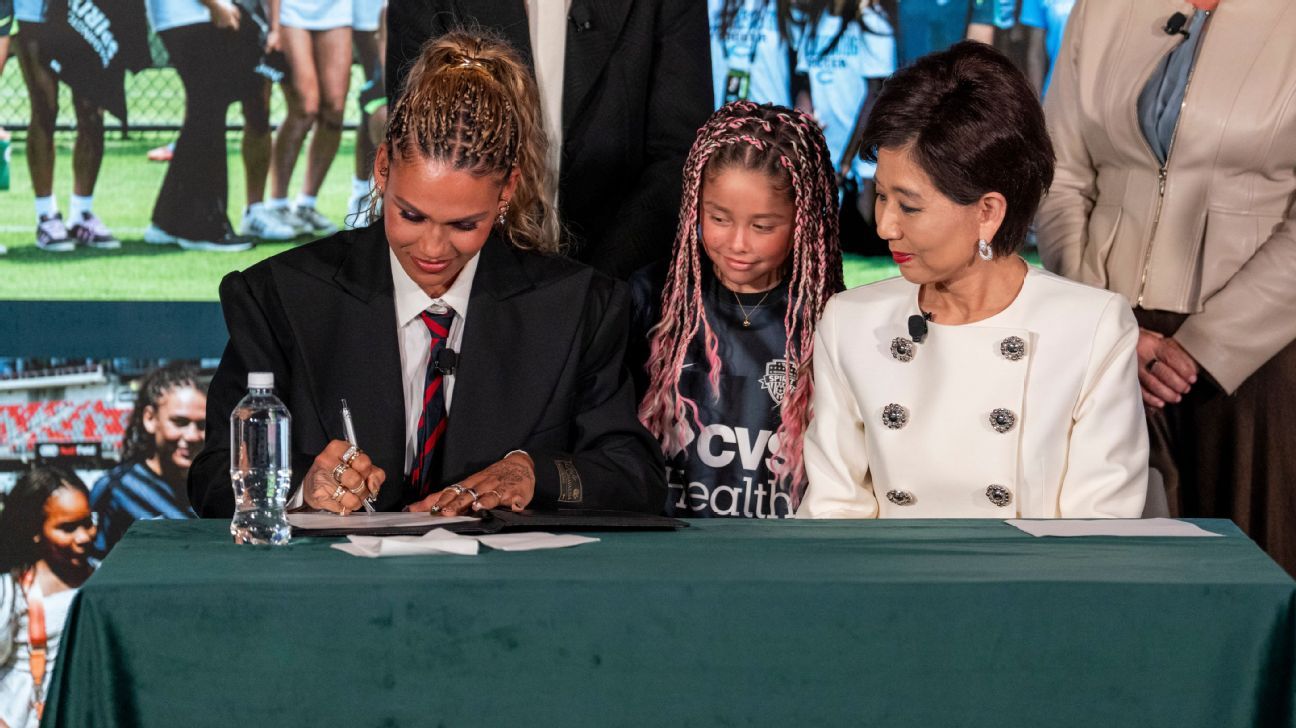
NWSL commissioner Jessica Berman highlighted the landmark agreement between United States forward Trinity Rodman and the Washington Spirit as proof that the league’s new High Impact Player initiative is functioning as intended: to keep and draw in elite talent.
“We couldn’t be more thrilled to have Trinity in the NWSL,” Berman stated to ESPN on Friday. “We have always emphasized that it was a priority and that we would advocate for her, aiming to find a way to secure her within the regulations that apply to all teams, and we succeeded in doing so.”
Rodman made history as the first player in NWSL to officially take advantage of the High Impact Player rule with the announcement of her new three-year contract on Thursday. The agreement will compensate Rodman with over $2 million annually, as confirmed by multiple sources to ESPN, making her the highest-paid player in NWSL history.
Her agent, Mike Senkowski, indicated that this also positions her as the highest-paid female player globally.
However, the NWSL Players Association opposes the High Impact Player (HIP) rule’s implementation and has recently lodged a formal grievance, claiming that the league’s execution of it breaches the collective bargaining agreement and federal labor law.
The HIP rule, informally referred to as the “Rodman Rule,” permits teams to exceed the salary cap by up to $1 million for star players.
In contrast, the PA suggested increasing the cap by $1 million without any qualifications for players.
Berman asserted that the HIP rule was established to strategically advance the league. The NWSL has seen the departure of USWNT stars Naomi Girma, Alyssa Thompson, and Sam Coffey to England over the past year, and the HIP rule aims to compete for top talent.
“It is our responsibility at the league to create policies that influence behavior,” Berman explained to ESPN. “It is also our duty to ensure that capital and resources are allocated strategically to foster long-term growth for the business.”
She added: “We are aligned with the players in our goal to expand this business and league sustainably, with a focus on long-term growth and viability. All of this is crucial. It is not unusual for leagues to be prescriptive and tailored in how they formulate policies that encourage specific behaviors that can significantly invest capital into the system.”
The union contends that the HIP rule should be subject to collective bargaining. Article 8.16 of the CBA states that the league “may at its discretion, after consulting with the NWSLPA, reduce or eliminate the Salary Cap charge against the Team Salary Cap for certain roster classifications.”
Berman mentioned that she could not provide further details due to the ongoing grievance but stated that the NWSL is within its rights to implement the rule following good-faith consultation with the union.
“In its broadest sense, when there is a consultation right in good faith, it is precisely that,” Berman remarked. “The party — in this case, us — has the right to proceed despite any objections on various factors.
“The good faith aspect is very significant, both to us and to the Players Association, which is that in that situation — and frankly in any other situation — we are and were genuinely interested in the Players Association’s input and feedback.
Berman noted that the concept of the HIP rule had been discussed “in various forms” among the NWSL’s board of governors as early as 2023. The league monitored the global market, Berman stated, before concluding this fall that it was the appropriate time to implement such a rule.
“Naturally, Trinity’s contract was expiring, and that was always something we were aware of, monitoring closely, but these developments were indeed happening concurrently,” Berman explained.
“Trinity’s contract is merely one of many instances in the market that we were observing. It was always our aspiration that Trinity would benefit from whatever rule we chose to enact, and we are pleased that this has come to fruition.”
High Impact Player funds will increase in proportion to the cap, ESPN confirmed: $1.257 million in 2027, $1.342 million in 2028, $1.4 million in 2029, and $1.457 million in 2030.
Berman stated that this totals $115 million in new investment over that period, considering the cap increase along with revenue sharing, in addition to the HIP funds.
The criteria for a player to qualify for the HIP rule is also a contentious issue for the union. Among the possible qualifications is players’ marketability as assessed by an external media outlet.
“The league is attempting to control and interfere by dictating which players receive what compensation from this pool of funds,” NWSLPA executive director Meghann Burke told ESPN earlier this month. “Our stance is that teams — GMs, soccer operations, and business personnel at the team level — are uniquely positioned to make decisions about how to structure their rosters and negotiate contracts.
“We firmly believe that assessing a player’s value, both in terms of athletic merit and business criteria, is nuanced. It is more complex than a few bullet points. It is the responsibility of the teams to make those judgment calls, and in a free agency system like we all agreed to, that is how it functions. It is a free market.”
Berman stated that the criteria were designed to be “surgical and tailored in how this additional capital is being allocated and in support of growing our business,” and that the league did not arbitrarily dictate the list of players.
“That necessitates looking for external sources that are objective, providing a perspective or indication of who the top players are,” Berman remarked.
There is a second grievance filed by the NWSLPA regarding the league’s veto of an agreement between Rodman and the Spirit (prior to the ratification of the HIP rule). The union described the league’s actions as a “flagrant violation” of Rodman’s free agency rights and a breach of at least five sections of the CBA.
This grievance remains unresolved despite Rodman and the Spirit reaching a new agreement.
“Unequivocally yes, it violated the league’s rules,” Berman stated regarding the previously proposed deal. “In the broader context, it is our responsibility to apply our rules consistently and with integrity across all our clubs. For that reason, the contract was not approvable.”
Both grievances may be heading toward arbitration.
Berman expressed that she does not believe the grievances or the recent events have negatively impacted her or the league’s relationship with the union or players.
“Not from my perspective,” Berman stated. “I cannot speak for others. From my standpoint, absolutely not. It is our duty to operate professionally, transparently, and with respect. We have done that and will continue to do so. Based on my assessment of our ongoing operations with the Players Association, that has not changed.”
