
Carrick’s composure during turmoil is precisely what Manchester United requires.
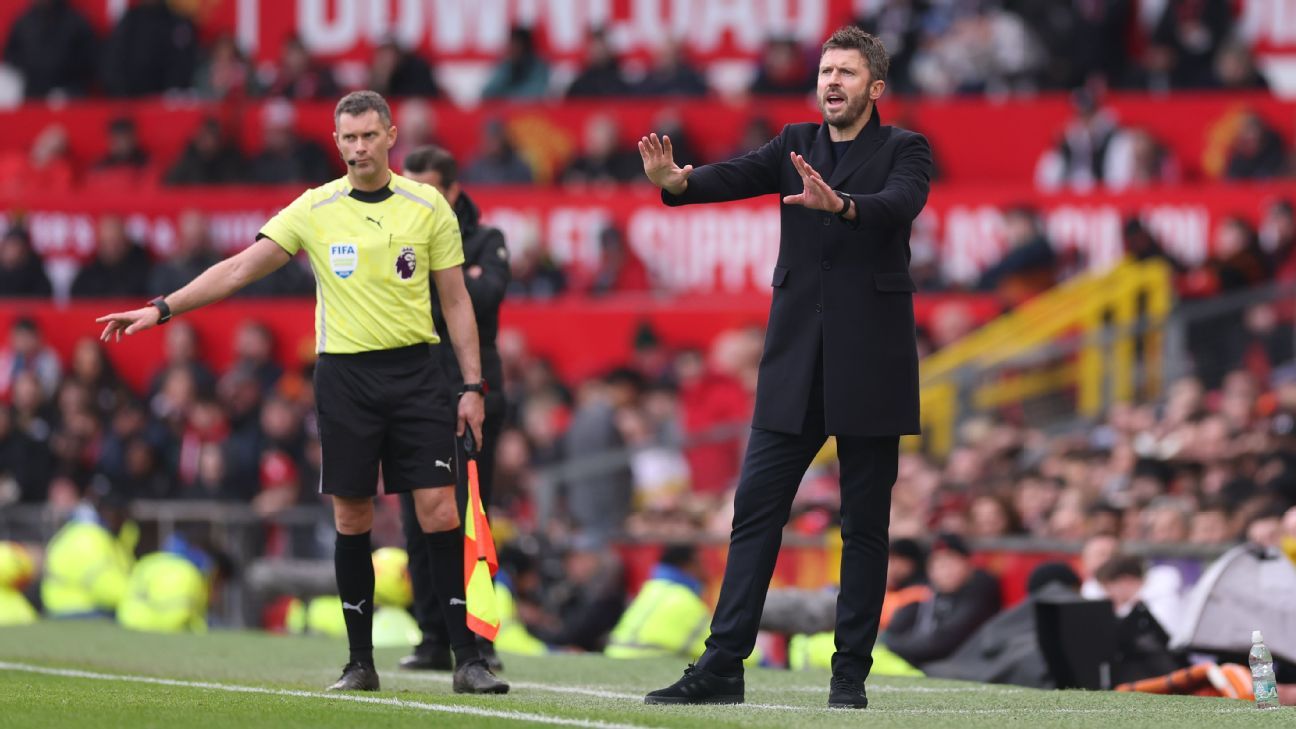
MANCHESTER, England — Michael Carrick has reintroduced simplicity to Manchester United, yet he cannot completely eliminate the chaos. After witnessing Benjamin Sesko net a stoppage-time winner to secure a 3-2 triumph over Fulham, it was a blend of simplicity and chaos.
United appeared to be on track for three points at Old Trafford, having established a 2-0 advantage with goals from Casemiro and Matheus Cunha. However, an 85th-minute penalty from Raúl Jiménez, followed by Kevin’s remarkable equalizer in the first minute of stoppage time, seemed poised to grant Fulham a point and disrupt the momentum of Carrick’s short tenure.
Yet, Sesko’s decisive goal in the 94th minute — a precise turn and shot following a cross from Bruno Fernandes — flipped the match in United’s favor and secured the win.
This was a quintessential “Fergie Time” goal witnessed by Sir Alex Ferguson, stemming from United’s pursuit of victory rather than settling for a draw. Although United channeled the chaos to their advantage for the win, the groundwork was laid by Carrick’s composed and thoughtful choices before and during the match.
Three matches into his role as head coach for the remainder of the season — United intentionally refrained from labeling him as Ruben Amorim’s interim successor — Carrick has led United to three consecutive victories against Manchester City, Arsenal, and now Fulham, placing the team in an unexpected position for UEFA Champions League qualification.
There has been considerable discussion about Carrick revitalizing United’s “DNA” and honoring the club’s attacking ethos of risk for reward. However, the reality of the team’s resurgence under their former midfielder is that he has eliminated the confusion and complexity introduced by Amorim, streamlining every aspect of the squad.
Thus, when Sesko scored his winning goal, having previously hit the post with a header, it was a testament to Carrick’s approach of doing what Amorim seldom did: substituting a forward (Cunha) with another (Sesko).
A similar scenario unfolded in last week’s 3-2 victory at Arsenal, where Cunha netted the winner after coming on as a substitute for Bryan Mbeumo at the Emirates — once again illustrating Carrick’s adherence to straightforward, like-for-like substitutions.
However, it all originates from Carrick’s initial selections. In his third match in charge, he made his first substitution — an injury-enforced introduction of Cunha for Patrick Dorgu — but instead of altering tactics or formation, he simply positioned Cunha on the left of his attacking trio to fill the void left by Dorgu, who is set to be sidelined for 10 weeks due to a hamstring injury.
Carrick has maintained the same back four — Amorim opted for a back-three in nearly all of his 63 matches in charge — and the same midfield duo of Casemiro and Kobbie Mainoo.
Indeed, Mainoo has emerged as one of the standout performers during Carrick’s brief tenure, yet Amorim had opted not to start the 20-year-old England international in any Premier League match this season. By placing Mainoo in a defensive midfield role, Carrick has allowed captain Bruno Fernandes to operate in his preferred No. 10 position further up the pitch.
Amorim, of course, utilized Fernandes in deeper roles and then further forward, struggling to find a way to accommodate his best player within his 3-4-3 formation. This indecision, or inflexibility, ultimately proved detrimental to Fernandes, the team, and eventually, the head coach himself.
In his attacking positions, Carrick has benefited from having Mbeumo and Amad available after AFCON duty, both of whom have been pivotal. They are also thriving under the new coach’s commitment to simplicity and utilizing players in their optimal positions.
For an extended period, United persisted with Amorim despite his idiosyncrasies, including frequent changes, tactical rigidity, and the tendency to substitute defenders in the second half when his team was under pressure.
The result of Amorim’s methodology was that the players operated in a constant state of uncertainty, leading to consistently poor results; Carrick has adopted the opposite strategy, which is atypical in a modern game often influenced by data and medical teams. However, it is yielding positive outcomes.
Carrick’s United are playing with freedom, confidence, and achieving results that rarely seemed attainable under Amorim. The new head coach is also demonstrating courage by taking risks to secure victories. Those like-for-like substitutions may appear straightforward, yet many coaches opt for safer strategies. By substituting attackers for attackers, Carrick is indicating his desire to win while also showing trust in his players to both attack and defend equally … a trust that seemed lacking during Amorim’s 14 months in charge.
It remains uncertain whether Amorim is now back in Portugal reflecting on the need for greater flexibility and boldness, but he is likely avoiding watching any United matches at this time, as it would only serve as a reminder of what might have been.
Carrick is not allowing himself to dwell on any feelings of regret; he is fully committed to keeping it simple and embracing risk, which is why United have been performing so well.
