
Bodo/Glimt: Key factors contributing to the Arctic club’s impressive Europa League performance
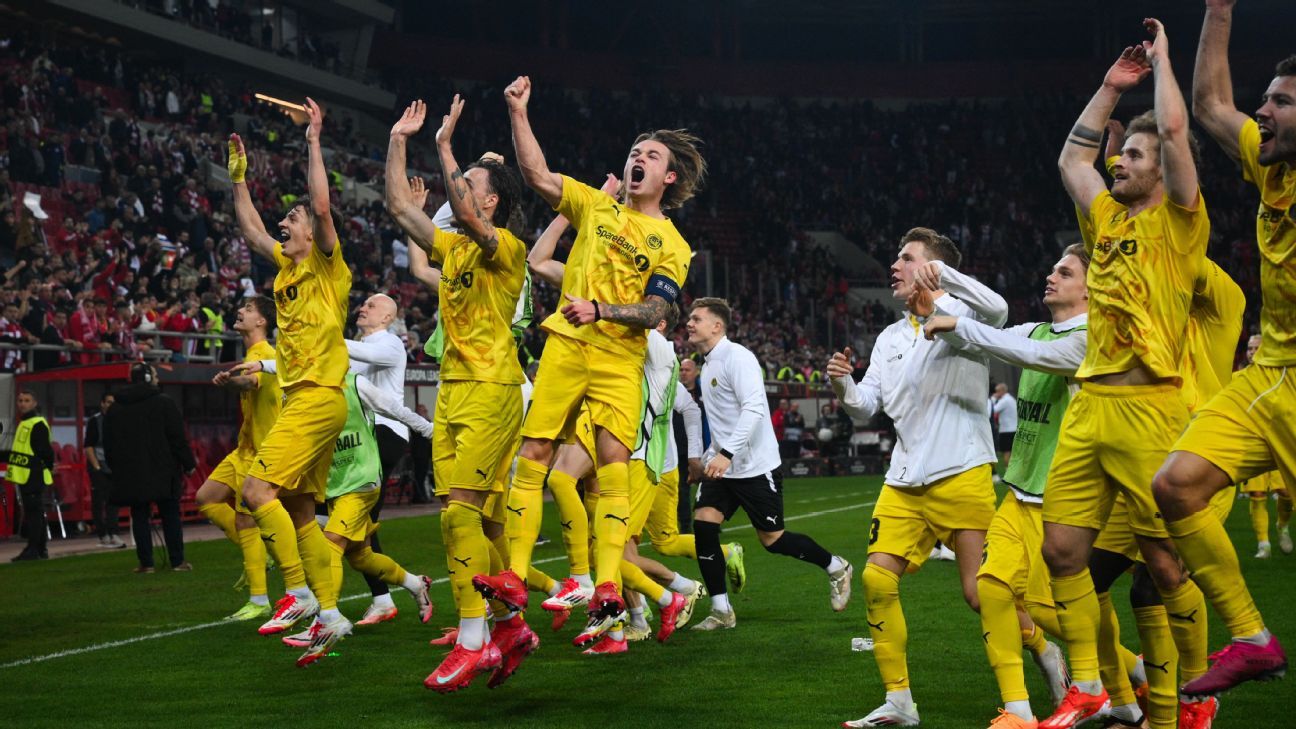
Bodo/Glimt, regarded as the most unexpected contenders in European football, engage in meditation prior to training, gather for discussions when they concede, and collectively choose a captain for each match. Their fundamental belief is to refrain from discussing victories or examining the league standings. There are no clichéd remarks about the necessity of securing three points.
These practices are merely a fraction of what explains how a small club from Norway, located so far north that it lies within the Arctic Circle, is set to face Tottenham Hotspur on Thursday in the UEFA Europa League semifinals, just a few matches away from potentially claiming a European trophy and securing a spot in next season’s UEFA Champions League.
The residents of Bodo are well aware that this is a classic David vs. Goliath narrative. They understand that the entire population of their town (42,831) could fit into the Spurs’ stadium with 22,000 seats still unoccupied, and that their yearly transfer budget matches what a Spurs player might earn in a single season. They recognize that they are still not fully recognized in European football, as their opponents this season will likely check their travel destination: tracing their finger northward, then further north, until they arrive at a location that is a 16-hour drive from Oslo, where December offers only 56 minutes of daylight and nearly 24 hours in July.
Nevertheless, no one at Bodo/Glimt is astonished to have reached this stage. Perhaps this is not truly an underdog tale. Bodo/Glimt secured their inaugural Norwegian league title in 2020 and has since won it four times in the last five seasons. During this period, they have advanced to the knockout stages of European competitions, defeating notable clubs such as AS Roma, Celtic, and Besiktas.
This season, they triumphed over FC Porto in the league phase before coming close to defeating Manchester United. In their most recent match, the quarterfinals, they eliminated Lazio over two legs, the first of which was played in heavy Arctic snowfall. Thus, the prospect of adding Tottenham to their list of defeated teams seems achievable, albeit somewhat unlikely.
Several factors contribute to the club’s advancement to the final four. A significant aspect is the emergence of a talented generation of players from their youth system, including Jens Hauge and Patrick Berg, who joined the first team just prior to their first title win in 2020. Additionally, the frigid conditions that any visiting European team encounters, combined with a squad largely composed of players from northern Norway, many hailing from Bodo itself, play a role. Furthermore, an appealing style of play has been cultivated by a coaching staff led by manager Kjetil Knutsen, who is now linked to potential positions in the Premier League.
However, any narrative regarding Bodo/Glimt’s rise typically begins in 2017, with their relegation to the Norwegian second division and the introduction of a Norwegian fighter pilot named Bjørn Mannsverk.
Eight years ago, Mannsverk joined the club after recently concluding active duty that included missions in Afghanistan and Libya. A colleague in his squadron had mentioned Bodo/Glimt and inquired if he could assist. This was during the months following their relegation, and the club’s management insisted that their players were capable, but a mental collapse at the season’s end had cost them. They invited Mannsverk, who had little interest in football, to work with the players. He accepted.
“Bjørn has brainwashed us for six years now,” Ørjan Berg, a former player who now works in the youth department, told ESPN. His son, Patrick, serves as the club’s official captain.
Mannsverk stipulated two conditions for his involvement: players had to seek him out voluntarily—he would not engage with anyone who was mandated to see him—and he would not act as their agent. “I stated that I wouldn’t impose decisions on the players in favor of the club [such as signing a new contract or adopting a training style],” Mannsverk explained to ESPN. “I will be there for the player.”
Mannsverk, who was initially unpaid and later described his role as more of a “hobby,” also posed a question to the management. “What if a player tells me they no longer want to play football?” he inquired. “What if they wish to leave the club? I will support them in those choices. Are you prepared for that risk?”
It is a considerable risk for a club to engage someone they do not compensate. Yet, they embraced the opportunity, sensing it could be beneficial. It did not take long for that concern to materialize.
One of the first players to approach Mannsverk was midfielder Ulrik Saltnes. “A very intelligent player,” Mannsverk remarked. “Excellent in training, poor in matches.” Saltnes was grappling with stomach issues during games that caused diarrhea, limiting him to playing only half a match at a time and once sidelining him from training for a week. The club’s medical staff conducted various tests but found nothing. Saltnes suspected it was a mental issue and thought Mannsverk might assist.
“He expressed his frustration with failing to perform in matches and his exhaustion from the pain,” Mannsverk recounted, adding that Saltnes indicated he intended to quit football in the coming months to pursue his university studies.
“I responded, ‘Okay, that’s fine,'” Mannsverk said. “We began discussing: ‘Why do you love football? This is your dream, yet you are leaving?'”
Saltnes shared the mental pressure he placed on himself.
“When you set your ambitions too high or restrict your time to resolve issues, it becomes challenging,” Mannsverk noted. “If the only solution to failure is to apply more pressure, that is not sustainable. I believe that was Ulrik’s situation; he had been doing that for many years. Yes, his skills improved, but the stress was excessive. His body had been signaling for years, indicating, ‘You won’t play.’
“I said, ‘Alright, but since you’re leaving, why not enjoy the last few months, go with the flow, don’t worry, and just have fun?'”
Saltnes found that idea appealing, but then he countered; it sounded like being on autopilot. He wasn’t performing at peak intensity, so how could this help him? “Can you receive less playing time than you currently have?” Mannsverk asked. “No. And will they dismiss you? Nope. So there is no risk.”
Saltnes couldn’t dispute that. He agreed to give it a try. “He helped me to stop worrying, to alleviate all the pressure, and then my performances just took off,” he stated. “I think it was about a month and a half later that the stomach pain was nearly gone. It feels miraculous, but it illustrates how much mental pressure over time can affect you.”
To say it continued to yield positive results would be an understatement. Just look at the snowy Europa League quarterfinal first leg against Lazio earlier this month. Bodo/Glimt emerged victorious with a score of 2-0. Saltnes netted both goals.
Mannsverk, with the full backing of the coaching staff and management, had additional ideas. He proposed that players meditate, dressed in their kits, every morning before training.
“You often see when I enter organizations that there may be a stigma and some resistance, but I believe the way we approach it is hardcore performance,” Mannsverk stated. “It’s not wishy-washy. It’s not about being vulnerable and surrounded by smoke. It is hardcore performance. [As fighter pilots] we do it in our flight suits, we sit in the chairs we typically use, and we meditate.”
After conducting 30-minute meetings with several players, he organized group sessions with the entire team. These were open-air discussions, a safe environment to share thoughts and ideas, allowing for brutal honesty regarding their performances. Players then present these reflections to their coaches. As Mannsverk puts it: “That creates friction.”
The central tenet of the club’s philosophy now is to avoid viewing everything through the lens of a scoreboard—league standings, points, and cup runs no longer dictate their success. Instead, they concentrate solely on “process,” focusing on what they can control. Anyone who has played or observed football knows that the superior team does not always win; the scoreline only adds unnecessary pressure.
This may seem straightforward, but it requires a collective commitment and open-mindedness to implement. The ongoing discussion revolves around their performance. What can they enhance? This has led to some intriguing developments.
For instance, the practice of huddling after each goal originated from a conversation Mannsverk had with the players. They noted that their communication on the field was limited compared to the comprehensive team discussions before matches and at halftime. “It’s unfortunate there isn’t a timeout clock like in handball,” Mannsverk remarked, eliciting laughter from the players.
Then, in a subsequent match, during a stoppage in play, one player pointed out that each time a goal is scored, the game pauses briefly. Why not use that time to communicate? This led to what they refer to as “The Ring,” where they convene to quickly discuss what went wrong and how to rectify it.
“It is a way of showing care for one another, to unite and say, ‘Hey, mistakes happen, let’s refocus,'” Mannsverk explained. Approximately 18 months later, before a European match, another player observed that their performance often dips for a few minutes after scoring. Why not implement “The Ring” at that moment as well?
These meetings and techniques have fostered a calming effect on the team and instilled confidence in their ability to execute manager Knutsen’s attacking style, which is based on high pressing and high-risk passes.
“I don’t believe it would be feasible to play like that without Bjørn and the mental work we do,” Saltnes told the New York Times in 2020. “No, I don’t think that would end very well at all.”
The result has been multiple league titles and, this season, their deepest run in Europe to date. According to Ørjan Berg: “I believe that today’s team is playing the best football ever seen in Norway.”
Bodo/Glimt may refrain from dreaming of Europa League success within the club, but it appears no one has informed their supporters. The club’s stadium accommodates just over 8,000 fans, meaning the majority of the town will be unable to attend next Thursday’s semifinal second leg.
“Every person you encounter, whether they are 2 years old or 102 years old, is talking about Tottenham, and 99% of the conversation revolves around tickets for the match,” Runar Berg, Ørjan’s brother, who also played for the club before retiring and joining the marketing department, told ESPN.
Fans are concerned about whether the team can withstand the challenge posed by Ange Postecoglou’s squad. Their task is made more difficult by several suspensions: midfielders Patrick Berg and Hakon Evjen are suspended for the first leg, while striker Andreas Helmersen is ruled out for the entire tie. Starting winger Ole Blomberg and first-choice center back Odin Bjørtuft are also uncertain.
Nonetheless, these worries are not a prevalent topic within the club. “We have more players,” Mannsverk stated. It is an almost remarkably misplaced confidence to have in a single team.
Mannsverk’s contributions have not gone unnoticed. Other clubs have approached Bodo/Glimt to inquire about the secret behind their success. Mannsverk, who prefers the designation “culture builder” over “mental coach,” has received job offers from other teams.
“I tell them, ‘No, I can’t. I’m with Bodo,'” he says. “They sometimes respond, ‘Okay, do you have another fighter pilot or a military individual?’ It’s as if they don’t understand. That’s why we are not afraid to share what we do because we recognize how challenging it is to actually implement it.”
