
Atletico’s trio of matches, Miami Dolphins may determine Barcelona’s campaign
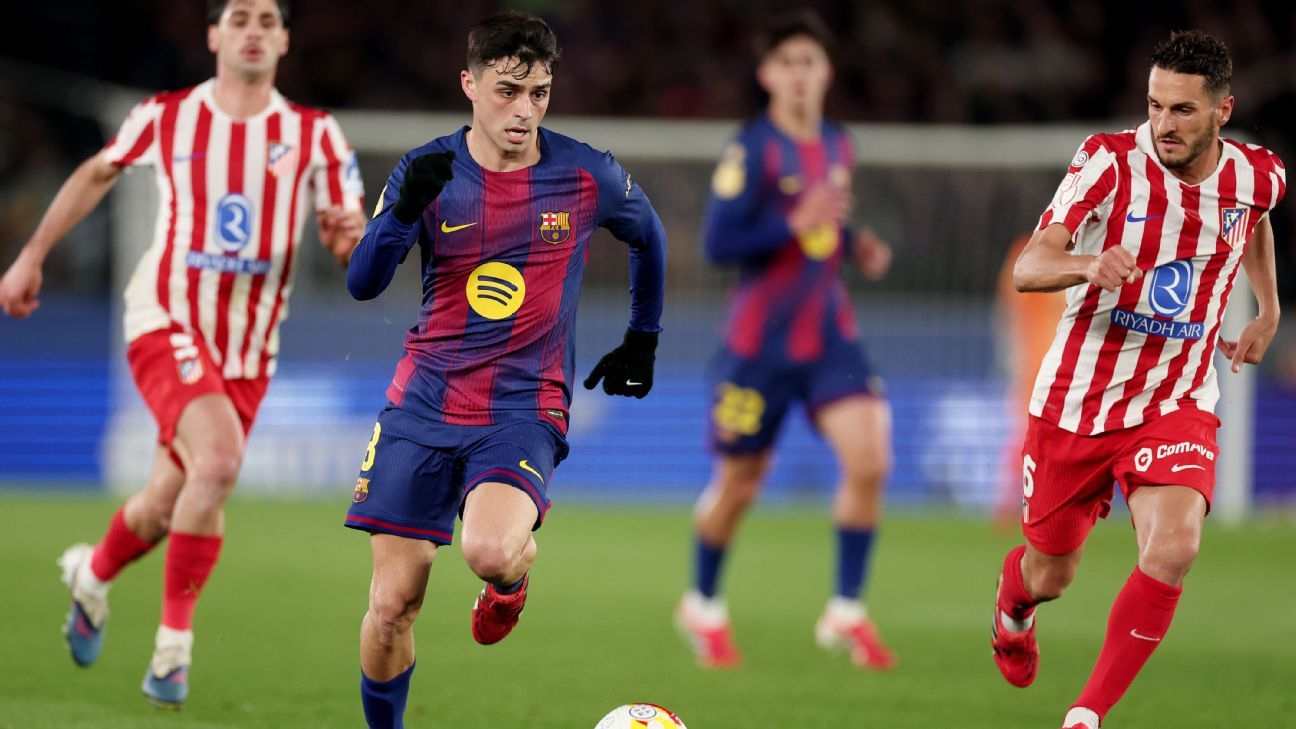
Here’s my brief overview: We are about to experience a series of three matches within 10 days between two top-tier teams, whose last eight encounters have yielded a total of 32 goals (averaging four per game!). Each of their last five knockout clashes has been thrillingly decided by a single goal, with one team already securing a spot in a cup final and one of these two guaranteed to advance to this season’s UEFA Champions League semifinal.
Consider the intriguing possibility that the outcome of this monumental trilogy could be influenced by the NFL’s Miami Dolphins; in those previous eight matchups, there have been three red cards, one missed penalty, one successful penalty, and a remarkable own goal by a goalkeeper. With anticipation already building, you would mark your calendar, stock up on beverages and snacks, and prepare to watch intently. Right?
(If your response was “no” or “unsure,” please seek immediate assistance, increase your daily Vitamin C intake, and get more sunlight.)
Sunday marks the beginning of this head-to-head series, which could either jeopardize or enhance Barcelona’s season. This is because Atlético Madrid, the hosts on Sunday, have slightly less at stake, as they enter a LaLiga match that they can afford to lose—something many of their supporters may even desire.
Before detailing the remaining two matches in this trilogy (April 8 and 14, to be precise), it is important to clarify the context.
Atléti will face Spanish champions Barça, with the title feeling as distant as Halley’s Comet for Los Colchoneros. However, a victory over Hansi Flick’s injury-plagued, fatigued league leaders would allow Atléti’s bitter rivals, Real Madrid, to close the gap to just one point behind the Catalans. Given that Los Blancos are on the rise and can sense Barcelona’s vulnerabilities, this creates a potent situation for both Madridistas and Colchoneros! While Atléti harbors no affection for Barcelona, they are equally frustrated by their subjugation by Madrid, tired of watching them accumulate trophies and relish the bragging rights.
However, Atléti’s serious and highly animated coach, Diego Simeone, cannot afford to adopt the mindset of his club’s staunch supporters, who would likely trade a league defeat at the Metropolitano on Sunday for an aggregate victory in the subsequent two matches: the Champions League quarterfinals that will determine who faces Arsenal (most likely) in the semifinals.
Among the 32 goals scored in their last eight encounters are this season’s clashes: Barcelona triumphed 3-1 and 3-0 at home, while Atléti secured a 4-0 victory in Madrid. Indeed, due to the Copa del Rey semifinals and the Champions League, these fierce rivals will meet a total of six times this season.
Spanish football has not witnessed such a congested series of direct confrontations between the same two teams with so much at stake in 15 years.
This recalls the notorious Clásico Wars of 2011, when Jose Mourinho’s Madrid and Pep Guardiola’s Barça battled through a 1-1 Liga draw, a 1-0 Madrid Copa del Rey final victory, and Barça’s 3-1 aggregate Champions League semifinal win, with the four intense matches occurring over 18 days.
It was a toxic, thrilling, titanic experience—entertaining for the viewers. While there is slightly less at stake now, these fixtures are still immensely significant and high-pressure, though they do not carry the weight of a Clásico, Copa final, or Champions League semifinal.
Reflecting on the intensity of such tightly packed encounters, Iker Casillas, Madrid’s goalkeeper during that explosive period, later admitted: “We weren’t prepared for those four matches in such a short span. We all had so much at stake. Those four games left a mark on Spanish football and everything surrounding it. It even took on a political dimension. If Barcelona had won, it felt as if Catalonia had overshadowed Madrid.”
What is at stake this time is substantial, however.
As noted, a win for Barcelona on Sunday would strike a blow to Real Madrid’s ambitions—Álvaro Arbeloa and his teammates have every reason to believe that Barcelona could drop points against Atléti. If the reigning champions deliver a champion’s performance, they will have eight matches remaining (including one Clásico at Camp Nou) with Flick’s team holding at least a four-point advantage (Madrid faces a seemingly vulnerable Mallorca earlier on Sunday).
The first leg of the Champions League at Camp Nou is set for next Wednesday, followed by the decisive match back at the Metropolitano the following Tuesday, which presents a different challenge altogether.
Last season demonstrated that the financial ramifications of merely reaching the quarterfinals, rather than the semifinals, can amount to €32 million (Barcelona earned €116 million, while Aston Villa received €83 million). This is not a trivial sum; it could cover the cost of acquiring a decent fullback or a superstar’s annual salary. Furthermore, whichever team—Atlético or Barcelona—emerges victorious in just over two weeks may face the daunting prospect of a dream/nightmare final against Real Madrid in Budapest.
Whether Madrid can overcome Bayern Munich and then, likely, Paris Saint-Germain in the semifinals is a separate issue, but it carries what the Spanish refer to as “morbo.” This term signifies a special, morbid, all-consuming, and potentially unhealthy fascination. Deep within Barcelona’s psyche, there has never been a Clásico Champions League/European Cup final. For neutrals, too, it represents the most explosive and alluring possibility—regardless of how distant it may seem.
As for Atlético vs. Madrid in a Champions League final… what more is there to explain, dear reader? Simeone has confessed that he still cannot hear the Champions League anthem without recalling the anguish of losing to Madrid in the 2014 and 2016 finals; a last-minute header from Sergio Ramos salvaged the first for Los Blancos in Lisbon, while an offside Ramos goal and penalty misses from Antoine Griezmann and Juanfran cost Atléti the second. Imagine the heartache.
In truth, if you are convinced and preparing your schedule to ensure you enjoy every moment of this enticing trilogy, then I would suggest that Atléti begins as slight favorites.
Barcelona, clearly the superior team on an individual basis, will be without Raphinha, which poses a significant challenge for them. The Spanish champions have not kept a clean sheet in 10 Champions League matches this season, and crucially, Pedri has been struggling with his form. He is fatigued.
Two of the matches will take place at Atléti’s Metropolitano stadium, where the Dolphins add an intriguing twist to this football spectacle. Miami won their regular-season matchup against the Washington Commanders at the Santiago Bernabéu last November, but they trained for three days on Atlético’s Metropolitano pitch, and the impact of all that weight on the playing surface necessitated a complete relaying of the grass.
Spain experienced an exceptionally cold, wet, and gray winter, and the pitch did not settle well. Two significant matches—defeating Barcelona 4-0 in the Copa and eliminating Tottenham Hotspur with a first-leg 5-2 win—were heavily influenced by opponents consistently slipping and falling, time and again, as their studs failed them. Do you recall the struggles of Antonin Kinsky and Mickey Van de Ven—both inadvertently gifting Atléti goals due to their slips?
Even Atléti’s captain and all-time appearance leader, Koke, expressed his concerns, stating: “It’s not good. We slip, the surface lifts up… A team like Atlético requires the pitch to be in optimal condition. We are expected to perform at a high level, and we need a quality pitch to play on, with quality grass.”
Will this factor into the matches? Will Atléti thwart Barcelona’s season (they have eliminated them from the Champions League in their last two encounters), or will someone like Lamine Yamal rise to the occasion just as Lionel Messi did during the Clásico Wars of 2011?
You have been forewarned. Don’t miss a moment.
