
NBA insights: Executives and scouts evaluate Peterson, Dybantsa, and leading draft candidates
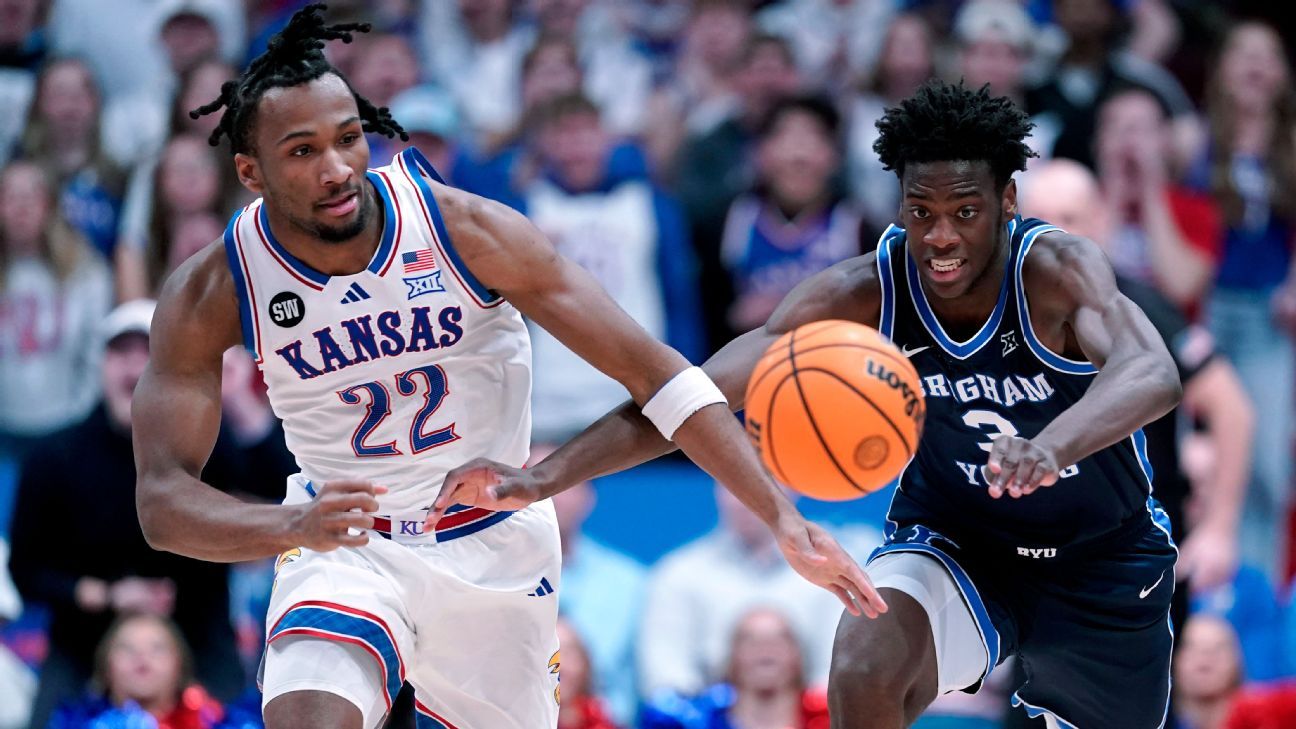
NBA executives are actively attending conference tournaments nationwide to gather insights on the upcoming class of professional talent. The Big 12 tournament at Kansas City’s T-Mobile Center has become a primary focus, with the conference featuring 10 anticipated first-round selections in ESPN’s most recent mock draft.
“It’s like a preview of lottery night,” a president from a Western Conference team remarked to ESPN, “but this time we’ll all leave feeling optimistic.”
The tournament highlights several elite freshmen who are central to draft conversations, including potential No. 1 picks such as Kansas’ Darryn Peterson and BYU’s AJ Dybantsa, along with Houston’s Kingston Flemings and Chris Cenac, and Arizona’s Brayden Burries and forward Koa Peat. All 30 NBA teams are present, including many top decision-makers.
As the 2025-26 regular season approaches its conclusion, up to eight teams are currently competing for favorable draft positions. (This figure could be higher if certain struggling franchises had control over their first-round selections in June.)
For teams that may not secure top-tier talent, the interest in this draft class extends beyond just the potential No. 1 picks.
“We’re very intrigued by this draft because of its depth. There are numerous impactful players,” an Eastern Conference scout stated.
“And [the 2027] draft doesn’t appear as promising. You never know; there are players in every draft, but this year feels like a double draft,” a scout from the West commented.
This depth offers hope to teams like the Sacramento Kings, Brooklyn Nets, Utah Jazz, and Washington Wizards—four franchises that will enter the offseason with a combined 15-year absence from the playoffs—suggesting that their pick, regardless of its position, could lead to a transformative moment for the franchise.
As the Big 12 semifinals approach on Friday (7 p.m. and 9:30 p.m. ET on ESPN2), here’s a summary of what executives, scouts, and coaches are saying about the leading names on NBA draft boards.
The race for No. 1 remains a two-player contest
As has been the case throughout the season, Peterson and Dybantsa continue to be the top two prospects on most draft boards.
Peterson, who retains the No. 1 spot in ESPN NBA draft analyst Jeremy Woo’s latest mock draft, began the season as the expected top pick but has experienced a fluctuating campaign with the Jayhawks. His struggles have been largely due to injuries, having missed 11 games due to various issues while also playing limited minutes in several other contests.
However, when healthy, Peterson has demonstrated his exceptional talent, including scoring 27 points on 10-of-15 shooting in the regular-season finale against rival Kansas State, and boasting the highest usage rate in Division 1 at 33.6%, according to CBB Analytics.
“As talented a scorer as they come,” one general manager from a power conference remarked about Peterson’s abilities. “The agility, the intensity; he steps in and takes control of games. NBA personnel are trying to gather information on the injuries, but he’s worth a few headaches.”
Dybantsa, on the other hand, is essentially the only healthy player left on a Cougars team that has struggled as the season has progressed. Injuries, particularly to senior forward Richie Saunders, have hindered early-season aspirations for a Final Four appearance.
Nonetheless, this has not diminished his draft stock or competitive spirit. With his 6-foot-9 frame and innate scoring talent—Dybantsa is the first freshman since Trae Young in 2018 to lead the nation in scoring—he continues to generate excitement among NBA decision-makers.
“He possesses all the necessary skills; he’s a dynamic scorer who will contribute points in the NBA immediately,” a seasoned Eastern executive stated.
 play1:58Is AJ Dybantsa ready for the NBA?
Jay Williams and Kendrick Perkins discuss their confidence in AJ Dybantsa’s readiness for the NBA.
On Tuesday, Dybantsa kicked off his Big 12 tournament by hitting 15 of 21 shots for 40 points, breaking Kevin Durant’s freshman tournament scoring record set in 2007. Despite BYU’s run concluding Thursday against Houston, Dybantsa surpassed Durant again with a total of 93 points, establishing a new tournament record.
“I believe Dybantsa is the clear No. 1,” an Eastern executive commented. “He’s exceptional. There’s still so much potential for him to develop.”
“He’s the most straightforward candidate for the No. 1 spot, but the game doesn’t come as effortlessly to him as it does for some of the truly elite players,” another Eastern executive noted.
“[Dybantsa] is likely going to be our No. 1,” a scout from the West said. “But it’s not finalized.”
The situation remains uncertain, as Peterson, despite his inconsistent freshman season, is still regarded by many league insiders as the leading candidate to be the first name announced by NBA commissioner Adam Silver on draft night.
“In terms of talent, he’s clearly [No. 1],” an Eastern scout remarked. “He has the complete package. When he has played, he has demonstrated that he possesses the ‘it’ factor.”
A Carolina showdown for No. 3
While a prospect could potentially surpass Peterson or Dybantsa, the prevailing expectation is that the third and fourth selections will feature two forwards from Tobacco Road rivals: Duke’s Cameron Boozer and North Carolina’s Caleb Wilson.
Boozer may be the most intriguing player in this year’s draft. His statistics leading into this week’s ACC tournament for the likely No. 1 overall seed in this year’s NCAA tournament are remarkable: 22.7 points, 10.2 rebounds, 4.1 assists, and 1.5 steals per game while shooting 58% from the field and 40.7% from beyond the arc. He led Duke in points, rebounds, and assists in eight games this season, the highest number by a freshman in three decades.
This level of performance has led some NBA decision-makers to argue that Boozer should be considered alongside Peterson and Dybantsa as a potential No. 1 pick.
“I believe there’s a top three, and a case can be made for any of them,” a second Eastern executive stated. “Boozer has consistently been the best player at every level, which can help mitigate some of his athletic concerns. … I would advise trusting the high-level feel players to figure it out.”
So why isn’t Boozer firmly in contention for the top pick? Simply put, it’s due to his physical build resembling that of his father, two-time NBA All-Star Carlos Boozer. This has raised questions among scouts and executives regarding whether the 6-9, 250-pound Boozer has already approached his peak performance and whether his potential athletic limitations might restrict his NBA ceiling.
However, at least one NBA executive believes Boozer’s track record should alleviate any concerns within the league.
“You can focus on what he lacks compared to the other players in terms of athleticism or other factors,” an Eastern assistant general manager noted. “But he’s a winner and has consistently succeeded at every level, achieving success in everything he has engaged in this year.”
Wilson’s draft profile is quite the opposite. He showcased a dynamic skill set with the Tar Heels before a thumb injury sustained last week ended his season, particularly excelling in transition after securing a rebound.
“He was a high school player who wanted the ball in his hands, aiming to be a point power forward but lacked the motor and toughness,” a rival ACC coach remarked about Wilson. “Since arriving at Carolina, his commitment and toughness have significantly improved.”
Wilson averaged 19.8 points, 9.4 rebounds, 2.7 assists, 1.5 steals, and 1.4 blocks while shooting 57.8% from the field in 24 games, demonstrating why many within the league believe he could be selected ahead of Boozer as the third player off the board.
“He’s quite raw, and there’s substantial upside,” the first Eastern executive stated. “I can easily envision him becoming a top-three player in this draft. I think Cam already possesses his NBA-ready physique, but Caleb has considerable room for growth.”
After No. 4, several guards enter the conversation
The consensus indicates that the next four selections will likely include freshman guards: Flemings, Illinois’ Keaton Wagler, Arkansas’ Darius Acuff Jr., and Louisville’s Mikel Brown Jr.
Multiple sources have drawn comparisons between Flemings’ top-end speed and ball-handling skills to a former MVP.
“Derrick [Rose] had the ability to turn the corner and secure a clean layup,” another Eastern scout noted. “That’s a rare quality, and Kingston possesses it.”
Flemings, along with freshman teammate Cenac, has received commendations from NBA scouts and executives for his willingness to compete under Cougars coach Kelvin Sampson, who is recognized for his rigorous program where playing time is not easily granted.
“He has demonstrated that he can fulfill all the requirements of a point guard in their two-guard system,” a scout from the West stated. “He meets all the criteria: intelligent, enhances teammates’ performance, possesses positional size, can shoot, and is an engaged defender.”
 play0:20Kingston Flemings draws the and-1 bucket for Houston
Kingston Flemings drives to the basket and draws the and-1 for Houston.
Wagler has gained attention throughout his freshman season at Illinois, with a 46-point game against fellow NBA prospect Braden Smith and Purdue on January 24 igniting a new wave of interest. Wagler is the first Big Ten freshman in the last 30 years to average at least 18 points while shooting 40% from three-point range.
At 6-6, his positional size should facilitate his transition to the NBA.
“Wagler has rapidly ascended the draft board,” the first Eastern scout remarked. “He has a Tyrese Haliburton-like profile in some respects … unconventional shot, fast riser. I like him. He definitely has the size. If someone selected him at five, I could understand it.”
Acuff is the latest standout guard to play under John Calipari, joining a list that includes Rose, John Wall, Devin Booker, Jamal Murray, De’Aaron Fox, Shai Gilgeous-Alexander, Tyrese Maxey, and Reed Sheppard, among others.
There will be inquiries regarding how Acuff’s slender frame will adapt to the NBA, but the 6-3, 190-pound guard has certainly excelled for Arkansas. The SEC Freshman and Player of the Year has averaged 22.2 points and 6.4 assists while shooting 43.7% from three-point range.
“The player who is most prepared to play in the NBA is Acuff,” the first Eastern executive stated. “If you only observed him play, you’d assume he was a four-year player. That’s how fluid he is.”
If not for Peterson’s health concerns at the top of the draft, the most puzzling narrative in the lottery might belong to Brown. The 6-5, 190-pound guard is averaging 18.2 points and 4.7 assists while shooting 41% overall and 34% from three-point range. He has faced intermittent back issues that have caused him to miss the ACC tournament.
“He’s akin to a larger Darius Garland, a high-level shooter who understands how to utilize ball screens and create opportunities for others,” the ACC coach remarked. (It’s noteworthy that injuries limited Garland to just five games in his single season at Vanderbilt, yet the Cleveland Cavaliers still selected him No. 5 in 2019.)
Brown’s profile includes several impressive performances for the Cardinals—he scored at least 20 points in nine of his 21 games, including 45 in a victory over NC State on February 9—but his health has complicated how NBA teams assess his draft potential.
“I have a favorable impression of the Louisville player,” the first Eastern scout stated. “He’s exceptionally smooth, though I believe he’s more of a combo guard than a traditional point. However, the back issues are a concern.”
