
How the Rockets asserted themselves to develop one of the NBA’s top offenses
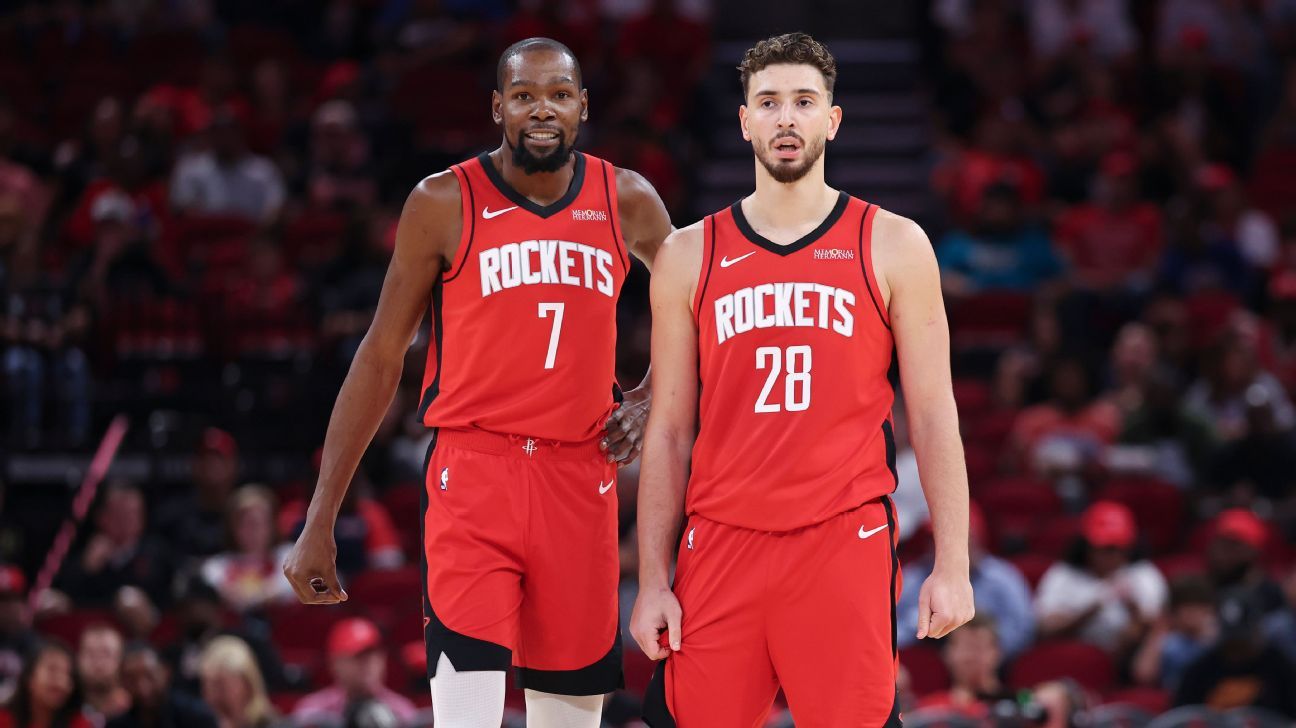
IT’S 9:20 PM ON Jan. 15, and a hooded Kevin Durant presses his right palm to his forehead, gazing at a stat sheet and trying to identify what went wrong in a 20-point defeat to the reigning champion Oklahoma City Thunder.
“Honestly, I feel like I’m missing good shots,” he remarked. “We took 104 shots. We didn’t turn the ball over excessively. My shooting is meant to motivate the entire team.”
However, that was not the case on this occasion.
Durant converted 7 of 23 attempts from the field and failed to make any of his five 3-point shots. For the Houston Rockets, this second encounter with OKC, following a season-opening double-overtime defeat, was an opportunity to gauge their strength against the league’s elite. Instead, the Rockets concluded the worst seven-game stretch of 3-point shooting (58 of 236; minimum 200 attempts) in NBA history, as reported by ESPN Research, marking their fifth loss in seven games.
Less than 24 hours later, Houston coach Ime Udoka conveyed confidence in his team’s unconventional offensive strategy and its potential for longevity.
“The formula can work,” he stated to ESPN.
By employing a committee approach at point guard due to Fred VanVleet’s season-ending knee injury sustained before training camp, the Rockets surprisingly rank No. 3 in the NBA in offensive rating (118.9). They have achieved this through a dominant yet methodical style (Houston ranks 28th in pace) that features contributions from various players within their large lineups, primarily Durant and center Alperen Sengun.
Nevertheless, the Rockets’ unconventional approach has led to inconsistency.
Udoka anticipates that this will stabilize as the season unfolds.
“What we do is seek quality shots,” Udoka explained about 90 minutes before a late tipoff against the Minnesota Timberwolves at the Toyota Center on Jan. 16. “We’re doing it unconventionally this year without a true point guard, like a setup guy such as Fred [VanVleet].
“Kevin and Alpi [Alperen Sengun] are attracting all that attention and creating open opportunities. Many teams are doubling, scrambling, and we’re excelling on the boards. So, the strategy is for those players to draw attention, create a crowd, and gain the advantage.”
Durant and Sengun validated Udoka’s insights later that evening against a Timberwolves squad missing star guard Anthony Edwards (right foot injury maintenance). The pair combined to score or assist on 77 points in a 110-105 win, with Durant achieving a season-high 39 points on 11 of 18 shooting and 6 of 8 from beyond the arc. The 37-year-old scored against seven different Minnesota defenders, marking the second-highest scoring performance by any Rockets player aged 35 or older (Clyde Drexler scored 43 points against the LA Clippers in 1997), according to ESPN Research.
Sengun added 25 points and 14 rebounds before fouling out near the conclusion of his ninth game this season with at least 25 points and 10 rebounds.
Bully ball in Houston was effective once more.
“We’ve got the talent,” forward Jabari Smith Jr. told ESPN. “It’s about figuring out how to make it work. It’s untraditional, but we see glimpses. When the ball is moving and flowing, that’s when we build leads and it really transforms into something.”
UDOKA AND THE Rockets coaching staff spent last season experimenting with large lineups and concluded the 2024-25 campaign leading the NBA in offensive rebounds per game (14.6). Houston’s size also enabled them to aggressively pursue offensive rebounds off missed shots, resulting in more second-chance points, another category the Rockets topped last season (18.1) on their way to a 52-30 record.
This strategy nearly yielded success in the playoffs against the aging and undersized Golden State Warriors. Houston pushed the Warriors to seven games. However, even before that series, the Rockets recognized the need for a reliable offensive player. Jalen Green was the team’s leading scorer (21.0 points per game) that season, but as a 22-year-old in just his fourth NBA season, he lacked the consistency to guide Houston to its ultimate goals.
Meanwhile, a discontented Durant was stuck in Phoenix, a team that had engaged in discussions with various franchises around the league to trade the former MVP months earlier around the February trade deadline without his awareness.
Houston patiently observed and awaited a reduction in Phoenix’s asking price, which eventually occurred over the summer.
Green, on the other hand, struggled in his role as Houston’s primary offensive option during the postseason. Aside from scoring 38 points in a Game 2 victory, Green averaged 9.2 points on 31.1% shooting in the other six games, as the Rockets lost 4-3 to the Warriors.
“Even if you’re really satisfied with your team, which we were, it’s still my responsibility to look for potential opportunities,” Rockets general manager Rafael Stone stated. “Unless you’re a champion, unless you’ve just won the championship, you need to improve.”
To achieve that, Houston finalized in July the largest trade in NBA history involving seven teams and numerous picks and players—including former Rockets Green and Dillon Brooks—to acquire Durant, one of the league’s most prolific scorers.
“When we need a bucket, there’s not much deliberation,” Rockets guard Amen Thompson said. “We just aim to get KD the ball. If you want to double Alpi and leave KD open? Or double KD and leave me, Jabari, and Reed on the backside? He’s definitely an extra threat.”
The height of the 6-foot-11 Durant, a 15-time All-Star, further enhances Houston’s size.
“We identified something that worked last year and decided to amplify it,” Udoka remarked. “We became a larger team. … We’re capitalizing on our size and the offensive rebounding that some of our players naturally excel at. Amen is great at it, Tari is great at it, Steven is great at it. Jabari and some others have developed into it, as has Alpi. So, it became a focus last year. But we’ve intensified that this year.”
REED SHEPPARD SQUEEZED into a pair of tan suede cowboy boots and donned a mauve hoodie while sharing a laugh with veteran Jeff Green in the locker room after Houston triumphed over the Western Conference’s second-place team, the San Antonio Spurs, on Tuesday, led by the second-year player’s team-high 21 points.
With Houston trailing by eight points early in the fourth quarter of a game they had been behind by as many as 16, Sheppard launched a 33-footer from the Toyota Center logo as Victor Wembanyama approached. The shot hit nothing but the floor. A large contingent of Spurs fans among the 18,055 in attendance erupted in laughter.
Sheppard anticipated the worst when the no-nonsense Udoka approached during the next timeout.
“He said, ‘Dude, I love that shot. Don’t worry,'” Sheppard recounted. “He could have easily reacted differently. It wasn’t even close. But it was about having the confidence to take that shot and just play without overthinking.”
Sheppard went on to score eight consecutive points in just 1:19, giving Houston its first lead of the second half with a 26-foot pull-up jumper with 4:45 remaining. He finished with a team-high 12 points in the final quarter, hitting 3 of 5 from 3-point range.
“I appreciate the five-point line pull-up, even though he airballed it,” Udoka said. “That demonstrates his confidence. We’re going to need that from some players in our lineup.”
The average height this season across the NBA is 6-foot-7. However, Houston’s most frequently used lineup—Durant, Sengun, Smith, Josh Okogie, and Thompson—averages nearly 6-9. When the Rockets deploy their Texas-sized double-big lineup, four of the five players (Steven Adams, Durant, Sengun, and Smith) stand at 6-11, with the 6-7 Thompson handling point guard duties.
“When you have Alpi [Sengun], Steven, and Jabari crashing the boards, we’re creating numerous opportunities for more offensive possessions with KD shooting alongside me, Reed [Sheppard], and Jabari,” Thompson noted.
In Udoka’s view, Sheppard and emerging star Thompson are vital to Houston balancing the fluctuations of their nontraditional, aggressive offense. Sheppard can contribute by attacking opposing defenses from the 3-point line, while Thompson excels when driving to the basket for dunks and setting up teammates for open shots.
“When he can rebound and push the ball, making those spectacular plays above the rim, especially at home, the crowd feeds off it,” Durant said of Thompson. “We thrive off it.”
Udoka concurred but is eager for further development from Houston’s young guards.
“The formula can work as we help Reed and Amen acclimate to the point guard position,” Udoka stated. “That’s our goal this year, and they’ve made progress in that area. … They need to find the balance between being aggressive, and in Amen’s case, specifically, getting to the basket or finding teammates to score. We understand it won’t happen overnight. But by the right time, later in the season, we want to see fewer mistakes regarding the aspects we’re addressing and have them in peak form by the time meaningful basketball begins.”
HELP AT POINT guard does not seem to be forthcoming, according to Udoka, who informed ESPN that the organization has not discussed adding to that position as the trade deadline approaches.
Houston is hard capped, sitting at $1.25 million below the first apron.
“We’ve always been confident and discussed our depth, relying on all these players like Aaron [Holiday] and Jae’Sean [Tate] and others who aren’t playing as much. We felt we had a team three-deep at every position with Clint [Capela] as the backup center. So, [adding help at the trade deadline is] not something we are considering.
“We want to see what [Thompson and Sheppard] look like with a year of point guard experience and eventually getting Fred back. For now, we want those players to grow into that role.”
Houston ranks 29th in the NBA in 3-point attempts (30.7 per game) and 25th in made 3-pointers (11.3), but the Rockets are sixth in 3-point percentage (37.0). Thus, it is evident that players like Sheppard (40.9% from 3-point range), Durant (39.5%), Okogie (38.1%), and Eason (46.1%) are making the few 3-pointers that Houston does attempt count. Smith and newcomer Dorian Finney-Smith are also capable long-range shooters, but the latter is still working his way back into the rotation after missing the first 27 games due to offseason left ankle surgery.
Nevertheless, only 29.1% of the Rockets’ scoring comes from beyond the arc.
Udoka anticipates that Houston’s shooters will perform when the ball reaches them, but the team’s potential for second-chance scoring opportunities has been hindered by Adams’ recent injury setback, presenting yet another challenge to Houston’s ability to maintain its unconventional offensive strategy. Adams, ranked No. 6 all-time in offensive rebounding percentage (15.33) behind Houston’s No. 3 center Capela (15.38), suffered what Udoka described as “a severely sprained ankle” on Sunday against New Orleans and is out indefinitely.
Capela will assume the role of primary backup center behind Sengun and will play alongside him in double-big lineups. Smith is also likely to see time at center in some of Houston’s lineups until Adams returns.
It is noteworthy that the Rockets score 45.6% of their points in the paint, ranking seventh in the NBA. That production could decline if Adams is sidelined for an extended period and Sengun and Capela struggle to fill the void.
Nonetheless, the Rockets currently sit at No. 4 in the Western Conference and appear poised to advance beyond last year’s first-round exit with Durant leading the charge.
Utah Jazz coach Will Hardy worked alongside Udoka on Gregg Popovich’s staff in San Antonio for three seasons (2016-17 to 2018-19), before reuniting with Udoka in 2021 as an assistant in Boston, as the Celtics advanced to the 2022 NBA Finals.
Hardy observes a Rockets team and offense shaped in the likeness of his tough, no-nonsense colleague.
During their time as assistants under Popovich, Hardy recalled the Hall of Fame coach encouraging disagreement and discussion in coaches’ meetings. Popovich despised the notion of “yes men,” but Udoka never fit that mold. Back then, Udoka stood firm. His determination to do so now has only intensified, knowing that his unconventional strategy can yield benefits down the line that Houston hasn’t experienced since the 1990s, when it last reached the NBA Finals.
“That’s how they’ve played since he arrived,” Hardy noted. “That’s an identity that Ime and their roster have established. I don’t see why it wouldn’t be sustainable. It needs to be complemented by other elements. However, I don’t believe you can abandon your team’s identity at a certain point. There are tactical aspects in any playoff series that must be navigated, but I think the overall character of your team is something you want to establish and maintain as much as possible.”

