
Alcaraz and Djokovic: Contenders for the Australian Open Championship.
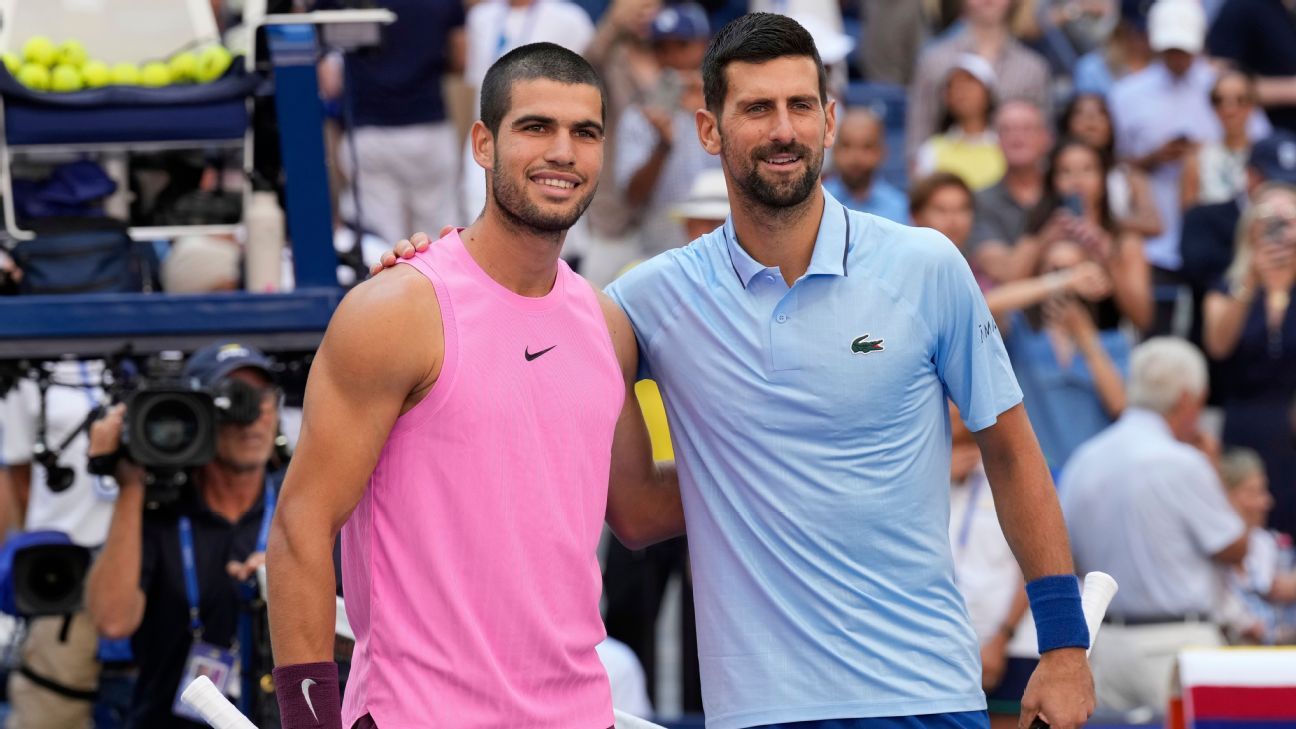
Top seed Carlos Alcaraz is set to face fourth seed Novak Djokovic in the Australian Open men’s final, with a significant milestone at stake. Will Alcaraz triumph and become the youngest male player to secure all four major titles? Or will Djokovic defy expectations and achieve a record-breaking 25th Grand Slam title?
Who will emerge victorious? Our analysts provide their insights.
What strategies can Alcaraz employ to overcome Djokovic?
D’Arcy Maine: In Friday’s semifinal, Alcaraz persevered through injury, cramping, and even vomiting during the 5-hour, 27-minute match, not to mention facing formidable play from Alexander Zverev, yet still managed to secure the win. When asked how he triumphed under such conditions, Alcaraz remarked that he maintained a mindset of “believing, believing, all the time.”
This encapsulates what makes Alcaraz exceptional. He possesses the confidence to win regardless of the situation and fights until the final point. Clearly the superior player at this moment, and with a physical advantage, if Alcaraz maintains the same fighting spirit and unwavering determination he has displayed, this match should be his to claim.
Jake Michaels: Alcaraz’s revamped serve (inspired by Djokovic’s, no less!) has proven to be a crucial asset throughout this tournament. If he continues to achieve a high first-serve percentage, he will be difficult to defeat, even against the greatest returner in tennis history.
Moreover, it may seem counterintuitive given his 16-year age difference with Djokovic, but Alcaraz needs to conclude the match swiftly. Following his grueling, energy-draining five-and-a-half-hour semifinal against Zverev in the heat, the longer this final extends, the more it favors Djokovic. This is not only due to the 24-time major champion being fresher, having spent four fewer hours on the court to reach the final, but also because he excels in high-pressure situations when Grand Slam matches are closely contested.
Jarryd Barca: Clearly, this applies to both competitors, but Alcaraz does not need to reinvent his game; he simply needs to be the best version of himself. The world No. 1 has shown consistent performance throughout the tournament, dispatching his first five opponents in straight sets before enduring that intense, physically and mentally taxing five-set semifinal against Zverev. He experienced cramping and struggled to move during the final stages of the third set, yet Alcaraz demonstrated the kind of resilience we often associate with Djokovic, overcoming a 3-5 deficit in the fifth set to win despite not being at his best.
From a tactical perspective, variety will be essential. Alcaraz must disrupt Djokovic’s rhythm by varying pace and direction, something Jannik Sinner failed to do adequately in his semifinal defeat. Alcaraz needs to take away Djokovic’s comfort and compel him to work for every point. If Alcaraz can exhaust the 38-year-old’s legs early and frequently, his own remarkable athleticism and creativity should give him an advantage in the match.
What strategies can Djokovic employ to defeat Alcaraz?
Maine: While recovery will be vital for both players heading into Sunday’s final, it will be particularly crucial for Djokovic. At 38 years old, the marathon semifinal on Friday is likely to impact Djokovic more than the five-plus-hour battle that the 22-year-old Alcaraz faced. To secure the elusive 25th major title — an impressive feat to even be in this position — he will need to summon everything he has.
If Djokovic can find additional energy, he will need to adopt a strategy similar to the one he employed during last year’s quarterfinal match. In that four-set victory over Alcaraz, Djokovic lost the first set and, despite an evident injury, took control. He began dictating points aggressively, hitting powerful groundstrokes and taking risks, maintaining relentless pressure until the match concluded. Regardless of the tactics he chooses, Djokovic will require his highest level of play to secure this victory.
Michaels: The contrast in Djokovic’s demeanor and performance level from the quarterfinal to the semifinal was striking. Against Lorenzo Musetti in the last eight, Djokovic appeared subdued and almost disengaged as he lost the first two sets. However, on Friday evening, in that monumental clash against Sinner, Djokovic once again resembled the competitor with the heart of a lion and unparalleled tennis skills. To defeat Alcaraz on Sunday evening, he must not revert to the demeanor he displayed in the quarterfinal — even for a moment. He must remain the aggressor, be relentless, and show emotion. If he can accomplish this, the crowd is likely to rally behind him, propelling him toward a 25th major title.
Barca: Like Alcaraz, Djokovic’s journey begins with recovery, but execution will ultimately determine the outcome, just as it did on Friday night. His serve was exceptional against Sinner and must be equally effective again; Djokovic won 86% of first-serve points in the second set and 77% in the fourth, using precise placements to alleviate pressure and dictate play. This allowed him to play aggressively with his forehand throughout the match, a level of aggression rarely seen so late in his career, but necessary to overcome the top two players in the world.
Against Alcaraz, Djokovic must replicate that pace and intensity. However, he does not need to out-hit the Spaniard on every point. Djokovic must outlast him in critical moments and find ways to replicate the 16 of 18 break points he saved against Sinner. That was the decisive factor in the semifinal. Limiting Alcaraz’s opportunities by remaining clutch, courageous, and protecting his serve will significantly contribute to his chances of victory.
Who will emerge victorious?
Maine: Alcaraz is favored, but Djokovic’s capabilities are well-known — and the magic he has often conjured throughout his illustrious career cannot be overlooked. While fatigue may play a role, Djokovic understands that this could be his best (and possibly last) opportunity to secure No. 25, and, as he did during the Olympic gold medal match against Alcaraz, he will give everything to achieve it. I cannot go against that. Djokovic in four sets.
Michaels: For years, I have maintained that Djokovic cannot be counted out at the Australian Open, regardless of the circumstances. He demonstrated this truth once more on Friday evening by dethroning defending champion Sinner with one of the finest performances of his remarkable career. At 38, he should not be in the final. He should not be able to compete with this new generation. Yet, here he is. How can one bet against him? Djokovic will triumph in five thrilling sets.
Barca: Both players enter the final battered and bruised. Alcaraz battled cramps to survive the third-longest match in tournament history against Zverev, while veteran Djokovic delivered one of the great performances of his career to dethrone two-time defending champion Sinner in over four hours, despite his own visible physical challenges.
So, does this boil down to recovery? Is it truly about who wakes up feeling more refreshed? Who can avoid physical issues for a longer duration? Djokovic’s history is significant in this context. He has never lost an Australian Open final, has already demonstrated the ability to turn back the clock once this week, and thrives under pressure. Alcaraz may be the world No. 1, but Djokovic is more familiar with this stage than anyone and may hold a psychological advantage, leading their head-to-head 5-4. If Djokovic can replicate anything close to his semifinal performance, it is difficult not to have faith in him. Djokovic in five.
Source: espn.com
