
England’s most disappointing Six Nations concludes with a framework, yet frustration persists along with a quest for solutions.

Approximately one hour after the final whistle at the Stade de France, Jack van Poortvliet articulated the sentiments of every England fan. “It’s disappointing that we know we have that [performance] within us,” he remarked. “Why can’t we replicate that more frequently?”
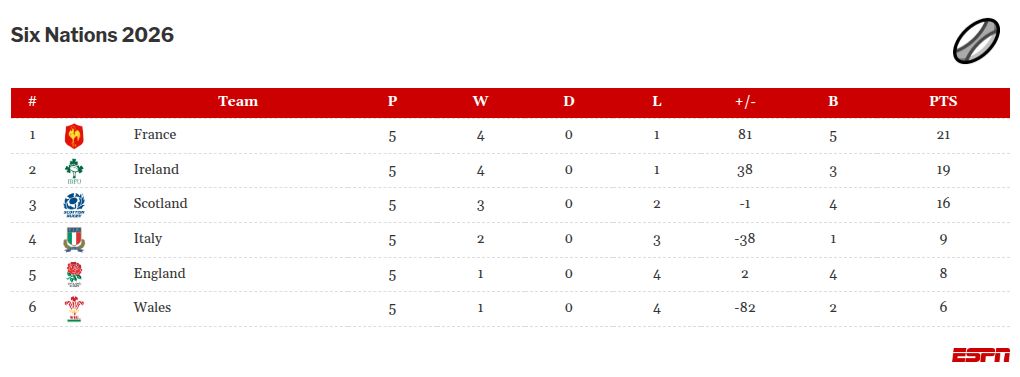
The substitute scrum-half had contributed to that enhanced performance, where England was mere seconds away from defeating France. However, yet another lapse in discipline, coupled with the consistent kicking of Thomas Ramos, extinguished that hope. England suffered their fourth loss in this championship, marking their poorest Six Nations performance to date. As the RFU begins to analyze the aftermath of this bleak campaign, the pivotal question must be: How and why did this championship unravel so severely?
The England squad returned home on Sunday, and the players will return to their clubs and everyday routines. Borthwick will conduct his own evaluation of a campaign where England had high expectations but ultimately fell short. Meanwhile, the RFU, which has expressed its support for Borthwick for the time being, will prepare for a post-tournament review.
The immediate response to the defeat from within the squad was a mix of pride and frustration. There was evident dissatisfaction related to match decisions. Borthwick was clearly upset about the decision to sin-bin Ellis Genge and award France a penalty try just before halftime, and he also questioned the altered call that led to Louis Bielle-Biarrey’s fourth try, where England was informed they had penalty advantage and played accordingly, only to be told it had shifted to scrum advantage, resulting in an error that France capitalized on. When it rains, it pours.
Vice-captain Jamie George, with cuts still visible, lamented the painful déjà-vu of witnessing Ramos convert a last-minute penalty to secure victory in Le Crunch, reminiscent of his previous kick in Lyon two years prior. Van Poortvliet was left searching for explanations as to why England could perform so well against France yet falter against Scotland, Ireland, and Italy. Sam Underhill emphasized the competitiveness of the match but expressed that his two dominant feelings from the campaign were a desire for more and a sense of dissatisfaction.
This sense of discontent encapsulates a campaign where England entered as one of the favorites to win the tournament. It began positively with their 12th consecutive victory against Wales. Everything seemed promising. However, things quickly deteriorated. Scotland reached an emotional intensity that England could not match, and familiar disciplinary issues that had previously been overlooked became significant weaknesses in the team. Yellow cards—including Henry Arundell’s 20-minute red against Scotland—meant they were constantly on the back foot, and indiscipline again cost them against Ireland and in their first-ever defeat to Italy. England’s attack was also ineffective, while their typically reliable lineout was careless against Ireland—a match in which Borthwick made two first-half substitutions due to their alarming start. In summary, across those three losses, one of the few areas of positivity was the scrum. It was a grim situation.
The RFU released a statement the morning after the defeat to Italy, supporting Borthwick through to the Nations Championship while also urging the team to learn from their mistakes and “grow through adversity.” The RFU indicated it would seek to “understand and rectify why [the team has been] unable to meet expectations.” Beneath the carefully crafted language, the message was harsh.
Against France, England demonstrated growth in challenging circumstances. “It’s a group where adversity will help us significantly as we move forward into the rest of the year and next year,” Van Poortvliet stated. The first part of the RFU memorandum was checked off.
On the field, England exhibited further development in Paris. They kicked less against Les Bleus and adjusted their game plan, despite earlier claims of adhering to a kick-first strategy. Sources informed ESPN that the matches where England played closest to the envisioned blueprint for the team occurred during their 2024 tour of New Zealand. This was evident in Paris. England was much more aggressive in the France 22, alternating between kicking and maintaining possession, consistently pressuring the opposition to gamble on their defensive focus. “We earned our chances through being physical in the middle territory,” George remarked. “I thought Fin Smith and Ben Spencer were outstanding in their game management.”
– Six Nations grades: Did England fail? Results for every team
– George backs Borthwick despite worst-ever 6N
– Borthwick: Six Nations pain will help England grow
In the forwards, the performance was strong, with Ollie Chessum excelling at blindside and Maro Itoje delivering his best showing of the championship. “That is our blueprint,” Van Poortvliet noted. “That’s what we must carry forward. The boost and confidence it instills in the team when you’re really challenging an opponent with speed of ball creates a great atmosphere within the team.”
Underhill stated: “I’d say the boys put their best foot forward and played as we know we can. Sometimes it takes various reasons or circumstances to trigger that. The work off the ball, the effort to get set, all the unseen aspects came together.”
However, questions persist regarding how to address their ongoing issue: discipline. England accumulated nine yellow cards during the tournament, matching Italy’s dismal tournament-worst total from 2002. With two minutes remaining in Paris, England held possession. The match was within their reach, but it slipped away as they conceded two penalties, allowing Ramos his moment of glory. Genge’s yellow card earlier in the match proved costly, leading to a penalty try and two additional scores for France.
“You need to keep 15 players on the pitch. The teams are so skilled that when you lose players, it becomes extremely challenging,” Borthwick stated. The team continues to seek answers, asserting that there is no singular, overarching reason for their poor discipline.
George emphasized the need for England to analyze why they started matches slowly and to find a way to be “a lot more difficult to beat.” Central to this is ensuring that 15 players remain on the field. “I genuinely believe you have to examine each [yellow card] individually,” George remarked. “It’s quite challenging to identify an overarching theme regarding why we’re receiving yellow cards…it is a matter of individual accountability.”
George has been a near-constant presence in the team since his debut in 2015. He has experienced nearly every emotion while wearing the England jersey and understands the significance of maintaining calm, rational thought, avoiding impulsive decisions. The RFU should take note.
Next is the RFU review, where players and staff will provide feedback to a panel, leading to conclusions being drawn. One individual close to the process stated that the fundamental question needs to be: “What on earth happened?” From there, a clearer picture can be formed. George asserts that ultimately, the players must take responsibility for their record of one win from five, but he takes pride in how united they were behind the scenes throughout the tournament.
The team’s leadership has faced scrutiny over the past three weeks, with suggestions from sources that some players were not aligned with others. However, George insists that this is not the case. “It would have been easy for us to fracture, and I have been part of teams that have, with whispers in corridors and doubts about game plans and personnel,” he explained. “Honestly, there has been none of that. Our unity has been a significant strength of the team for over 12 months.”
George has also expressed support for Borthwick to continue leading England, stating that the coaching staff should remain intact as well. Now is not the time for drastic changes. “Steve is one of the best coaches I’ve ever worked with, and under Steve, I believe we will be among the favorites to win the World Cup in 2027,” George stated. “We are a great team, a strong group of players, and he is the ideal person to guide us there. He is an English coach who deeply cares about this game, and he is also an exceptionally skilled coach who has developed an excellent program. When you combine that with a talented group of players, it creates a formula for success.”
It is up to the RFU to decide whether to heed George’s counsel. The challenges ahead remain significant. England’s next match is against South Africa in Johannesburg on July 4. “Our set-piece is in a strong position. Look, South Africa hasn’t played in 10 months. It’s challenging for us to assess where they are, but they are world-class. They are the best team in the world,” George noted. “Facing them in Johannesburg is a tough task. But what an incredible opportunity.”
In the immediate future, the players will return to club commitments, and with the review set to commence, the consequences of this championship will continue to unfold. “It’s been a painful tournament, and we are all feeling the hurt,” Borthwick remarked. “There is a determination to ensure this pain strengthens the team.” This will linger for some time. Four losses from five is disappointing for a team that should have been contending for a title. A thorough examination will take place, the RFU will make its decision, and England will move forward. However, they must learn from this experience and ensure that this was the lowest point.
