
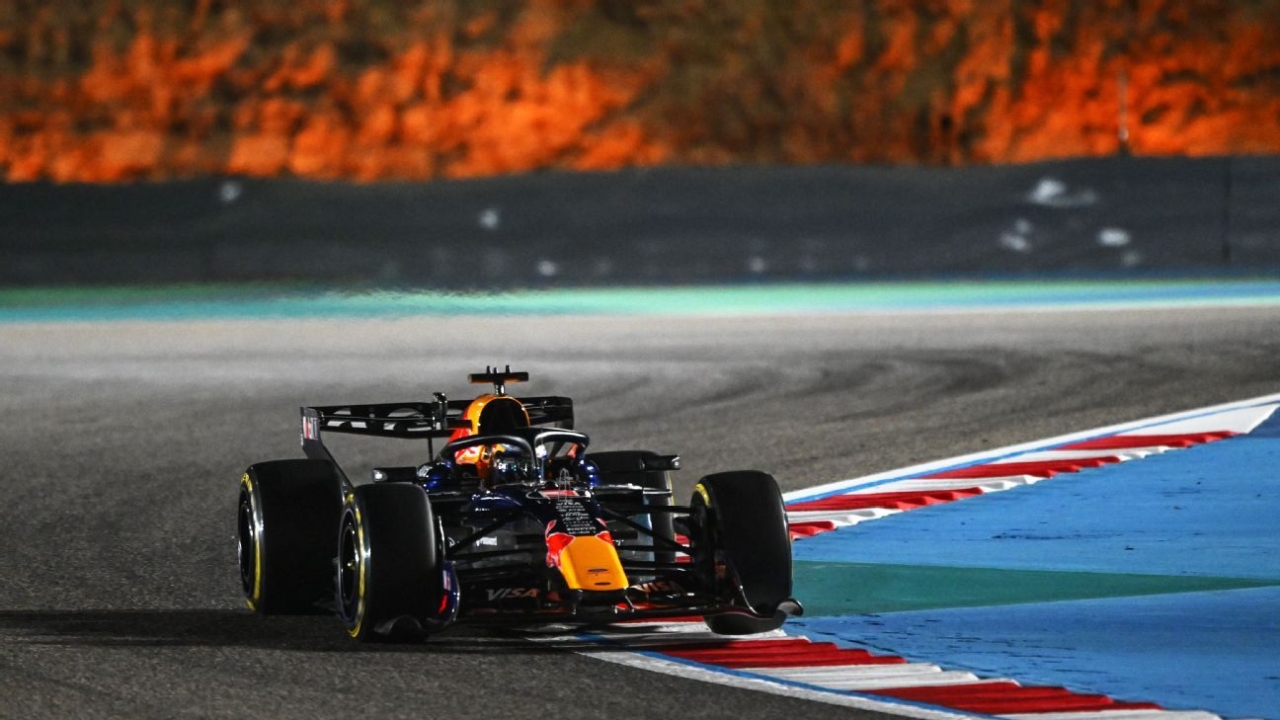
Mercedes team principal Toto Wolff asserts that Red Bull has established the initial standard for power unit performance under the new Formula 1 regulations, despite ongoing discussions regarding Mercedes’ interpretation of these rules.
Mercedes was considered the frontrunner heading into the season after the initial five days of testing in Barcelona last month, but Wolff expressed that he has been particularly impressed by Red Bull’s performance at the start of the season.
Following their separation from Honda at the conclusion of 2025, Red Bull has developed its own power unit for 2026—a significant endeavor that involved recruiting several prominent engineers from Mercedes’ engine division.
When asked to evaluate Red Bull’s success as an engine manufacturer, Wolff remarked: “Well, I was hoping that they were worse than they are, because they’ve done a very good job.”
“The car and the power unit are the benchmark at the moment, I would say. And then obviously you have Max in the car. That combination is strong.”
The new regulations for 2026 place greater emphasis on the electrical components of the hybrid power units, allowing the battery to harvest and deploy three times more power than last year.
This increased focus on electrical power means that recharging the battery and effectively managing energy deployment throughout the lap will be crucial for performance.
Wolff noted that data from Wednesday morning’s test session in Bahrain showed that Red Bull could deploy more energy on the straights compared to its competitors, both in single laps and over multiple laps.
“Look at the energy deployment today,” he stated. “They are able to deploy far more energy on the straights than everybody else.”
“On a single lap we’ve seen it before, but now we’ve observed it over ten consecutive laps with consistent straight-line deployment.”
“I would say that as of today, which is the first official day of testing, with the usual caveats, they’ve set the benchmark today.”
When asked if Mercedes could achieve a similar level of deployment, Wolff replied: “Today, no.”
Wolff spent the majority of Wednesday’s media session addressing inquiries regarding a dispute over the interpretation of this year’s engine regulations.
The controversy revolves around the V6 engine’s compression ratio, which has been reduced from 18:1 in 2025 to 16:1 this year to facilitate competition among new power unit manufacturers.
The regulations specify that the engine’s compression ratio will be assessed at ambient temperatures, but it appears that Mercedes has discovered a method to comply with the legality test while achieving a higher compression ratio—and thus greater power output—when the engine is operating at elevated temperatures.
This matter has already been extensively discussed among power unit manufacturers and the sport’s governing body, the FIA, after it was initially raised by Mercedes’ competitors at the end of the previous year.
“I think that the lobbying from the other engine manufacturers has massively ramped up over the last few months,” Wolff stated. “I mean, secret meetings, secret letters to the FIA, which obviously there’s no such thing as secret at this point.”
“And that has brought it to the situation. So there have been three meetings that we know of between the FIA and power unit manufacturers over the past couple of weeks. Nothing seems to have been resolved.”
The FIA has expressed its intention to “solve” the issue before the season’s first race and to prevent the matter from being referred to the stewards or resolved in court.
One potential solution is to amend the rules so that the compression ratio limit of 16:1 also applies when the engine is hot, but this would require approval from the FIA, led by its president Mohammed Ben Sulayem, and Formula 1, led by Stefano Domenicali.
“I believe that fundamentally the president of the FIA and Stefano will look at it in a holistic way and avoid too much gamesmanship,” Wolff added.
Four teams are utilizing Mercedes engines this year, including customer teams McLaren, Alpine, and Williams.
When asked if there was a chance that eight cars might not be on the grid at the opening race in Australia if the rules are altered, Wolff provided a vague response.
“Well, if it becomes a regulation, you need to adhere to the regulation,” he said.
“And if you can’t adhere to the regulation, then the FIA needs to come up with some kind of invention of how to adjust for that. And that’s unclear to us.”
He added: “You know, I’ve been here for a while, and you’re being misled and you’re misleading all the time. So there is no such thing as surprises anymore.”
“The wind can change suddenly. Bernie Ecclestone [Former F1 CEO] would say, ‘change of circumstance.’ I said A yesterday, but today my opinion is B. And that happens all the time.”
Source: espn.com
