
McLaren suggests modifications to F1 regulations due to safety issues.
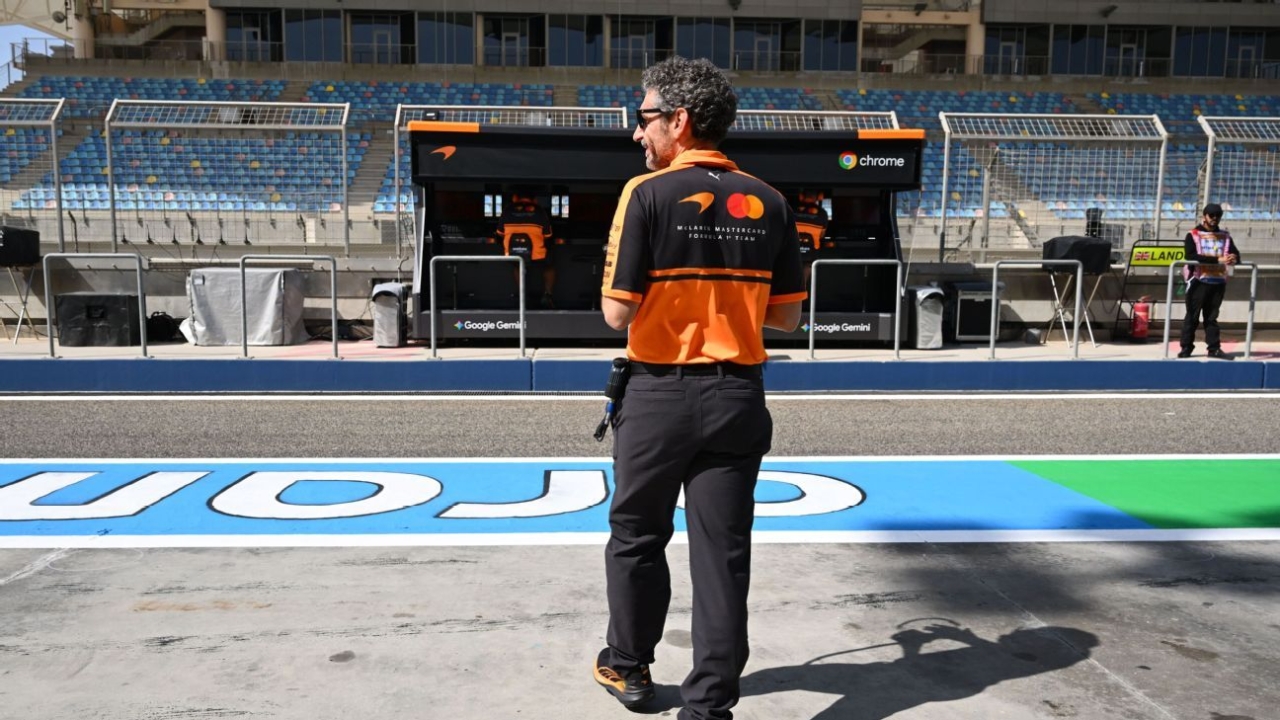
McLaren team principal Andrea Stella stated that this week’s preseason testing in Bahrain has highlighted three aspects of Formula 1’s new regulations that require modification prior to the first race in Australia, noting safety issues for two of them.
All three concerns pertain to F1’s new power units, which have caused difficulties for teams during the two preseason tests conducted thus far and have faced significant criticism from four-time champion Max Verstappen.
The first issue involves race starts, which now necessitate a longer and less efficient procedure to ensure a clean launch, increasing the risk of collisions on the grid as some cars achieve optimal starts while others struggle.
The second issue pertains to the risk of collisions at high speeds when cars are running in close formation, as the lead driver may need to ease off the throttle to recharge their power unit’s battery—a method referred to as “lift and coast.”
The third concern is that F1’s substitute for the DRS overtaking aid, termed overtake mode, may not deliver the required speed advantage in actual racing scenarios to facilitate wheel-to-wheel competition.
Teams were aware of the potential for all three issues leading up to preseason testing, but after observing the cars on track, Stella believes it is “imperative” that solutions are implemented before the first race in Australia next month.
“I think it’s imperative [changes are made] because it’s possible and it’s simple,” he remarked. “We should not complicate what is straightforward and we should not delay what can be done immediately. Therefore, I believe it is something we should certainly achieve before Australia.”
Concerns Regarding Race Starts
After numerous practice starts by drivers this week in Bahrain, it has become evident how challenging it will be to achieve a clean start at the beginning of a race this season.
Until the car reaches a speed of 50km/h, it cannot utilize any of its electrical boost, meaning the initial launch relies solely on the V6 turbo engine.
Under the previous regulations, a component of the power unit’s hybrid system, known as the MGU-H, was employed to spool the turbo and provide optimal boost pressure for the start, but the MGU-H was eliminated as part of this year’s changes to the power unit.
Consequently, the V6 engine must be revved to generate turbo boost pressure and reduce a common issue in turbocharged engines known as turbo-lag.
During practice starts in Bahrain, cars were seen revving for over ten seconds to build turbo boost before finally launching.
There is concern that the current start procedure—which involves five red lights illuminated at one-second intervals before all five are extinguished to signal the start of the race—will not allow enough time for drivers starting from the back of the grid to prepare their turbo for a clean start.
Stella believes this raises a safety issue, which he thinks can be easily addressed by modifying the start procedure.
“We need to ensure that the race start procedure allows all cars to have their power units ready because the grid is not the place for cars to be slow off the line,” he stated.
“This is of greater importance than any competitive interest. I think all teams and the FIA should take responsibility regarding what is necessary in terms of the race start procedure. I’m considering the timings, for example, the timing of the lights and the timing before the lights.
“They need to be appropriately set to ensure that, first and foremost, it is a safe phase of the race.”
The situation is complicated as Ferrari is believed to have chosen a smaller turbocharger to mitigate turbo-lag. A report by The Race indicates that the Italian team initially raised the concern but was not heeded by its competitors and has since blocked a more recent attempt to alter the start procedure.
‘Lift and Coast’ Collisions
The other safety concern highlighted by Stella pertains to drivers needing to ease off the throttle to recharge their power unit’s battery. Such practices are more likely this year due to the necessity of maintaining battery power, but Stella, referencing Mark Webber’s airborne incident at the 2010 European Grand Prix in Valencia, believes they could lead to serious collisions if a car closely following is unable to react to the sudden deceleration.
“There could be cars that follow another car, and the car ahead may want to lift to harvest [energy],” Stella explained. “This may not be an ideal situation when following closely, and this could create a race scenario similar to what we’ve seen before in Valencia, [Riccardo] Patrese in Portugal, and several others that we definitely do not want to see again in Formula 1.”
Challenges in Overtaking
The final issue raised by Stella concerns the lack of overtaking, which is again linked to the new power unit and the constraints teams are currently facing under the new regulations.
DRS, F1’s long-established overtaking aid, had to be eliminated this year to accommodate a new “straight line mode.” Although the front wing now opens along with the rear wing in straight line mode, it is accessible to all cars on all straights and is utilized as a means to reduce energy-draining drag rather than as an advantage over the car in front for overtaking.
To replace the DRS, F1 has introduced a system that allows the pursuing car to utilize more electrical power up to a higher speed, while the lead car’s electrical deployment will decrease as speed increases. This system is intended to provide the overtaking car with a higher top speed similar to what DRS used to offer, but Stella asserts that evidence from testing indicates there is insufficient energy available to use it effectively.
“I think, unlike in the past, where we had DRS that created a significant advantage from an aerodynamic drag perspective for the following car, this year, when you follow someone, you experience the same drag and the same power, making overtaking quite challenging,” Stella noted.
“Our drivers have been racing alongside others during these three days of testing in Bahrain, and they found it extremely difficult to overtake. The additional energy available when following within one second is hard to utilize because this extra energy may only result in slightly more deployment at the end of the straight, if at all.
“Thus, I believe, as an F1 community, we should examine what can be done to ensure that we have a reasonable feasibility regarding overtaking. Otherwise, we risk losing one of the fundamental aspects of racing, which is providing drivers with the opportunity to overtake.”
Stella hopes that all three issues will be addressed by teams and the FIA at the upcoming F1 Commission meeting scheduled for Wednesday next week. He emphasizes that his recommendations are not aimed at gaining an advantage over competitors but are instead focused on the welfare of the sport.
“We are not discussing how fast you are in qualifying,” he stated. “We are not talking about your race pace. We are discussing safety on the grid.
“As I mentioned earlier, some topics are simply more significant than competitive interests. For me, ensuring safety on the grid, which can be achieved through simple adjustments, is just a logical priority. It’s a matter of greater importance.”
Source: espn.com
