
Could the Australian Grand Prix feature the most chaotic F1 start? Reasons for potential early turmoil.
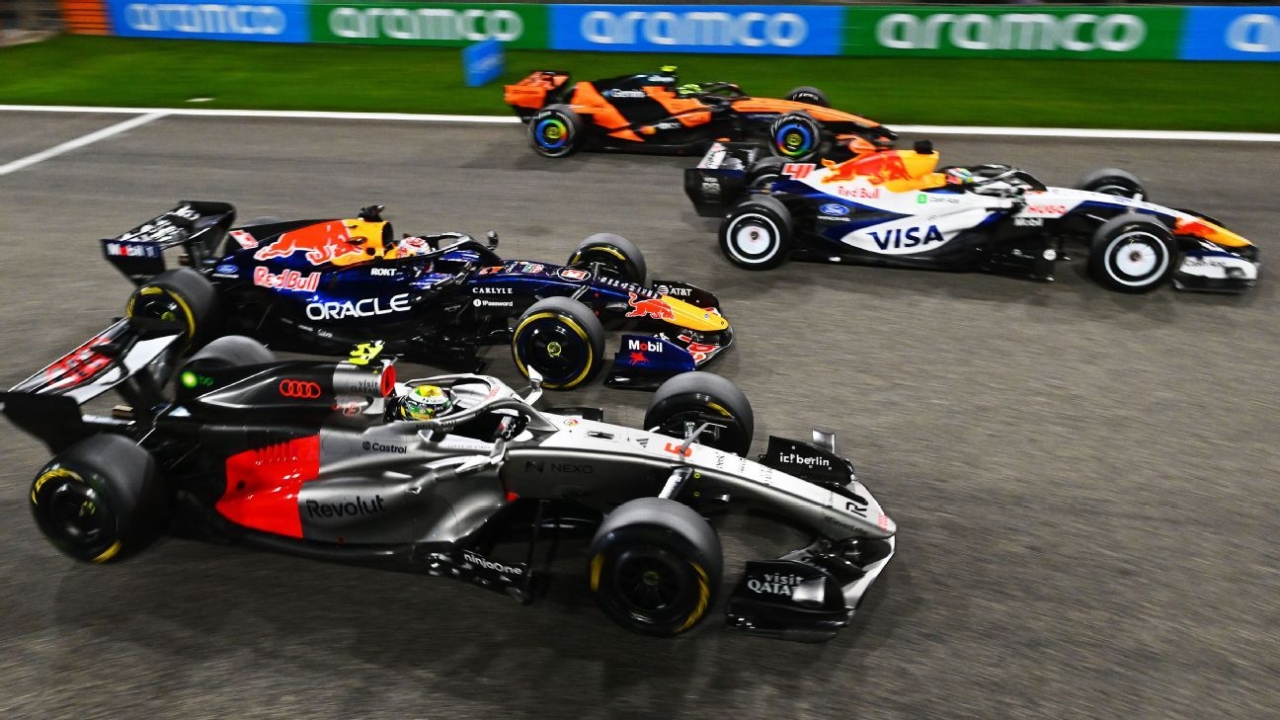
Grand prix starts have historically been prone to unpredictability, but this year, drama is almost assured when the lights turn off in Australia on Sunday. A side effect of modifications to Formula 1’s power unit regulations has made achieving a clean start from the grid considerably more challenging, increasing the likelihood of multiple position changes before reaching the first corner.
During early practice starts in testing, issues were so pronounced that McLaren team principal Andrea Stella expressed safety concerns regarding potential collisions, as some cars struggled to leave their grid positions while others launched perfectly. This has already prompted adjustments to F1’s starting procedure to allow all drivers additional time to prepare on the grid.
Prominent figures like Max Verstappen have downplayed safety worries, indicating that drivers can opt to start from the pit lane if they feel anxious, yet the potential for significant reshuffling of positions remains when the lights go out.
– Bold predictions for F1 in 2026: Ferrari will end its title drought
– Australian Grand Prix 2026: Race start time, how to watch, full schedule
– Does winning first race of F1’s new era guarantee title?
What’s the issue?
The primary challenge is a phenomenon referred to as turbo-lag, which results in delayed acceleration when the driver presses the throttle. Turbo-lag occurs because turbocharged engines must generate sufficient exhaust gas pressure to spin the turbo before it can provide the power advantage of compressed air to the engine. In simpler terms, it presents a complex situation.
Under the previous turbo-hybrid regulations, the intricate Motor Generator Unit-Heat (MGU-H) provided a solution. The MGU-H was an impressive component of the hybrid system that not only produced electricity from the spinning turbo but could also function as an electric motor to spin the turbo in place of exhaust gas pressure.
With F1’s new regulations for 2026, the intricate and costly MGU-H technology has been eliminated from the power units to simplify entry for newcomers Audi and Red Bull. While this is beneficial, it means that the relatively large turbos in F1 must now depend solely on exhaust gas from a 1.6-litre engine to achieve the optimal boost pressure for acceleration.
‘But what about the MGU-K?’ we hear the engineering students inquire. Although still a vital part of the power unit in 2026 and more powerful than ever, the Motor Generator Unit-Kinetic is not permitted to engage and supply electrical energy to the rear wheels until the car reaches 50km/h. This means it cannot assist with the turbo-lag induced lack of responsiveness during the initial phase of the start and only activates once the worst of the turbo-lag has passed.
A basic solution is to rev the engine prior to the start to build boost pressure, which was indeed audible from the cars at regular intervals during preseason testing. However, for most drivers, this process took over 10 seconds to yield satisfactory results, and even then, they had to lower the revs and release the clutch at precisely the right moment to achieve an optimal getaway.
“Oh man, it’s complicated,” Audi driver Gabriel Bortoleto remarked during the first week of preseason testing in Bahrain. “The 10-second thing, and then after five seconds I already lost count and then the engine’s revving up, gear in and out, and you need to release the clutch. It’s quite a mess. It was much easier last year.”
What’s changed?
To provide all 22 drivers a fair chance of making a clean start, an additional five-second hold has been incorporated into the start procedure before the lights go out. There were concerns that cars positioned at the back of the grid would not have adequate time to generate boost pressure under the standard start procedure, leading to sluggish starts for the rear half of the grid or hurried attempts that triggered the car’s anti-stall, leaving the driver as an unfortunate obstacle on the track.
The new start process trialed during testing is as follows:
– The last car returns to the grid after the formation lap, and a flag marshal waves a green flag at the back of the field.
– The flag marshal signals the start of the procedure, but instead of the first of the five lights illuminating, a five-second delay is initiated. During testing, blue lights were displayed on panels along the side of the grid to indicate this part of the procedure to the drivers.
– At the conclusion of the five seconds, the first red light activates, followed by four more at one-second intervals.
– Once all red lights are illuminated, the official race starter determines when to extinguish them and commence the race.
Who’s making the best starts?
The differences in start quality during testing quickly became a significant topic of discussion. Ferrari seemed to have the most reliable getaways, and during a practice start on the grid in Bahrain, Lewis Hamilton advanced from 11th place to overtake George Russell’s Mercedes, which started from pole position, by the first corner. Although Russell may have eased off somewhat following his initial launch, the acceleration of the Ferrari was evident.
“To win a race, you’ve also got to get off the line quite well,” Russell stated. “And I think the two starts I’ve made this week were worse than my worst ever start in Formula 1.
“And, Lewis, down in P11, got into P1. So, at this stage, I don’t think it matters how quick you are [in qualifying].
“I think what’s going to trip you up, it’s always going to be that tallest hurdle. And that’s what we’re trying to get our heads around right now, and we’re stumbling on some at the moment.”
The strong starts for Ferrari were also reflected by the Haas and Cadillac teams that utilize Ferrari’s power unit. The prevailing theory is that Ferrari’s engine is equipped with a smaller turbo than its competitors, facilitating the driver’s ability to reach the optimal boost pressure before the lights go out.
However, while some advantages will likely be inherent by design, it is also true that start performances will improve as drivers gain more practice.
“I think it’s just very random at the moment, and I think we’re all kind of learning what makes a good start, what makes a bad start,” McLaren driver Oscar Piastri commented. “There are some pretty big pitfalls you can encounter if you get yourself in trouble.
“But even just managing the power and the procedure is one aspect, and also just the way we execute starts is much more challenging than last year. It’s trickier from every angle. And I think what we’re witnessing at the moment is people getting it right while others are getting it very wrong.
“So, I think certainly at the first few races, we could see some starts that resemble what we have this week. But I think we’ll start to converge hopefully pretty quickly if you’re on the unfavorable side of that.”
Nonetheless, Sunday’s “lights out” moment in Australia will be essential viewing.
Source: espn.com
