
Antonelli and Ferrari deliver uplifting performance in F1, yet critics persist.
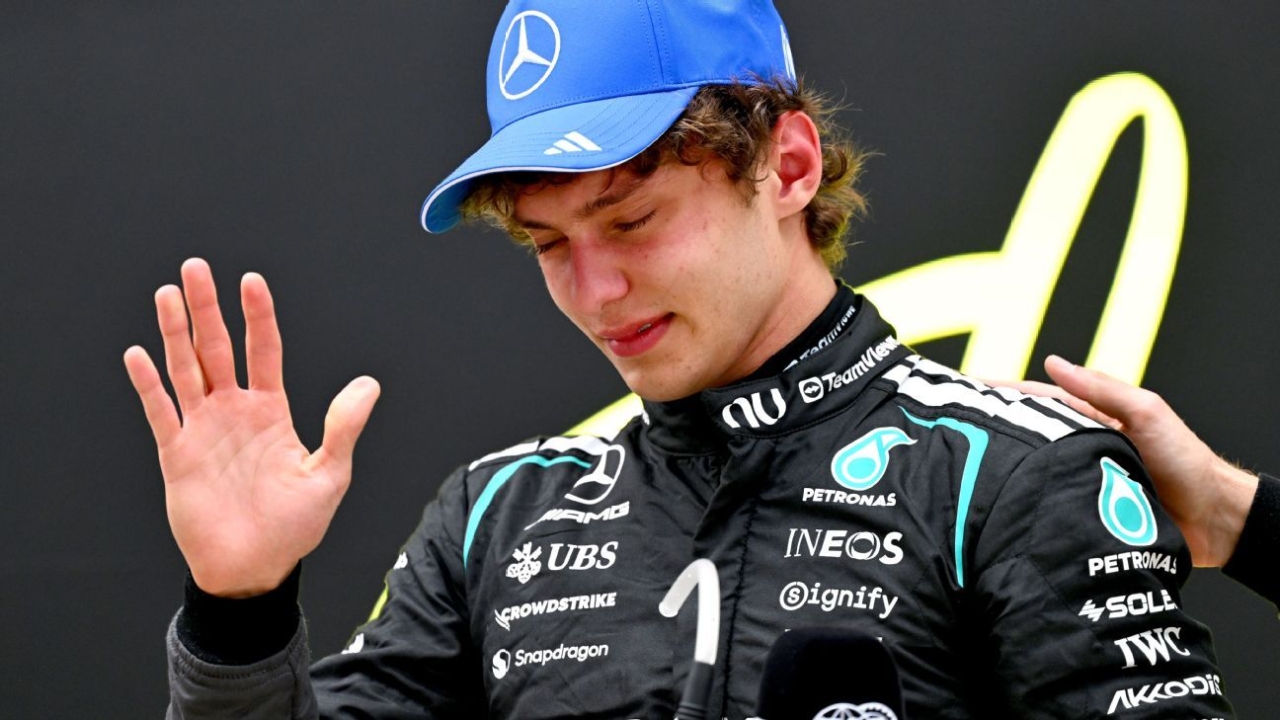
SHANGHAI – – Kimi Antonelli struggled to contain his emotions as he reflected on becoming Formula 1’s second-youngest winner in history.
“I’m speechless,” said a tearful Antonelli, 19, as a microphone was placed in front of him on Sunday. “I’m about to cry, to be honest.”
The tears indeed flowed, and Antonelli’s victory is one that will be cherished and hard to replicate in the near future.
Depending on one’s perspective, Antonelli’s triumph, alongside the man he succeeded at Mercedes, Ferrari’s Lewis Hamilton, on the podium, marked a much-needed boost for the sport. On the surface, the second race of F1’s new era—featuring cars with a contentious, much-discussed 50/50 split between combustion and electric power, along with a significant shift towards energy recovery and battery enhancements—had all the elements one could desire from a grand prix.
Multiple lead changes? Check.
Cars capable of closely following one another, much more so than seen in recent regulatory changes? Check.
A popular new race victor, a fresh-faced talent seemingly on a trajectory to stardom? Check.
A championship battle that suddenly appears less predictable than it did a week ago? Check.
Ferrari in contention? Check.
An extended and entertaining duel between Ferrari’s drivers, Hamilton and Charles Leclerc, who frequently raced wheel to wheel without incident? Check.
To top it all off, F1 experienced a feel-good post-race podium ceremony. The race result culminated in Mercedes’ past, present, and future sharing a podium together with the well-liked Peter Bonnington, who served as Hamilton’s engineer until the seven-time world champion’s move to Ferrari, a transition that led Mercedes boss Toto Wolff to make the bold decision to replace the statistically greatest driver of all time with a teenager.
Considering the driver Antonelli is becoming, that decision now appears to be a brilliant move.
However, as the celebrations unfolded on the podium, another headline was being formed a bit further down the Shanghai pit lane. Ironically, it came from the only name above Antonelli’s on the list of F1’s youngest race winners: Max Verstappen.
“It’s still terrible,” said the Dutchman, who has expressed disdain for these new cars since his first lap in them. “I don’t know, if someone enjoys this, then you really don’t understand what racing is about. It’s not fun at all. It’s like playing Mario Kart. This is not racing.”
Verstappen moved from camera to camera reiterating a similar sentiment, delivering his most concise and scathing critique of the new regulations to date. Amid the positive atmosphere from the race at the front, it was also hard to overlook Verstappen’s remarks, and even more challenging to ignore the number of people who seemed to resonate with his views as soon as he expressed them, even if Sunday’s race had all the hallmarks of a classic.
It’s still unclear how to fully assess Formula 1’s regulations, but Sunday’s Chinese Grand Prix presented a curious and contrasting narrative of two sides, highlighting just how far apart those extremes are.
The yo-yo effect
While Sunday’s race concluded with the top four finishing in the order they started, that does not accurately reflect how the contest unfolded. Similar to the season opener in Melbourne and Saturday’s sprint in Shanghai, the fast-starting Ferraris made life quite challenging for Mercedes at the front. Hamilton led into Turn 1, eliciting huge cheers from a Chinese crowd that seemed as passionately supportive of the seven-time world champion as one might find at Silverstone later this year.
After some early excitement, Mercedes quickly regained a comfortable one-two position, only for fate to intervene with Lance Stroll’s halted Aston Martin. An early Virtual Safety Car at a similar point in the race had neutralized the wheel-to-wheel battles in Melbourne a week prior, but the Safety Car this time reignited the competition. Antonelli was able to pull away into the distance for his first victory, but George Russell’s prolonged struggle to overtake the Ferraris, along with their own ensuing battle, became the focal point of the race.
F1’s new cars have introduced an existential crisis for the sport since their first public appearance in February. F1 has always had elements that required management—most notably, in recent years, Pirelli’s unpopular tires—but nothing to the extent demanded by these new hybrid engines. Cars now harvest energy into their batteries during the braking phase of a lap, which has turned qualifying into a lifeless, frustrating spectacle where drivers often coast through some of the calendar’s most daunting corners. The spectacle has, at least outwardly, appeared more exciting during the races themselves.
After Melbourne, Leclerc coined a phrase that will likely stick with these cars for as long as they exist: “yo-yo racing.” The back-and-forth nature of overtaking has already become a defining characteristic of this generation. With a battery pack on each car, drivers now have the option of when to utilize the boost around a lap. Earlier in the week, Verstappen compared this to Mario Kart, joking that he had taken to the popular video game as part of his race preparation. Following their battle for victory in Melbourne, both Russell and Leclerc noted that the newest aspect of the cars had fostered a racing style that has prioritized strategy over bravery.
Mercedes was in a league of its own on Sunday, and when it mattered, easily dealt with the Ferrari duo. However, the fight between Hamilton and Leclerc continued, with the Italian team refraining from intervening at any point to alter or freeze positions for fear of a collision.
“Huge respect for both of them,” Ferrari boss Fred Vasseur stated after the event. “It made sense in this situation to let them race. I know perfectly well we can also look very foolish half an hour later, but at the end of the day, it’s also the best way to build up a team.”
 play0:46Hamilton & Leclerc admit they had ‘great fun’ during Chinese GP battles
Ferrari’s Lewis Hamilton and Charles Leclerc speak after the Chinese Grand Prix.
Leclerc and Hamilton had nearly collided during a wheel-to-wheel battle in the sprint, but their contest on Sunday was both firm and fair. “This is actually quite a fun battle,” Leclerc communicated to his team at one point.
The enjoyment he referred to will likely be debated for a long time. One does not have to scroll through social media for long to find fans vocally arguing that two drivers using a power boost to pass each other back and forth is not the type of racing Ayrton Senna described when he famously stated, “If you no longer go for a gap that exists, you are no longer a racing driver.” Gaps with F1’s new cars seem irrelevant now—all that matters is whether one car has more boost than the other at the next corner.
What is not up for debate is that the new formula appears to have addressed one persistent issue. F1 has experienced several iterations of regulations in the past that have led to the same old problem: cars that cannot closely follow one another. A car that cannot get close enough to follow cannot also get close enough to attempt an overtake. Drivers who tried to do so would wear out their tires, brakes, or both. This was why the Drag Reduction System (DRS) was introduced in 2011, after Fernando Alonso spent the entire 2010 Abu Dhabi Grand Prix stuck behind Renault’s Vitaly Petrov, costing him that year’s title.
While a common critique of the new regulations has been that they have created “artificial” racing, it’s important to remember that the DRS mechanism was the sport’s first artificial aid designed to increase overtaking during race weekends. It was often referred to as a band-aid and was far from perfect, but it would be misleading to suggest that artificial racing has only emerged this year.
While much of the focus on the new generation has been on what lies beneath the engine covers, aerodynamics were also a significant part of the change. This seems to have had a remarkable impact on the racing. More simplified aerodynamics were implemented to reduce the effects of “dirty air,” the turbulent wake generated behind cars that made following one another so challenging. That issue, at least according to Hamilton, has been resolved with these new cars.
“The cars are easier to follow, much better than in previous years,” he stated on Sunday evening. “You can get very close. There’s not a bad wake where you’re losing too much downforce. I think it’s the best racing that I’ve ever experienced in Formula 1.”
It is often said in Formula 1 that a competitive driver is a happy driver. Hamilton, in particular, exemplifies this sentiment better than anyone at the moment.
The seven-time world champion detested the so-called ground effect cars of 2022-2025, a period during which he secured only two race victories. His complaints about them were numerous; he was one of the most vocal regarding the bouncing quirk the cars produced, an effect known as porpoising. It could not have been easy witnessing Red Bull and Verstappen dominate the championships during the initial years of that set of regulations.
Now, the situation has flipped 180 degrees.
While Hamilton and Ferrari seem to be in a favorable position, Verstappen and Red Bull are struggling. Far from being as competitive as Mercedes suggested it would be during preseason testing, Red Bull has had a challenging start to the new year. Verstappen retired his car midway through the race. Every journalist waiting for him in the media pen anticipated he would double down on his criticisms.
When asked if the rules could be salvaged by making minor adjustments within the regulations, Verstappen replied, “You can help it a little bit, but it’s fundamentally flawed.”
When it was pointed out to Verstappen by ESPN on Sunday evening that the sport had thus far featured three races of back-and-forth action, he shrugged.
“It’s just Kimi or George that is winning, right? It’s not really back and forth,” he responded. “They’re miles ahead of the field. It’s just that Ferrari sometimes has these good starts that they push themselves in front, and then it takes a few laps to sort it all out. Like I said, this has nothing to do with racing.”
On whether F1 was now prioritizing overtakes above all else, regardless of how they occurred, he stated, “I hope they don’t think like that, because it will eventually ruin the sport. It will come back to bite them.”
In this instance, Verstappen has a valid point. All three races we’ve witnessed—two full-length races and Saturday’s sprint in Shanghai—have seen Ferrari’s rapid starts propel the red cars into contention. Mercedes was still 15 seconds ahead of the fastest Ferrari after Melbourne’s 58-lap race, and 25 seconds clear after Sunday’s 56 laps in Shanghai, even with a Safety Car that bunched the field back together after 11 laps. Mercedes is significantly ahead, and it raises questions about what a race will look like once the leading cars can neutralize Ferrari’s threat from the start.
The fact that Verstappen was not involved in either fight—and that it seems a long time until Red Bull will be competitive again—might be a contributing factor to the broadside he directed at the sport on Sunday night, but he insisted that current competitiveness was irrelevant.
This is not a viewpoint Verstappen has suddenly adopted in recent days, weeks, or even months. He has been vocal about this since 2023 and 2024, when the regulations were merely theoretical. He and Red Bull anticipated “Frankenstein cars” where the driver had minimal real input in actual racing.
“I would say the same if I were winning races because I care about the racing product,” Verstappen added. “It’s not about being upset about where I am, because I’m actually fighting even more now, of course. So you get to understand what you have to do and what it is about even more. For me, it’s really a joke.”
Whether Verstappen would have maintained the same stance if he had the 2026 Mercedes at his disposal is debatable, but his criticisms must be taken seriously. Wolff certainly suggested that Verstappen’s situation at Red Bull might be influencing his perspective on all things Formula 1 at present.
“I mean, Max is really in a horror show,” Wolff remarked on Sunday evening when asked about Verstappen’s comments.
The Class of ’26
The final word should belong to F1’s newest race winner. Antonelli’s victory is likely to be the first of many in a career that promises to be captivating. The Italian driver’s F1 journey thus far has been a rollercoaster, and we witnessed a glimpse of why three laps from the end.
The 19-year-old, who has rarely raced at anything other than the limit, locked up at the penultimate corner, briefly running wide and losing a small portion of his healthy lead. It was a heart-stopping moment that ultimately had no impact on the outcome, but perfectly encapsulated the youthful enthusiasm Antonelli has always displayed in his racing.
“Let’s just get this thing home,” came the message from an understandably anxious Bonnington on the pit wall. Bonnington oversaw all 84 of Hamilton’s victories with Mercedes as race engineer, coining the famous phrase, “OK Lewis, it’s hammer time” for when it was time for the seven-time world champion to push his tires to the limit.
The winning manufacturer sends a representative to collect the team trophy alongside the top three drivers, and there was only one individual, apart from Wolff, who should have been up there. Bonnington, better known as “Bono,” ascended the podium. It was a remnant of the Mercedes title-winning dominance of 2014-2021, and a sign of hope for those within the team that they can revive their glory days.
As a singular moment, it was a bit too much for Wolff.
“It’s been a while since I’ve been in Formula 1, but that podium now was probably one of the best moments I’ve ever had in Formula 1,” he told Sky Sports F1. “The three of them, with Bono right in the middle … rarely am I overwhelmed, but that is such a moment.”
As for Antonelli, he appeared overwhelmed by the entire experience.
When asked how special it was to share this moment with the key Mercedes figures in his career, with Hamilton by his side and his father present, he replied, “It’s been great to have my dad here to share this moment with him because he’s been part of this whole journey since karting. Also, with Bono and Toto—Toto brought me into the team in 2018 and has supported me all the way to Formula 1. He gave me the opportunity last year to put me in the car, and then again this year. So definitely it’s been a great journey so far. But of course, there’s still a long way to go, but we’re on a good path and I’ve been enjoying my time with Mercedes and the whole team. Just looking forward to the future.”
The discussion following Antonelli’s victory may well focus on Verstappen’s remarks and the ongoing debate surrounding F1’s perplexing new cars, but there is no doubt that a star was born on Sunday in Shanghai.
Source: espn.com
