
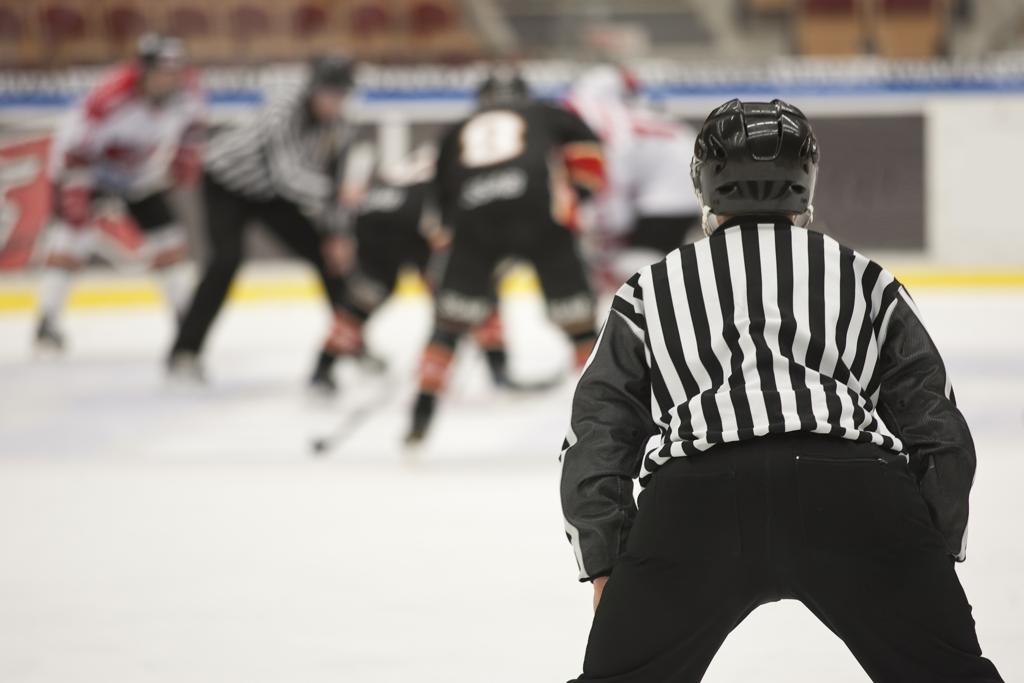
One of the most important jobs within USA Hockey is the Referee in Chief – the three national and 13 district leaders responsible for managing, training and supervising the more than 32,000 registered referees and linespersons across the country.
It’s a challenging but rewarding position, and for many, has served as a way to give back to their profession and honor those that helped them along the way. Few can say they’ve held the title for a quarter-century. Jim Dewhirst, who announced his retirement as Referee in Chief of the Southeast District earlier this year and was recognized for his dedicated service at USA Hockey’s Annual Congress in June, was one of those few.
For 25 years, Dewhirst, now 70, led the officials of the Southeast, a group that has grown to more than 2,800 strong. He was gracious enough to take the time to answer some questions about his long and impactful career from his current residence in Apalachicola, Florida.
USA Hockey: What led to the decision to retire as Southeast District Referee in Chief?
Dewhirst: I had been the Referee in Chief for 25 years. I felt like it was an opportunity for some fresh ideas and new energy in the position. I believe I had left the staff in a good place, and the person who replaced me, Nick Zaglifa, had been part of my staff for a long time. He’s a quality guy, who loves officiating and wants to do the right thing. The other piece is that my wife and I love to travel, and I didn’t want to have to leave my job for weeks at a time on a longer trip. So, it was the right time.
USA Hockey: How did you get the job 25 years ago?
Dewhirst: I was in California and had worked my way up in the system there over about 12 years, and then we moved back to Tennessee, where I had gone to college and had started my career as an official. I served as a state supervisor for five years, and then the RIC of the Southeast District announced he was stepping down. There were five of us that showed interest in the job. We had interviews with the affiliate presidents and district directors, and I was fortunate that they chose me. The 25 years have been an incredible experience. It’s truly been one of the highlights of my life.
USA Hockey: What drove you to want to be the Referee in Chief in the first place and why did you stick with it for so long?
Dewhirst: I wanted to make sure that we did things right in the Southeast. When I first started, each district was pretty autonomous. USA Hockey was the main body, but the districts often did things on their own. I wanted to make sure that this one was done right. Hockey was also growing in the Southeast and I wanted to be part of the growth of the game. To do that, you need to have good officials, so I wanted to make that happen. What kept me in it for so long is that I was surrounded by some truly great people.
USA Hockey: What did you feel was your most important task as Referee in Chief?
Dewhirst: The Referee in Chief is in charge of making sure the officials in the district receive the best education possible. We’ve worked hard at USA Hockey, especially in the last 10 years, to improve our education program from what it was. Times change, so education changes, and we’ve tried to produce a better education product for officials that are coming into the system. Hockey has grown so much in the Southeast over the last 25 years, so that was really important. I had some great opportunities when I was younger, and I just wanted to make sure that people had that going forward. We had one person come through, an official from Florida who made it to the NHL. To have individuals get these opportunities, work hard and move up, that’s really the best thing. Working with younger officials and helping them however I could, running the Level 4 seminars with other instructors, traveling throughout the district to help instruct, is what I’ve really liked about the job.
USA Hockey: How did you get started in the officiating profession? What was your career path?
Dewhirst: I started in 1980. I was in law school at the University of Tennessee and also playing on the school’s club hockey team. One of the main officials there, who also ran the Zamboni at the rink, stopped me after a game and asked me to show up the next morning to help officiate. I did and I’m sure I was absolutely awful. He did most of the work. Then he had me referee a 17U game and there was a bench clearing brawl, fights in the stands. It was terrible. But I did like the experience, and I thought to myself, I have to get better at this. I worked some lower-level youth games. Then we moved out to California that summer and I found the local organization there and had a fabulous supervisor who said ‘we’re going to teach you how to be a good referee.’ I started in lower divisions and got to work state tournaments and then had opportunities to work the USA Hockey regional tournaments. I made a lot of mistakes, but I tried hard to not make them twice. That helped me become a much better official. Then I got to work about 9-10 national tournaments. Just worked my way up. After 12 years we moved back to Tennessee. And that’s where I really began my crazy weekend schedule. There was a rink an hour away, but not a lot of hockey there, so I traveled to Atlanta, Huntsville and Nashville. I was traveling a lot. There was professional hockey, the ECHL had teams and then other leagues came in. Through it all I kept working youth games.
USA Hockey: What are some of your best memories as a hockey official?
Dewhirst: I had some opportunities to do some fun things. One of the highlights was in 1990. Prior to the Goodwill Games that year, there were exhibition games between Team USA and the Soviet Union’s national team. One of the games they played at Oakland Coliseum and I was asked to be a linseman. There were around 12,000-14,000 people there. It was packed. The teams didn’t like each other. The environment was just spectacular, with fans chanting ‘U-S-A.’ It was a great game. Some great names played in that game. And Team USA won. That was really the best game I ever got to be involved with.
USA Hockey: What has changed the most about the game since you started your stint as RIC?
Dewhirst: The sport of hockey is much different than it was 25 years ago. Back then it was really rough and tough, and more about how many people can you smash in a game. It wasn’t necessarily about the skill. You had to be a good skater and a good player, but so much was about physical toughness. The game now is so much faster than it was, and it’s been fun to watch that happen over all this time. I really love a fast-skating game, a clean checking game. Our coaches have done a really good job of getting kids to change the mindset from ‘how do I put someone through the wall,’ to ‘how do I get the puck and skate around them and score a goal.’ That has been the biggest change that I’ve seen in the game, and I think it’s been fabulous.
USA Hockey: What things have changed as it relates specifically to the officials?
Dewhirst: The game has grown so much. It used to be that you’d have lots of officials but not as many games, so you had to work really hard to get noticed to get a game. Now there are so many games being played and so many teams, that we have struggled to keep up with the number of officials needed to do those games. And not just the number of officials, but also the quality of those officials that can handle the speed and complexity of today’s game. That’s one of the reasons the education program has been evolving. We’ve tried to do a better job of educating and retaining our officials. The other thing is that younger officials today aren’t as interested in an apprenticeship where it takes several years to move up through the ranks. Many come in and believe they’re ready to go to the college or NHL levels. I’ve tried to impress upon them that you need to learn how to do it. If you’re working at the U12 or U14 level, be the best referee you can be at that level and then we’ll worry about the next step. I wish we could slow down the process a little bit. On the other hand, the opportunities are much greater then back when I was starting out. It’s a dual-edged sword. It’s good for those that can handle it, but not so good for those that can’t. More and better education is key.
USA Hockey: What advice would you have for former players or anyone who is interested in becoming an official?
Dewhirst: Number one is skating. Whatever level of skater you are you can be better. It’s not something that just happens. You need to work on it. I always talk to officials who were okay skaters and say ‘go out and get lessons.’ Have someone teach you how to be a really efficient skater. The games are so fast. And you have to be able to keep up with the play the whole time, no matter what system you’re doing, no matter what level you’re doing. The second thing is to avoid putting yourself in positions where it’s going to be difficult to succeed. A first-year official who is struggling at the Peewee level doesn’t need to be working a junior game, even if it sounds like a cool opportunity. You want to put yourself in a position where you can succeed and learn as much as you can about the game before you proceed up the ladder. Some other things are to know the rule book, be approachable for coaches and players. Last thing is if even if you get an opportunity to move up and work professional games, don’t forget about the youth. Keep working youth games.
USA Hockey: What will you miss most about being around the game?
Dewhirst: The people. You meet some incredible people in this sport. Sometimes your paths cross one or two times, sometimes they pass for a lifetime. I have developed life-long friends, that are all over the country. And that’s what’s awesome about it. There are some great, great people attached to hockey.
