
Building Confidence in the Crease
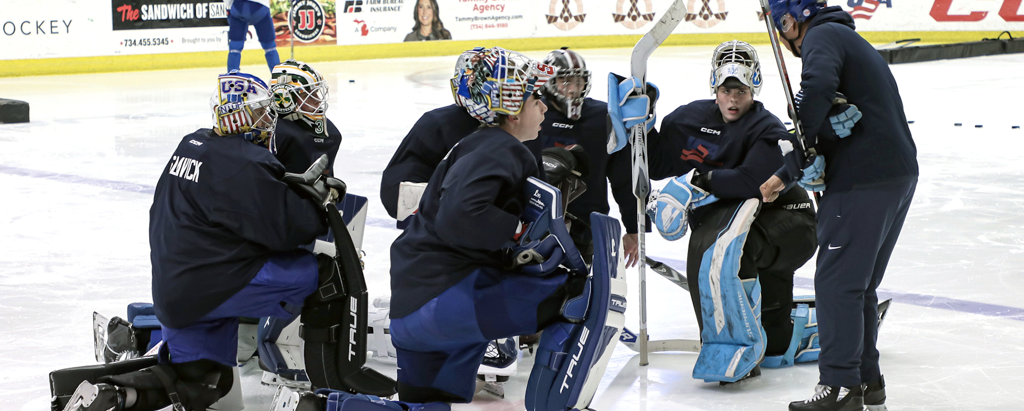
Hockey is a Team Game
The position of goaltending can sometimes feel like an island, especially for youth netminders. Their gear is different, the fundamentals they need to work on are specific and even their role on the team can be isolating. If the aim of the game is to score more than your opponent, the goalie’s role is to stop the opponent from getting more than you.
Alex Westlund, University of Connecticut Men’s Hockey Assistant Coach, said that involving your goaltender in all aspects of the team game is key to both their development and growth as a player and person. Goalies have a lot on their shoulders and coaches need to support them and help them handle the pressure of being the team’s last line of defense.
“A goalie is never trying to give up a goal, and sometimes if there’s an emotional moment and you give up a bad goal, it’s hard enough. Moving on to the next save, moving on to the next play is a constant theme and it’s something that good goalies do,” Westlund said.
Westlund shares ways that coaches can get netminder’s off the island, more involved with the team and further support their development.
Involvement Beyond the Net
Westlund gave the example of getting goalies involved in parts of practice that are typically designed for skaters. If your team is doing a puckhandling drill, such as chaos, let your goaltender get in on the action.
“Goalies should be absolutely involved in that stuff. It’s not quote-unquote, goalie specific, but the goalie who is good in that type of drill, I’m willing to bet it will translate to the crease.” Westlund said.
Especially at the earlier stages of a goaltender’s journey, overall athletic development is as important as learning technique. Getting into action that is normally reserved for skaters enhances all aspects of athleticism.
“Even the awareness of body positioning, special awareness, how far a guy is away. It’s all athletic development and that stuff is all great.” Westlund said.
Westlund is especially interested in goalies working on their overall skating. T-pushes, glides and hard stops are essential parts of the goaltender’s repertoire,
“I love when goalies are good skaters,” Westlund said. “I don’t think you can ever work on skating too much. Keep working on hard stops and hard pushes and rotations. All the habits of skating.
“The game is getting faster and more deceptive and we have to respond with that in mind. More often than not, it always comes back to skating and balance. Just hammering those things.”
In today’s game, goaltenders also have to be able to handle the puck. To get netminders involved in drills with position-specific skills, coaches can start a drill with a goalie touch. Rather than working on a breakout by dumping the puck into a corner, wrap it around the boards and let the goalie make the first touch.
“I don’t think goalies get enough reps in a team setting and practice to develop that skill. In terms of you’re going back to get a puck and how to figure out a forecheck, figure out where guys are, where your guys are, how to handle a puck on the boards when you’re under pressure,” Westlund said. “Those are all things that come into play and when a goalie becomes 14,15, 16 years old, most coaches just assume they know how to do it, but I don’t think the vast majority have gotten the reps they need at the younger levels to really implement it.”
Monitor Shot Volume
When it comes to shots on goal, coaches can help their goaltenders out. With the American Development Model, puck touches are prioritized. But goaltenders can be on the other end of those player puck touches and shots on goal.
“All the players probably love high-rep shooting drills because it feels good and probably turns into a lot of goals,” Westlund said. “But those are tough for the goalie, that’s mentally tough. You do a four-minute drill and you gave up 26 goals and your head is spinning trying to figure out what just happened. Those are things that need to be balanced.”
When designing practice plans, coaches should be mindful of the amount of shots a netminder is getting. Allow time for them to reset before getting a secondary shot or action. And if it seems like the volume is getting too high for a younger netminder, coaches can encourage them to take a breather.
“Nobody is going to want to just get pummeled in this small area game or a skill-based drill. In those types of drills where the volume is really high, it’s important to allow the goalie to hop out of the net for a few reps. One, to catch their breath, two to mentally reset,” Westlund said. “If the kids are shooting at an empty net for a few reps, that’s fine. You’re not ruining the drill or practice. If you’re communicating with the goalie and it is a high volume drill, especially if you’re talking about a 10 or 11 year old, they can take seven or eight reps and hop out for a couple.”
When it comes to goaltending, Westlund says that quality is more important than quantity.
“Hopefully the quality of the reps are better for the goalie as opposed to 50 reps that are average or are consistently getting worse by the time they’ve taken 30 in a row.”
Communication is Key
Even if you’re not familiar with the finer points of coaching the position, that’s OK as long as you are keeping lines of communication open with your netminders. Checking in with your team’s goaltenders and seeing how they are doing during practices can help you determine if they need more or less work.
“Getting their feedback can help in terms of what sort of drills, how they’re designed and where they are getting shots from,” said Westlund. “Not every drill needs to be designed for the goalie by any means, but if you’re a coach who doesn’t understand the position, it might be a good place to start in terms of getting that perspective.”
Keeping open lines of communication can also empower your goalies to do individualized work during quieter moments. Westlund gives the example of a team working on power play on one end of the ice, while the goalie on the other end is not facing shots. A coach can encourage the goalie to work on the position-specific skills.
“That’s a time for him or her to work on crease movement or maybe they're working on T-pushes or hard stops,” Westlund said. “That’s a time the goalie can be proactive in their own game as a way to stay involved.”
The biggest thing is ensuring goaltenders feel like a part of the team.
“Goaltending is a very isolating position. From the goalie’s side of things, when you feel like you’re on the outside and the coaches don’t talk to you, it exacerbates the distance,” said Westlund. “So simple communication, getting to know them, getting to know the athlete – what makes them tick – the communication beyond a goalie coach from the head coach and assistants, those touches are really important.”
