
Wolfsburg faces risk of relegation from the Bundesliga and diminished significance.
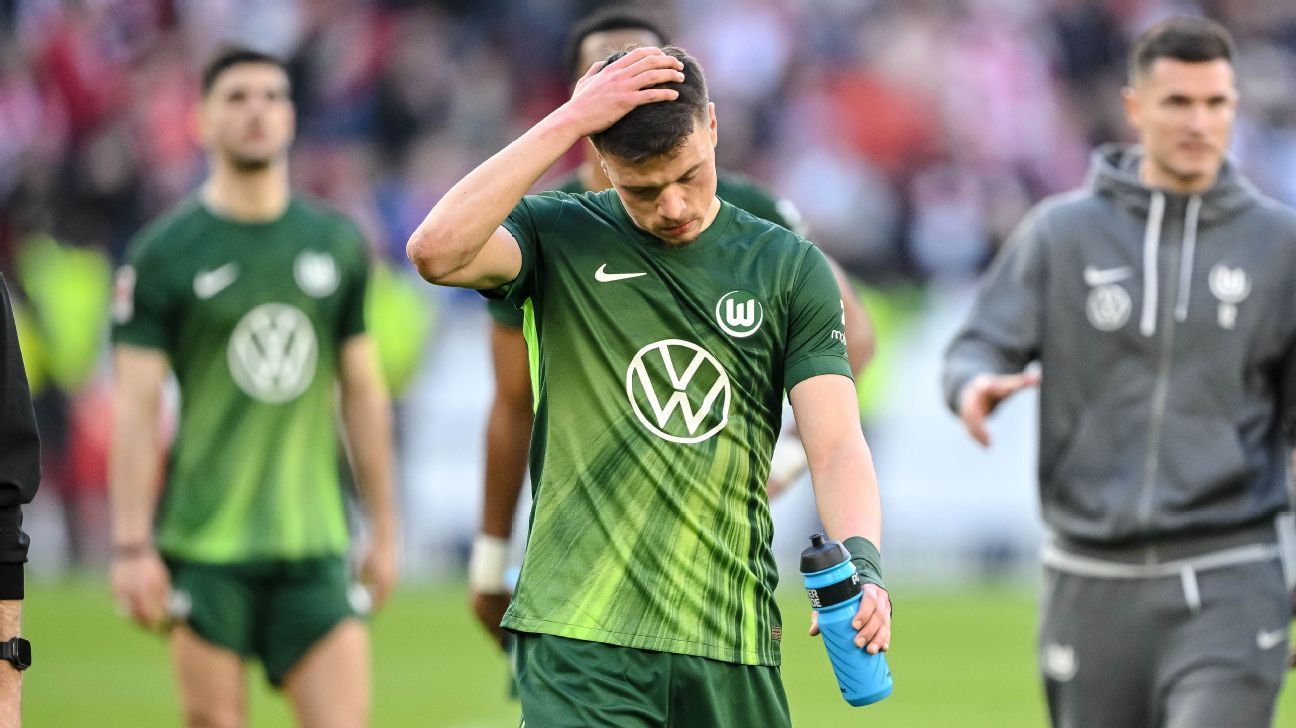
Wolfsburg is known as Germany’s Autostadt. The city’s very foundation is linked to Volkswagen and the automotive industry, yet there is a significant risk that its presence in the top-tier Bundesliga could falter in Niedersachsen, a region often overlooked in Northern Germany.
VfL (Verein für Leibesübungen, or “club for body exercise”) Wolfsburg first entered the Oberhaus (first division) in 1997 and has since become a fixture in the league. Only Bayern Munich, Borussia Dortmund, and Bayer Leverkusen have maintained their positions in the Bundesliga longer than die Wölfe (the Wolves).
Wolfsburg notably clinched the league title in 2009 under Felix Magath, during a period when standout players Edin Dzeko and Grafite shone in Germany. In 2015, they won the DFB-Pokal for the first time in their history. As recently as 2016, they were close to eliminating Real Madrid in the UEFA Champions League quarterfinals. After leading 2-0 from the first leg at home, they lost 3-0 at the Santiago Bernabéu, which initiated a prolonged struggle for relevance.
– Kane, Yamal lead ESPN’s Players of the Month for February
– Kane eyes Lewandowski: Tracking Europe’s goal, assist records
– The best teams in Europe right now: Barcelona, Bayern dominate
The following season, Wolfsburg fell to 16th place in the standings and only managed to secure their league status through a two-legged victory in a tense relegation battle against local rivals Eintracht Braunschweig. A collective sigh of relief was released along the Mittellandkanal, but since then, there has been a prevailing sentiment that Wolfsburg exists in a sort of limbo. This perception persisted even when Oliver Glasner was successfully guiding them back into the Königsklasse (Champions League) before departing due to apparent disagreements with Sportchef Jörg Schmadtke.
Not widely embraced by the broader German public, largely due to the 50+1 exemptions afforded to a club supported by the Volkswagen group, die Wölfe appear destined to remain in the Bundesliga without garnering much affection. It is evident that there is a sense of schadenfreude among fans of other clubs this season. Wolfsburg, currently second from the bottom with only 20 points from 24 matches, is experiencing its worst season since the 1997 Aufstieg (promotion) campaign.
The individual facing the most scrutiny is the club’s Geschäftsführer-Sport (managing director for sport), Dane Peter Christiansen, who joined in 2024 from FC Copenhagen.
Christiansen has invested significantly in players and built a large squad, but has gone through two coaches—Ralph Hasenhüttl and Paul Simonis—and the internally promoted former youth coach Daniel Bauer may be next in line.
Bauer made headlines this week with his assertion that the atmosphere and culture at the club are not bundesligatauglich (suitable for the Bundesliga). Whether this assessment will soon apply to Bauer himself remains an intriguing question.
This weekend’s Nordduell at home against Hamburger SV (Saturday, 9:20 a.m. ET, ESPN+) feels somewhat like a decisive match for both Bauer and Wolfsburg. Hamburg has performed reasonably well in their first season back in the Bundesliga following their inaugural Abstieg (relegation) and seven subsequent years in the 2. Bundesliga.
They are expected to bring a large contingent to the Volkswagen-Arena, and the match may even have a home atmosphere for die Rothosen. However, HSV currently finds themselves mittendrin im Abstiegskampf (ensconced in the relegation fight) after a loss to Leverkusen in the Wednesday Nachholspiel (make-up game).
This season, the relegation battle involves nearly half of the Bundesliga. It would be surprising if Union Berlin, currently six points above 16th place—the playoff position—gets drawn into it, and a home victory against the team in that position, Werder Bremen, would significantly aid their quest for safety in Berlin-Köpenick.
Bremen, now under Daniel Thopune, achieved a notable 2-0 victory over Schlusslicht (bottom club) Heidenheim, who appear destined for relegation after an unlikely three-year tenure in the Bundesliga.
St. Pauli and Mainz have embraced a spirit of improvement, which is perhaps not unexpected. Urs Fischer has had the desired impact since taking charge in Mainz, and it would be quite puzzling if that squad—still competing in European competition—were to falter significantly again.
With St. Pauli, there was always a sense earlier this season that even when Alex Blessin’s teams were losing, they were not being overwhelmed. By traveling to Sinsheim and defeating Hoffenheim, die Kiezkicker demonstrated their capability.
This resurgence by the two aforementioned clubs should justifiably make Köln and Borussia Mönchengladbach feel a bit anxious.
Köln coach Lukas Kwasniok received a recent vote of confidence from his superiors this week, but it seems this is a week-to-week concern in the Domstadt. The upcoming Rheinderby against Gladbach in a couple of weeks could take on even greater significance than usual, depending on the performances of both clubs in the interim.
Finishing 16th is often not a cause for alarm in the Bundesliga, as history indicates a stronger likelihood of survival for the top-flight representative in the playoff compared to the team finishing third in the 2. Bundesliga. However, no one wants to be Wolfsburg right now, languishing in 17th place and seemingly unable to engage the Notbremse (emergency brake).
