
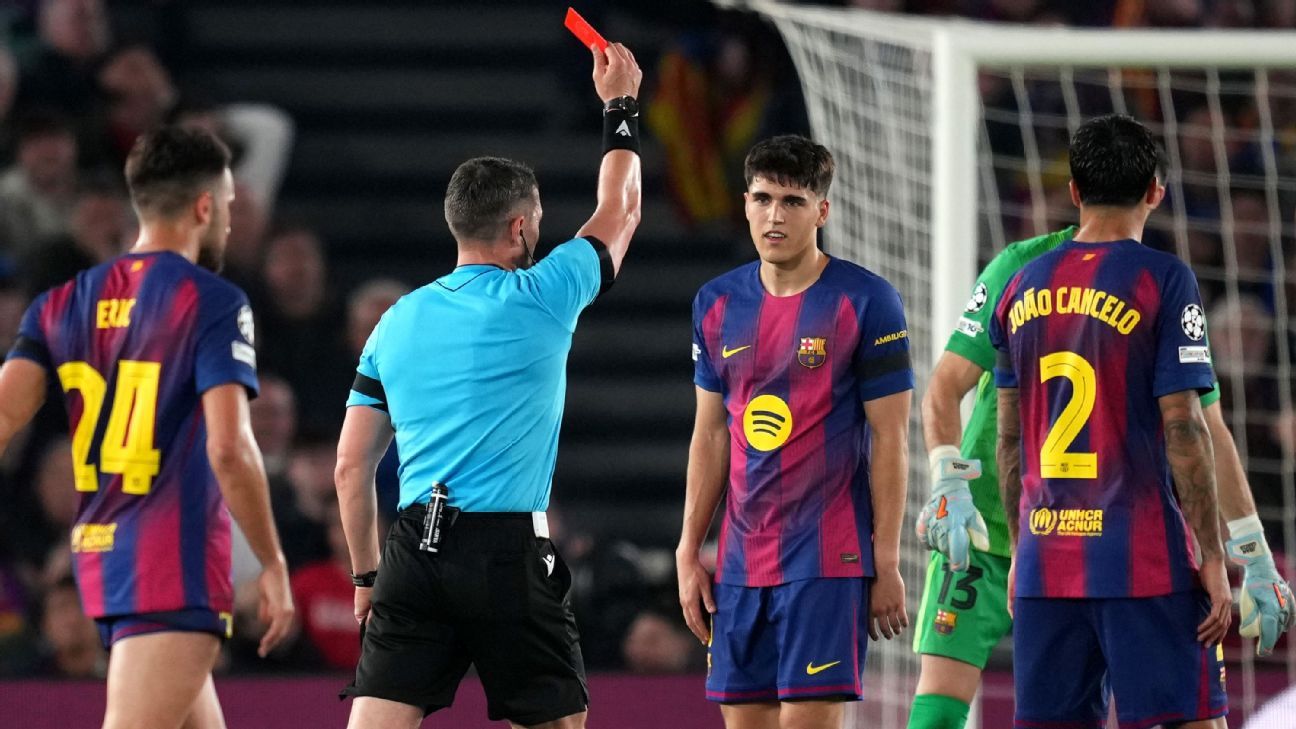
VAR assessment: Cubarsi’s red card altered Barça-Atlético match. Was it justified?
The video assistant referee generates debate weekly, whether in the Premier League, Champions League, or FA Cup, but how are decisions reached and are they accurate?
This season, we will analyze significant incidents to clarify the process regarding both VAR protocol and the Laws of the Game.
 Andy Davies (@andydaviesref), a former Select Group referee, has over 12 seasons of experience on the elite list, officiating in the Premier League and Championship. With substantial experience at the highest level, he has worked within the VAR framework in the Premier League and provides a distinct perspective on the procedures, reasoning, and protocols implemented during a Premier League matchday.
Barcelona 0-2 Atlético Madrid
Referee: István Kovács
VAR: Christian Dingert
In the 43rd minute, the score was level at 0-0 between Barcelona and Atlético, with both teams having 11 players on the field. By the 44th minute, the home side was reduced to 10 men. In the 45th minute, the visitors took a 1-0 advantage.
The match shifted when Pau Cubarsí received a red card, allowing Julián Álvarez to score a superb goal from the resulting free kick. Atlético would later add a second goal through Alexander Sørloth, concluding the match with a 2-0 victory and setting the stage for an exciting return leg of this Champions League quarterfinal at the Metropolitano Stadium on Tuesday.
Time: 44 minutes
Incident: VAR overturn. Red card issued to Barcelona’s Cubarsí.
What happened: Atlético midfielder Giuliano Simeone appeared to be on a clear path to goal when Cubarsí seemingly fouled him. The on-field referee awarded a free kick as anticipated but issued only a yellow card to the Barcelona defender.
VAR decision: VAR suggested an on-field review for a potential red card for denying a clear goal-scoring opportunity.
VAR review: VAR took time to assess the situation and had to evaluate the referee’s reasoning for issuing a yellow card instead of a red. The on-field referee believed that the ball was behind the attacker at the moment of the foul, indicating that the attacker was not in full control of the ball, which influenced the decision against a red card for denying a clear goal-scoring opportunity.
After reviewing multiple replays, the VAR concluded that the initial decision was incorrect. His assessment was that, without the defender’s foul, the ball would have progressed into the penalty area, giving the Atlético attacker a chance to score. After several reviews of the incident, the referee ultimately concurred with the VAR and sent off Cubarsí.
Verdict: The outcome was appropriate, and the VAR intervention was beneficial. The initial yellow card was unexpected, as the situation appeared to warrant a red card offense. However, the ball being airborne at the time of the foul complicated the decision and introduced uncertainty into the referee’s judgment, making him more inclined to issue a yellow card under those circumstances.
