
VAR analysis: Reasons Arsenal was denied a penalty against Everton
The video assistant referee generates debate weekly in the Premier League, but what is the decision-making process and is it accurate?
This season, we are examining significant incidents to clarify the procedures regarding VAR protocol and the Laws of the Game.
 Andy Davies (@andydaviesref) is a former Select Group referee, having spent over 12 seasons on the elite list, officiating in both the Premier League and Championship. With considerable experience at the top level, he has worked within the VAR framework in the Premier League and provides a distinct perspective on the processes, reasoning, and protocols implemented on a Premier League matchday.

Arsenal 2-0 Everton
Referee: Andy Madley
VAR: Stuart Attwell
Time: 23rd minute
Incident: Potential penalty for Arsenal
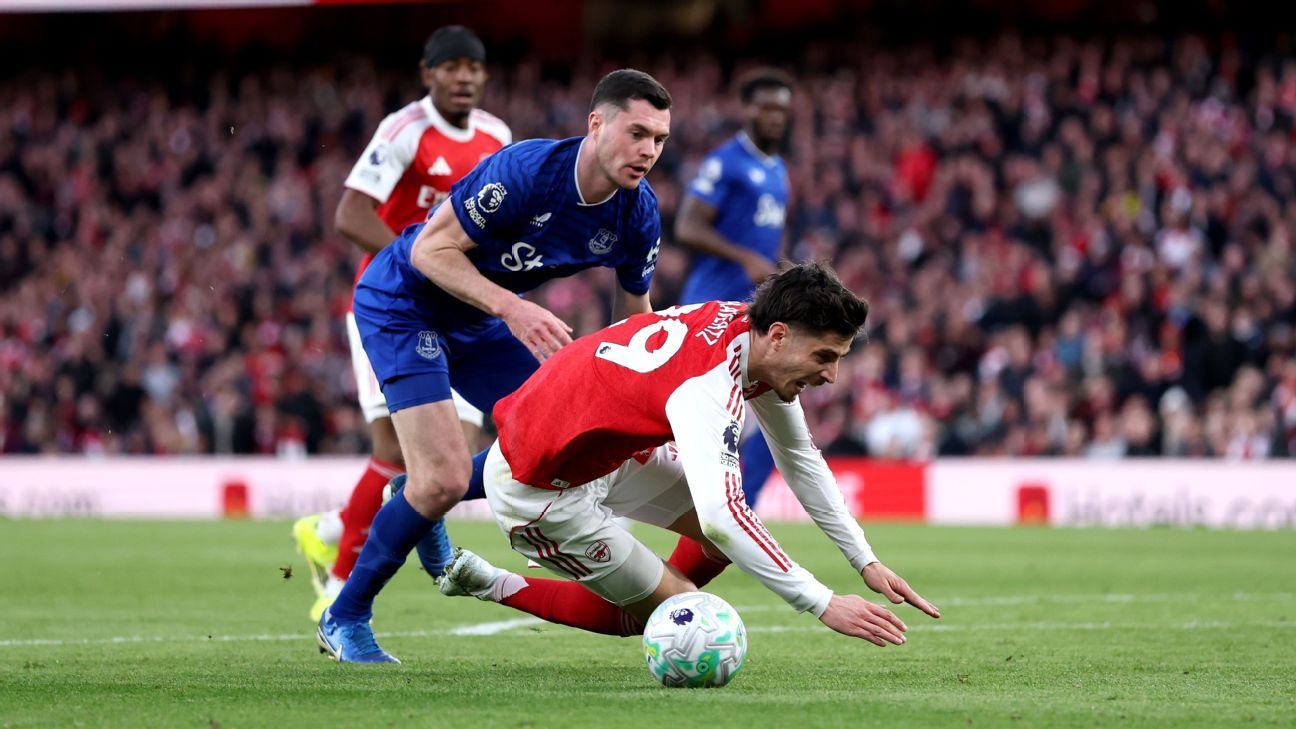
What occurred: Arsenal believed they should have received a penalty in the first half when Michael Keane seemed to step on the Achilles of Kai Havertz as the Arsenal player entered the penalty area. Referee Madley dismissed the appeals, with VAR supporting the on-field decision.
VAR decision: The referee’s ruling of no penalty for Arsenal was reviewed and upheld by VAR, as the contact from Keane on Havertz was considered minimal.
VAR review: The VAR needed to assess whether replays presented a different perspective from the details provided by referee Madley or his reasoning for not awarding a penalty on the field. Madley apparently did not view the contact by Keane as significant enough to impede Havertz, describing the level of contact as minimal and not affecting the Arsenal attacker’s ability to continue his run and potentially take a shot on goal. VAR concurred with the on-field reasoning and upheld the no-penalty decision.
Verdict: The lack of intervention by VAR in this instance is challenging to comprehend, as the contact by Keane, while not severe, did affect Havertz’s ability to advance and attempt a shot on goal. By stepping on Havertz’s Achilles, who was ahead of the defender, the level of contact should be considered a foul in this context. The official justification for not awarding a penalty is unconvincing; it appears that referee Madley viewed the contact as incidental, with both players inadvertently colliding while running in the same direction, which is understandable in real-time. However, the visuals indicated a different scenario, and an on-field review should have been suggested, leading to a penalty being awarded.
A note on the Chelsea huddle and Paul Tierney
Chelsea 0-1 Newcastle United
A huddle at the center of the pitch is a routine that Liam Rosenior’s team has employed prior to matches in recent weeks. However, this time referee Tierney was positioned in the center circle and was inadvertently caught in the midst of Chelsea’s huddle, holding the match ball.
The more I observe referee Tierney amidst the Chelsea team huddle, the less I understand his choice to remain and hold his position over the match ball.
Referees prepare thoroughly; Tierney would have anticipated that the Chelsea huddle would take place, and with Newcastle set to kick off, his intention was to be proactive and mitigate any potential conflicts with the opposing team. Nevertheless, his decision to stay over the match ball while the Chelsea players linked arms around him and not relocate to a more neutral position is perplexing and unnecessarily heightened the situation’s profile.
The Chelsea players appeared unfazed by Tierney’s presence as they proceeded with their pre-match routine; in fact, I would be surprised if they had not been informed by Tierney in the pre-match briefing that he would adopt this position if Newcastle opted to commence the match. Regardless, the optics were not favorable for the PGMO, Premier League, or Tierney.
This was an unfortunate situation that could and should have been handled differently.
