
Tottenham’s drop to relegation appears more certain following defeat against Sunderland.
SUNDERLAND, England — The reality of relegation has never been more palpable for Tottenham Hotspur. The initial enthusiasm surrounding the appointment of a highly regarded manager like Roberto De Zerbi is now overshadowed by the unsettling possibility that one of the Premier League’s historic clubs could face relegation.
Sunday’s 1-0 loss to Sunderland marks the first time this season that they will conclude a weekend in the relegation zone, with only six matches remaining. This is also the first instance in Premier League history that they have found themselves in the bottom three at this stage of the season.
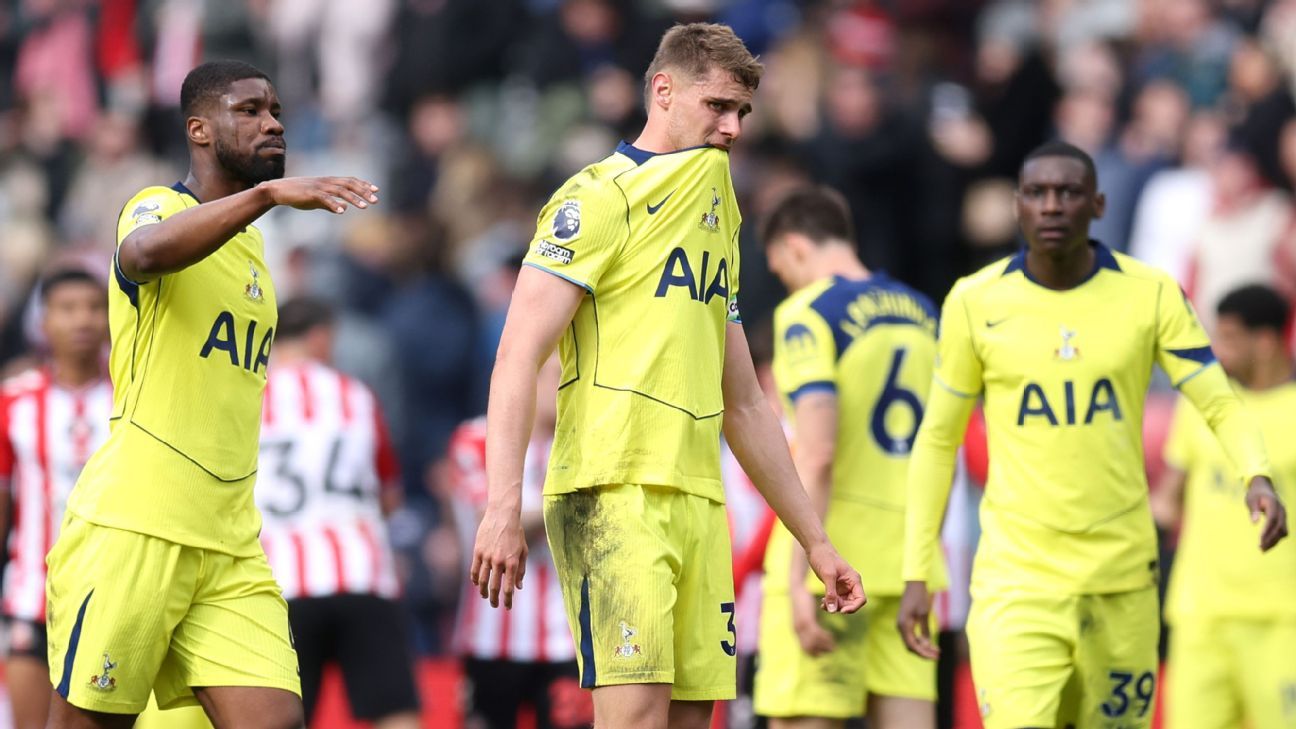
Their captain, Cristian Romero, exited the pitch in tears, while several teammates, including Micky van de Ven, appeared shocked at the final whistle. Welcome to Spurs, Roberto.
– Why did Spurs hire De Zerbi? Are his tactics suitable for the relegation battle?
– How players genuinely approach a struggle against Premier League relegation
– How did Spurs transition from Europa League champions to facing relegation?
Confronted with the prospect of relegation, is the anxiety itself the underlying issue?
“I believe so,” De Zerbi stated in his post-match comments. “If you ask me, I am 46 years old. I possess much more experience than the players, and I am absolutely positive because I know them as individuals and players, and that is why I am optimistic, not because we are Tottenham or because I must be positive.”
“They have the ability to win a match, and the goal now … is to secure one victory. Because if we win a game, we can view everything from a different perspective.”
Securing a single victory is easier said than done. Spurs have now gone 105 days without a league win. Fourteen matches without a victory is their longest such streak since 1935 — and they were relegated that year as well.
De Zerbi is a skilled head coach, but he is not a miracle worker. He spoke prior to the match about hoping Spurs could channel the spirit of their dynamic attacking play under Ange Postecoglou.
On one hand, it was an attempt to draw on recent motivation, reminding a visibly deflated squad of their inherent quality. On the other hand, it highlighted the perilous cycle Spurs find themselves in.
After all, the drawbacks of Postecoglou’s high-risk style of play are partly responsible for Tottenham’s current predicament. UEFA Europa League champions, yes, but they finished 17th in the league last season and are currently in 18th place.
De Zerbi aimed for Spurs to adopt the mindset of a prominent club. Randal Kolo Muani, Dominic Solanke, and Richarlison all started a match together for the first time. Where De Zerbi’s predecessor Igor Tudor opted for pragmatism, the former Brighton & Hove Albion manager sought courage, at least in his team selection.
When referencing the best aspects of Postecoglou’s approach, De Zerbi specifically mentioned Pedro Porro and Destiny Udogie. Consequently, Tottenham’s fullbacks frequently inverted and advanced, a characteristic of “Angeball.”
The midfield duo of Conor Gallagher and Archie Gray also harkened back to Thomas Frank’s tenure this season, a strategy he initially implemented after Gallagher’s arrival in January before abandoning it. Thus, it encapsulates Tottenham’s season thus far: managers experimenting with ideas to elicit more from a group of players whose performance levels are alarmingly below their expected standards.
Nordi Mukiele’s goal in the 61st minute was unfortunate in one regard — his left-footed shot took a significant deflection off Van de Ven, leaving goalkeeper Antonín Kinsky with no chance. It is, as the saying goes, the kind of luck that tends to accompany teams at the lower end of the table. However, Mukiele was permitted to drift infield with minimal pressure to create a shooting opportunity — precisely the type of lax defending that has placed Spurs in this situation.
Kinsky, notably, was one of the few Tottenham players to emerge with any credit in his first appearance since his disastrous 17 minutes against Atlético Madrid a month ago, enduring a collision with Romero that resulted in a lengthy stoppage. Sunderland’s Brian Brobbey pushed Romero, causing his knee to collide with Kinsky’s face. Romero appeared inconsolable as he departed, but De Zerbi expressed hope that the injury was not serious, adding that the Argentina international is a “big personality and we need him to complete the season.”
There is no quick fix. Moreover, De Zerbi believes that now is not the time for drastic changes.
“We are in a challenging moment,” he remarked. “My role is not to alter the style of play at this time. We implemented two or three adjustments with the ball and without it, but the essential aspect is our mentality, to maintain a positive outlook.”
The emphasis on mentality is evident. Both Frank and Tudor voiced concerns regarding this squad’s struggle to handle setbacks, and the statistics support that claim. Spurs have now failed to win any of their last 33 league matches when conceding first.
“You know me as a coach, but a crucial element of my coaching style is the mental aspect, to instill confidence in the players, to provide what they require in terms of mentality and assurance,” De Zerbi stated.
“For that reason, we could perform better, as they play better during the week when their minds are clear. During the match, it is undoubtedly different. My task is to assist them, to demonstrate what they accomplish during the week in the game.”
De Zerbi has only just begun, but the standings indicate that time is already of the essence to get that work right.
